

Most people try meditation once, decide they’re doing it wrong, and never go back.
They sit down, close their eyes, and immediately the brain launches into a monologue about dinner, tomorrow’s meeting, something they said three years ago, and whether they left the oven on. After a few minutes of this, they give up, conclude that meditation “isn’t for them,” and move on.
Here’s what nobody told them: that’s not failure. That’s the practice.
Meditation is one of the most misunderstood things in the wellness world. It’s been turned into a productivity hack, a spiritual requirement, and an Instagram aesthetic — and in the process, what it actually is has gotten completely buried.
This guide digs it back out. What meditation is, what the science actually shows, the main types, what to realistically expect, and the simplest possible way to start. No app required. No cushion. No experience needed.
| What Is Meditation? |
|---|
| Meditation is the practice of deliberately training your attention. It involves directing your focus — usually to the breath, body, or a chosen point of awareness — and gently returning that focus when the mind wanders. It is not about clearing your mind or achieving a blank state. It is a form of mental training, backed by decades of neuroscience research, that gradually changes how the brain processes experience, handles stress, and regulates emotion. The act of noticing distraction and returning — repeated over and over — is the exercise itself. |
KEY TAKEAWAYS
| What it is | Deliberate training of attention — not clearing the mind |
| The core mechanic | Focus wanders, you notice, you return. That’s the rep. |
| Origin | Ancient Vedic and Buddhist traditions; clinically formalised by Kabat-Zinn in 1979 |
| Brain effects | Reduces amygdala reactivity, strengthens prefrontal cortex, builds grey matter |
| Main types | Mindfulness, breath, body scan, loving-kindness, guided, movement, mantra |
| vs. Mindfulness | Meditation is a formal practice; mindfulness is an ongoing quality of attention |
| How long you need | Less than you think — 5–10 minutes daily produces measurable results |
| When results show | Small shifts in 2–3 weeks; structural brain changes after 6–8 weeks |
| Who it’s for | Anyone — especially people who think they can’t do it |
What Meditation Actually Is
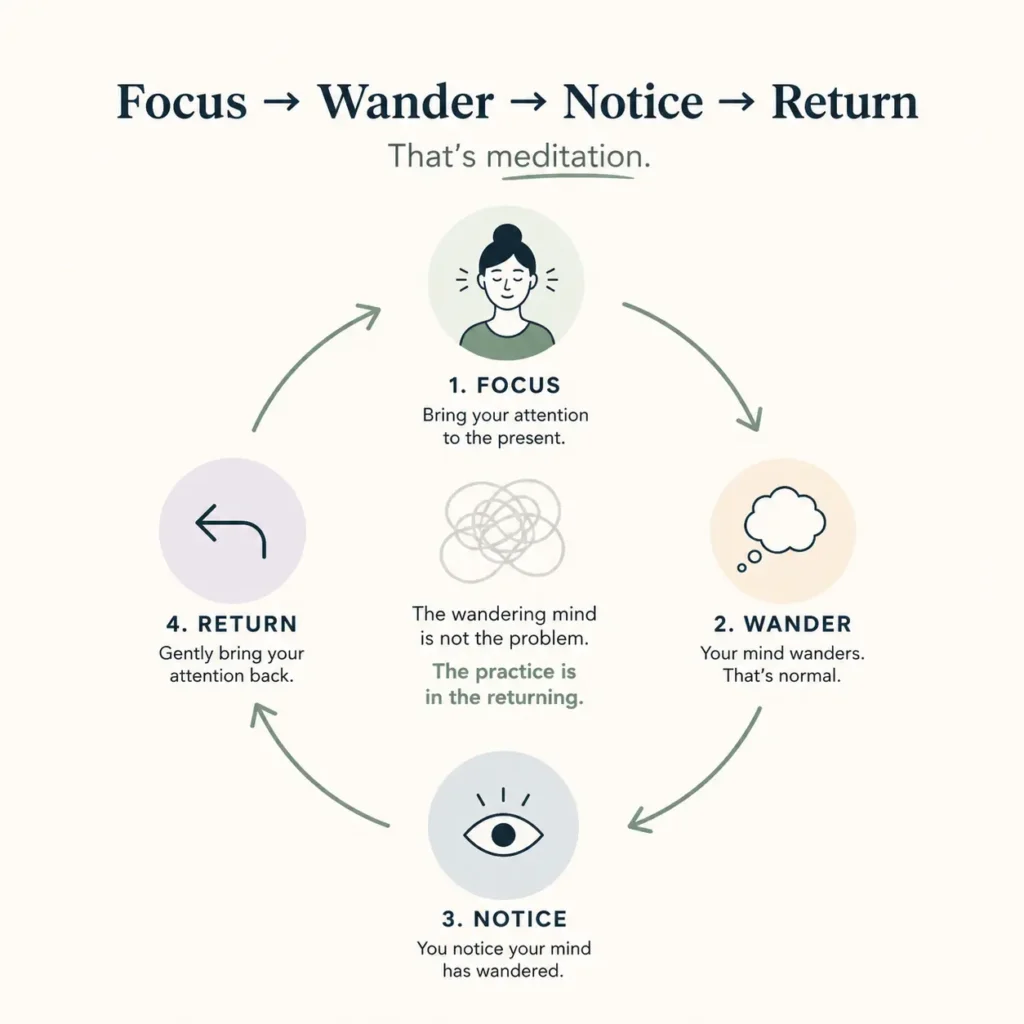
At its core, meditation is the practice of training your attention. That’s it.
Not achieving peace. Not emptying your mind. Not reaching an enlightened state. Training your attention — specifically, the ability to direct it intentionally and bring it back when it wanders.
The wandering itself is not the problem. Your mind is supposed to wander — a Harvard study found that the human mind wanders roughly 47% of waking hours. That’s not a flaw. That’s a default state. The problem isn’t the wandering. It’s that most people have never practised the returning.
The moment you notice your mind has wandered — the moment of noticing — is the moment of meditation. Every return is a rep. A session with a hundred wandering thoughts and a hundred returns is a productive session, not a failed one.
| The Core Mechanic Focus wanders → you notice → you return. That’s one rep. The practice isn’t the absence of distraction. It’s the response to it. Every time you return, you’re training the brain — whether the session felt peaceful or chaotic. |
A Brief History (The Non-Boring Version)
Meditation is not a modern wellness trend. It is one of the oldest intentional practices in human history.
The earliest written references appear in the Vedic scriptures of ancient India, dating to around 1500 BCE. Buddhist meditation developed from around 500 BCE, built around the systematic training of attention as a path to understanding the nature of mind. Taoist traditions in China developed parallel contemplative practices around the same era.
For most of history, meditation lived within religious and spiritual contexts. That changed in 1979, when Dr. Jon Kabat-Zinn developed Mindfulness-Based Stress Reduction (MBSR) at the University of Massachusetts Medical School. He stripped the religious framing from Buddhist meditation and rebuilt it as a clinical, secular, eight-week programme for chronic pain and stress.
That decision changed everything. MBSR gave researchers a standardised protocol they could study, replicate, and test. Within two decades, meditation went from fringe spiritual practice to one of the most rigorously studied psychological interventions in existence.
According to the National Center for Complementary and Integrative Health, meditation is now practised by roughly 14% of American adults — more than triple the rate from a decade earlier. Nearly 80% of US medical schools offer some element of mindfulness training.
What Happens in Your Brain When You Meditate
The neuroscience of meditation is one of the most compelling areas of recent brain research. Here’s what the evidence actually shows — without the hype.
The prefrontal cortex: attention and self-regulation
The prefrontal cortex handles executive function — focus, planning, emotional regulation, and the ability to pause before reacting. In regular meditators, this region shows increased activity and, over time, increased grey matter density.
This matters because the prefrontal cortex is your capacity for responding rather than reacting. Meditation trains this system directly: every time you notice your mind wandered and bring it back, you’re activating and strengthening exactly this circuit.
The amygdala: the brain’s alarm system
The amygdala triggers fight-or-flight stress responses. In people with chronic stress or anxiety, it tends to be overactive — firing in response to mental worry loops rather than actual threats. This is part of why you can’t relax even when nothing is actually wrong.
Sustained meditation practice is associated with reduced amygdala grey matter density — meaning the alarm system becomes measurably less reactive. This is one of the core mechanisms behind meditation’s effects on anxiety and chronic stress.
Neuroplasticity: the brain that changes with practice
The peer-reviewed study behind this — Hölzel, Lazar et al. (2011), published in Psychiatry Research: Neuroimaging — found that participants who completed an eight-week MBSR programme showed measurable increases in grey matter in the hippocampus and prefrontal cortex, alongside reductions in amygdala density. Average daily practice time: 27 minutes.
These are structural changes, not just mood shifts. The brain was physically different after eight weeks of practice.
For an accessible overview of the full clinical evidence base, the APA’s research summary on meditation is one of the clearest available — balanced, well-cited, and written for a general audience.
Interoception: the underrated benefit
One underreported effect of meditation is improved interoception — the brain’s ability to sense the body’s internal state. Hunger, tension, fatigue, the subtle physical signals of emotion.
Regular practice, particularly body scan and breath-focused techniques, trains this capacity. Better interoception is associated with stronger emotional intelligence, more reliable decision-making, and earlier recognition of stress before it escalates.
This is also why many people who start meditating begin noticing physical signs they’d been tuning out for years — like the physical symptoms of overstimulation or tension patterns they’d normalised entirely.
The Main Types of Meditation Explained
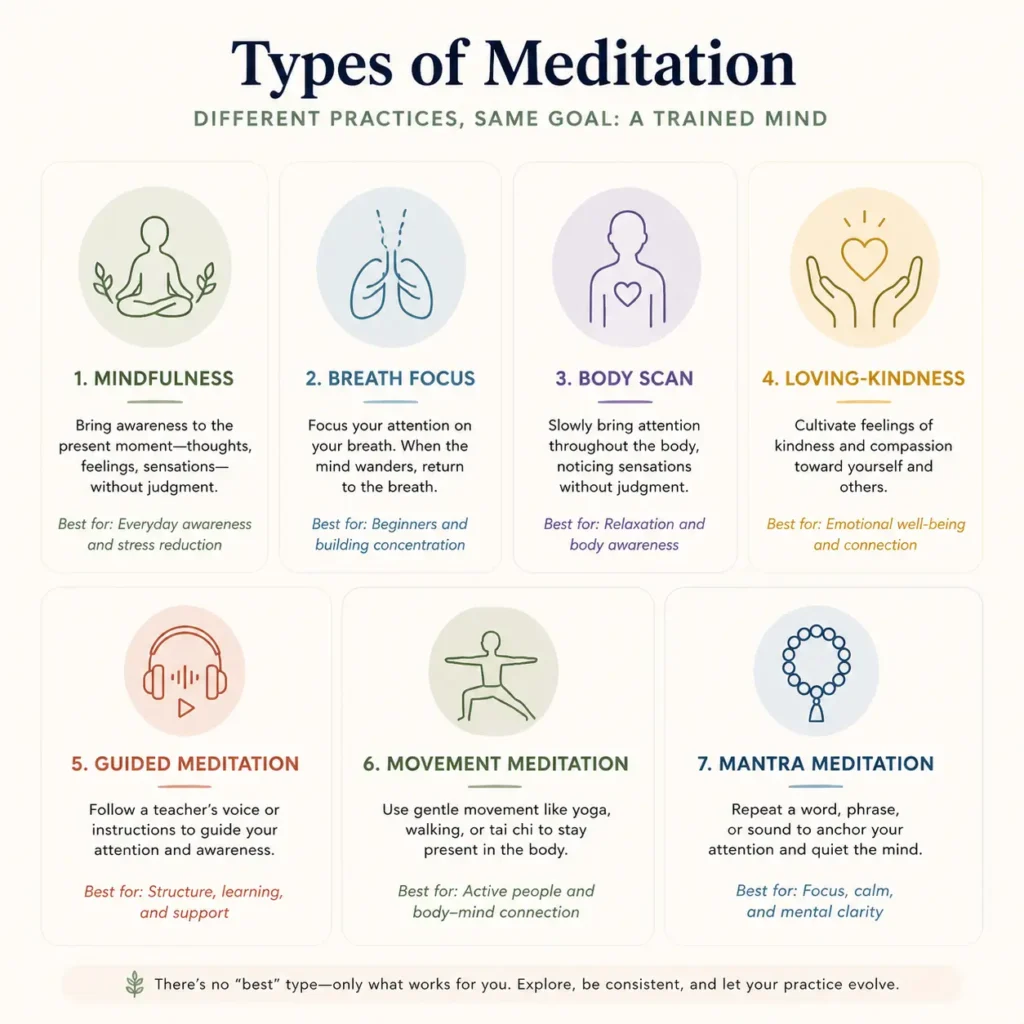
There is no single correct way to meditate. The word is an umbrella term for a large family of practices that share a common purpose — training attention — but differ significantly in technique, focus, and feel.
Here are the seven most widely practised types, with an honest description of what each involves and who tends to find it most useful.
1. Mindfulness Meditation
Mindfulness meditation involves observing your thoughts, feelings, and sensations as they arise — without following them, judging them, or trying to push them away. You’re not stopping thoughts. You’re watching them pass.
It is the most widely researched form of meditation in Western clinical settings and the foundation of MBSR and MBCT. Most of the neuroscience cited in this article was conducted specifically on mindfulness meditation.
Best for: people with anxious or overthinking minds who want a practice grounded in psychology. The complete mindfulness meditation guide for beginners walks through the approach step by step.
2. Breath Meditation
Breath meditation uses the breath as the anchor of attention. You focus on the physical sensation of breathing — the air moving in and out, the rise and fall of the chest or belly — and return to it each time your mind wanders.
It’s one of the oldest meditation techniques in existence and one of the most portable. The breath is always available. No equipment, no setup, no special environment required.
Best for: beginners who want something concrete and physical to focus on. The breath meditation guide covers the technique, and the mindful breathing guide goes deeper on using breath as an everyday mindfulness tool.
3. Body Scan Meditation
Body scan involves moving your attention slowly through different parts of the body — from feet to head — noticing sensations without trying to change them. It trains interoception and is particularly effective for stress, physical tension, and sleep difficulty.
Usually done lying down, making it one of the more accessible practices for people who find sitting uncomfortable or who practise before sleep.
Best for: people carrying physical tension, those with sleep difficulty, or anyone who finds breath-focused practice too abstract. For guidance on the most comfortable positions for lying-down or seated practice, the meditation positions guide covers every option with honest advice on what actually works. Pairs well with the mindfulness for sleep guide and the why your mind won’t stop at night post.
4. Loving-Kindness Meditation (Metta)
Loving-kindness meditation involves deliberately cultivating feelings of warmth and goodwill — first toward yourself, then toward others, then outward toward people you find difficult, and eventually to all beings.
It sounds soft. The research is not. Multiple studies have found that regular loving-kindness practice increases positive emotions, reduces self-criticism, improves social connection, and reduces implicit bias.
Best for: people who are hard on themselves, dealing with grief or difficult relationships, or carrying a lot of self-judgment. Pairs directly with self-compassion practice and cultivating compassion toward others.
5. Guided Meditation
Guided meditation uses a teacher’s voice or a recording to lead you through the practice. Rather than self-directing your attention, you follow verbal instruction — which removes a significant cognitive barrier for beginners.
This is the most common entry point for new practitioners, largely because apps have made guided sessions instantly accessible. The quality varies significantly, but the format is well-validated.
Best for: complete beginners, people who find silence uncomfortable, or anyone who struggles to self-direct. The 7 beginner meditation techniques post covers the main approaches for people just starting out.
6. Movement Meditation
Movement meditation brings meditative attention to physical movement — most commonly walking meditation, mindful yoga, tai chi, or qigong. Rather than sitting still, you use the body’s movement as the anchor of attention.
Particularly valuable for people with high anxiety, restless energy, or attention patterns that make sitting feel more distressing than settling. For many people, movement is simply a more natural entry point than stillness.
Best for: people who find seated practice difficult or who want to extend practice beyond formal sessions. For a dedicated practice guide, the walking meditation guide walks you through the technique step by step — indoors or outdoors, 10 minutes or more. The 35 grounding techniques includes several movement-based options that bridge grounding and meditative practice.
7. Mantra Meditation
Mantra meditation involves the silent or spoken repetition of a word, phrase, or sound. Neurologically, this works by occupying the verbal-linguistic mind with a neutral, repetitive input — reducing the space available for rumination and anxious self-talk.
Transcendental Meditation (TM), the most studied form of mantra practice, uses personalised mantras assigned by trained instructors. But any word or phrase that carries a quality of calm or neutrality can serve the same function.
Best for: people whose minds are highly verbal and find breath-focused practices insufficiently engaging. Worth exploring alongside meditation alternatives for anyone searching for the format that genuinely fits.
For people who want to bring meditative attention to everyday life without formal sessions, the list of 34 mindfulness activities maps out how that works in practice.
Meditation vs. Mindfulness: What’s the Actual Difference?
These two words are used interchangeably so often that most people assume they’re the same thing. They’re not, and the distinction is practically useful.
Meditation is a formal practice. It’s a structured activity you deliberately set aside time for — a session, a technique, a defined period of intentional training.
Mindfulness is a quality of attention. It’s a way of relating to your experience — present, intentional, nonjudgmental — that you can bring to any moment. Eating, walking, listening, waiting. The What Is Mindfulness guide covers what that quality of attention actually involves in depth.
The relationship: formal meditation is the most reliable way to train mindfulness. Think of it like strength training versus daily movement. Lifting weights (meditation) builds the capacity. Moving well throughout your day (mindfulness) is the application.
You can meditate without being mindful — going through the motions while entirely elsewhere. And you can be mindful without formally meditating, though it’s harder to sustain without practice. Learning how to practise mindfulness in daily life becomes far more effective once formal meditation has built the underlying capacity.
| Quick Distinction Meditation = a formal, structured practice you set aside time for. Mindfulness = an ongoing quality of attention you bring to everyday moments. Mindfulness meditation = a type of meditation that specifically trains mindful attention. You need time for meditation. You don’t need time for mindfulness — just intention. |
What Meditation Is NOT: 5 Myths That Stop People Before They Start
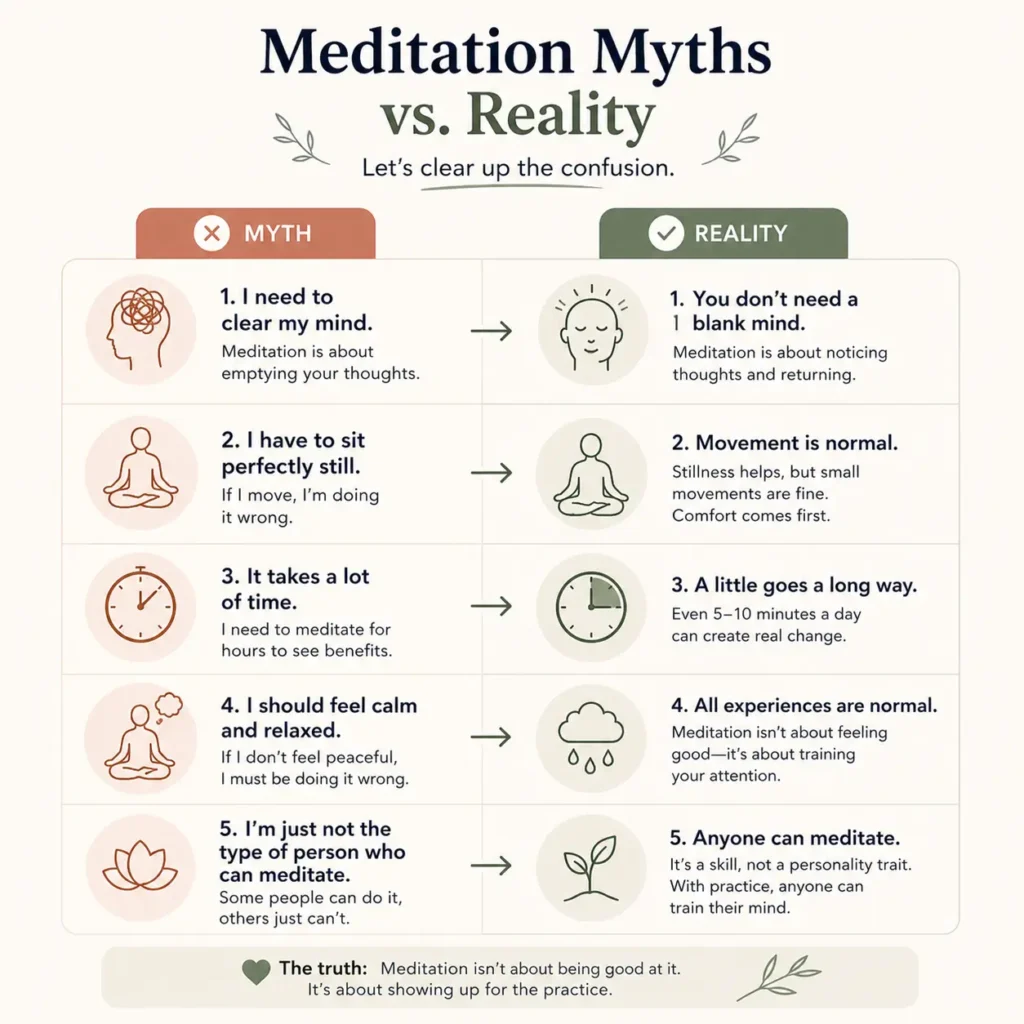
Myth 1: You’re supposed to have no thoughts
This is the most common misconception and the one that causes the most unnecessary quitting.
Meditation does not involve stopping thoughts. That’s not possible and it’s not the goal. The practice is to notice thoughts without being pulled into them — to observe rather than follow. A busy, wandering mind during meditation is completely normal, especially at first.
If sitting still feels genuinely impossible rather than just uncomfortable, what to do when meditation feels hard has specific approaches that work for very restless or anxious minds.
Myth 2: It’s religious
Meditation has roots in Buddhist, Hindu, and Taoist contemplative traditions. The clinical forms most widely taught and researched today are entirely secular.
MBSR was deliberately designed to be religiously neutral and is used in hospitals, schools, prisons, and corporations globally. You can practise meditation as a spiritual act if that resonates. You can also practise it as a purely neurological tool. The practice works either way.
Myth 3: It’s only for calm, patient people
The people who benefit most from meditation are often the people who seem least suited to it — those with anxious, overactive, relentlessly busy minds.
Meditation was developed in a hospital for people in chronic pain. It’s since been used successfully with anxiety disorders, PTSD, depression, and addiction. If your mind is loud and won’t stop — you’re not a bad candidate. You’re the ideal one. The mindfulness for anxiety guide and the post on why your brain won’t stop thinking are both written specifically for this. For those whose overthinking has tipped into low mood or depression, the mindfulness for depression guide is honest about what the evidence shows and what the limits are.
Myth 4: You need a lot of time
The structural brain changes documented in the research came from an average of 27 minutes of daily practice over eight weeks. More recent studies suggest even shorter sessions produce meaningful effects. The post on how long you should meditate has a more nuanced answer than most sources give, but the short version: less than you think.
Five consistent minutes a day will do more for you than 45 minutes once a week. Consistency matters far more than duration at the start.
Myth 5: You should feel something special for it to be working
Most people expect meditation to feel immediately calming or transcendent. Often it doesn’t. Especially at first, it feels like sitting with a busy, restless mind — which can feel pointless.
The effects are mostly retrospective. You notice them later, in life: a reaction you didn’t have, a thought loop you interrupted, a slightly longer pause before responding. If nothing dramatic is happening in the sessions, the practice is probably still working.
How Long Should You Meditate?
This is one of the most searched questions about meditation, and the honest answer is: less than most people assume.
For beginners, the research and clinical consensus point to the same starting recommendation: 5 to 10 minutes daily. That’s enough to build the habit, experience the basic mechanics of the practice, and begin generating neurological effects — particularly with consistency.
There’s a diminishing returns curve in meditation. Going from 0 to 10 minutes daily produces larger effects than going from 20 to 30. The first ten minutes are where most of the early benefit lives.
The how long should you meditate post covers how duration interacts with experience level, goal type, and the type of practice. Worth reading once the habit is established and you’re thinking about extending.
The practical rule: start with 5 minutes. Do that every day for two weeks. Then extend by 5 minutes if it feels sustainable. Never increase duration at the expense of consistency.
What to Expect in Your First Few Weeks
Unrealistic expectations are the main reason people quit before meditation has had a chance to work. Here’s an honest account of what the experience typically looks like.
Week 1: It probably feels pointless
Your mind will wander constantly. Sessions will feel unproductive. You may feel more aware of how noisy your mind is, which can actually feel worse than not meditating at all.
This is completely normal and, paradoxically, a sign the practice is working. You’re beginning to notice thoughts you were previously just swept along by. The discomfort of Week 1 is not evidence that you’re doing it wrong.
Weeks 2–3: Something small shifts
Most people notice a small change somewhere in weeks 2 or 3 — not in the sessions themselves, but in daily life. A moment where they caught themselves getting pulled into a thought loop and stepped back. A slightly longer pause before reacting.
These shifts are subtle and easy to miss if you’re waiting for something dramatic. The practice is working quietly, not announcing itself.
Week 4 and beyond: The first real evidence
By week four, most consistent practitioners have at least one moment that feels clearly different — a situation handled differently than it would have been three weeks ago, or a pattern of thinking interrupted before it ran its full course.
Challenges don’t disappear, but they often become more manageable. The 9 common meditation challenges guide is worth reading before you hit this point — it covers the most universal sticking points and what to do about each one.
How to Start: The Simplest Possible Version
No app. No cushion. No special knowledge. Here is a complete five-minute meditation you can do right now.
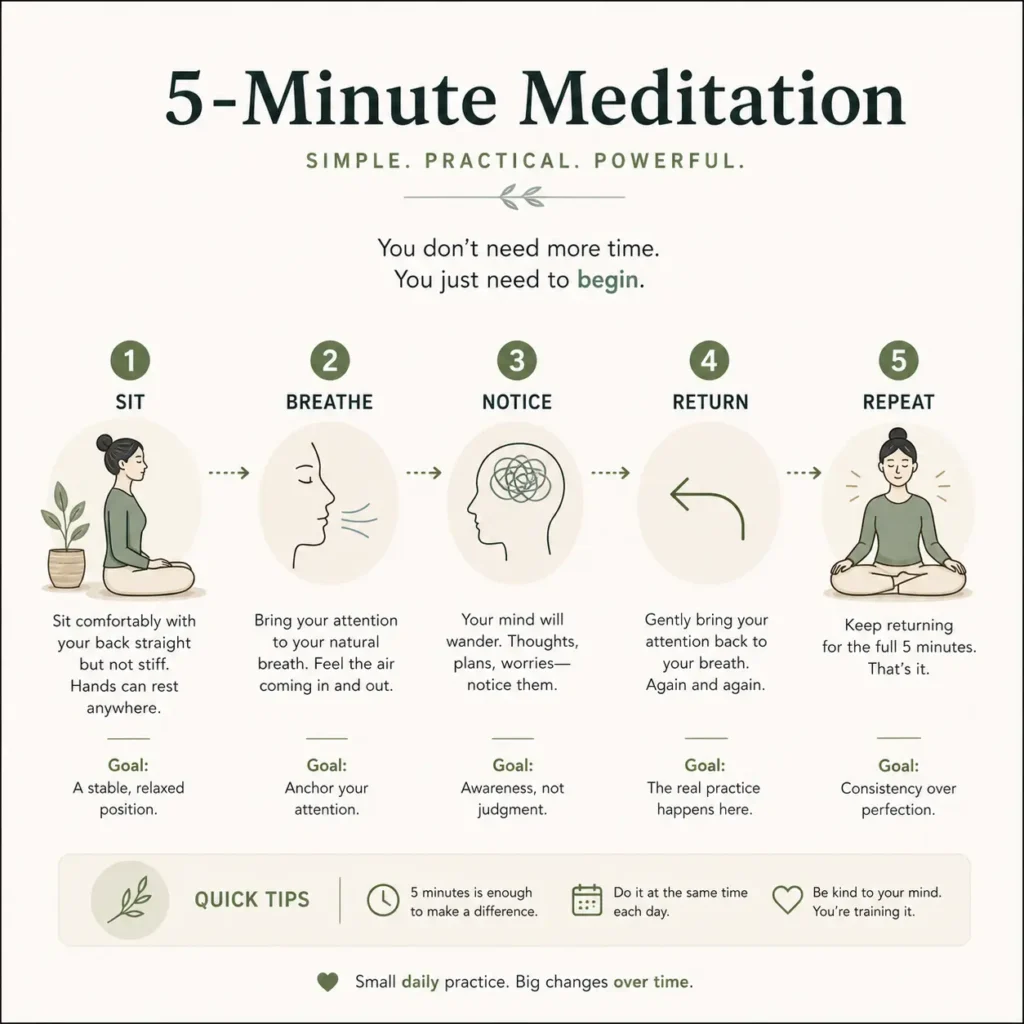
The 5-Minute Breath Practice
- Find a comfortable position — seated in a chair with feet flat on the floor is ideal. You can also sit on the floor or lie down.
- Take one slow, deliberate breath in through the nose. Let it out fully. This is your signal to the body that something different is happening.
- Let your breathing return to its natural rhythm. Don’t try to control it — just let it happen.
- Direct your attention to the physical sensation of breathing — the air at your nostrils, the gentle rise and fall of your chest or belly. You’re not thinking about breathing. You’re feeling it.
- When your mind wanders — and it will, probably within seconds — gently bring your attention back to the breath. No judgment. No commentary. Just return.
- Set a timer for 5 minutes. Keep returning until it goes off.
That’s a complete meditation. The quality is measured not by how few times your mind wandered, but by how consistently you came back.
| What to Do Next Once 5 minutes feels comfortable, extend to 10. When you’re ready to go deeper on technique, the how to meditate properly guide covers the mechanics in more detail. The daily meditation routine post helps you build the habit so it sticks long-term. And for the days when you only have a few minutes, the 5-minute meditation is worth bookmarking. |
Common Meditation Challenges (And What to Do About Them)
Almost every beginner hits the same handful of obstacles. Here are the five that come up most in the first few weeks. The full guide to meditation challenges covers nine in depth if you want the complete picture.
“My mind won’t stop”
This is not a problem. It’s the practice. A busy, wandering mind is not a sign you’re bad at meditation — it’s a sign you’re a normal human. The practice is noticing and returning, not maintaining stillness.
If the mental noise feels overwhelming rather than just normal busyness, try counting breaths from 1 to 10 and restarting each time you lose count. The counting gives the analytical mind just enough structure to hold onto.
“I keep falling asleep”
Extremely common, especially in the first few weeks and especially when meditating lying down or when tired. Usually means one of two things: your position is too comfortable, or you’re more sleep-deprived than you realised.
Try seated rather than lying down, with eyes slightly open rather than fully closed. If you consistently fall asleep, shift your practice to the morning before the day’s tiredness accumulates.
“I don’t feel anything”
Most effects of meditation are subtle and retrospective. You won’t feel them in the session. You’ll notice them later — in a reaction you didn’t have, a thought loop you stepped out of earlier.
If several weeks of consistent practice genuinely produces no change of any kind, try a different type. Breath-focused practice doesn’t work equally well for everyone. Body scan or loving-kindness meditation may land very differently.
“I can’t find time”
Two minutes counts. The goal at the start is not the perfect session — it’s the habit. A two-minute daily practice done for a month will do more than a thirty-minute practice done twice.
Attach practice to something you already do without thinking: before your first coffee, after brushing your teeth, before opening your phone. The “after X, I do Y” architecture is one of the most reliable habit-formation patterns available.
“I tried an app and hated it”
Apps are a popular entry point but they’re not universally effective. Some people find the guided voice intrusive. Others find the streaks and gamification add pressure rather than ease.
If an app didn’t work, try self-directed practice with a simple timer, or explore meditation alternatives — some people find that movement-based or journaling-based approaches fit far better than anything app-guided.
What Meditation Actually Does Over Time
The benefits of regular practice are well-documented, but often described vaguely. Here’s what the research actually points to. The 30 meditation benefits post covers the evidence in more detail across categories.
- Reduced anxiety and stress reactivity. Multiple clinical trials show MBSR significantly reduces generalised anxiety, with effects comparable to antidepressants in some studies and no pharmaceutical side effects.
- Improved sleep. Meditation reduces the rumination that drives insomnia, particularly for people whose sleep problems are driven by an overactive, worry-prone mind.
- Better emotional regulation. The gap between feeling something and reacting grows wider. Not because you feel less, but because the prefrontal cortex gets better at mediating the response.
- Reduced chronic pain. MBSR was developed for this. Multiple studies show mindfulness reduces the subjective experience of chronic pain even when it doesn’t reduce the pain signal itself.
- Improved focus and working memory. Even two weeks of daily practice has been shown to improve attention scores and working memory capacity in controlled research settings.
- Structural brain changes. Grey matter increases in regions associated with self-awareness, emotional regulation, and empathy after eight weeks of consistent practice.
- Burnout recovery. Mindfulness for burnout reframes the practice as deactivation rather than activation — a tool for people who are too depleted to sit down and try to feel better, but still need a way to begin.
And if mindfulness for stress is the primary reason you’re exploring this, that post covers the specific stress-response mechanisms in more detail.
Frequently Asked Questions
Is meditation the same as relaxation?
Not exactly. Relaxation can be a byproduct, but it’s not the goal and it’s not always what happens — particularly at first. Meditation is a form of training. Like any training, it can feel effortful. If you sit down expecting to feel instantly calm and you don’t, you’re not doing it wrong. Calm often comes later, as a side effect of the training.
Can I meditate lying down?
Yes, though most teachers recommend seated practice because lying down increases the likelihood of falling asleep. Body scan meditation is commonly done lying down and works well that way. If you have physical limitations that make sitting uncomfortable, lying down is entirely valid — just be aware of the sleep risk and adjust posture or timing accordingly.
Do I need an app to meditate?
No. A simple timer, a quiet space, and a basic technique are all that’s needed. Apps can be a useful starting point for some people, but many experienced meditators prefer self-directed practice, and some find apps actively counterproductive. Use one if it helps, skip it if it doesn’t.
What’s the best time of day to meditate?
Most practitioners and most research favour morning, primarily because the mind tends to be less cluttered before the day’s events accumulate, and because doing it first removes the question of whether you’ll find time later. The best time, practically speaking, is whatever time you’ll actually do it consistently.
Can meditation make anxiety worse?
For most people, no. For some — particularly those with trauma histories or dissociative conditions — turning attention inward without professional support can occasionally feel destabilising. If practice consistently increases distress rather than reducing it after several weeks, discuss it with a therapist. Starting with eyes-open or movement-based practices tends to be a gentler entry point for high-anxiety individuals.
How do I know if I’m doing it right?
If you’re directing your attention somewhere, noticing when your mind wanders, and returning — you’re doing it right. The quality of a session is not measured by how few distractions occurred. A session that felt chaotic but in which you returned fifty times is a better session than one that felt calm because you drifted into a pleasant daydream.
Is there a wrong way to meditate?
A few. Forcing yourself to stay in a painful position is unnecessary and counterproductive. Treating every wandering thought as a failure creates a layer of self-criticism that undermines the practice. And using meditation to avoid difficult emotions — rather than to build the capacity to sit with them — tends not to produce the same benefits as genuine practice.
The Bottom Line
Meditation is not about achieving a particular state. It’s about training a particular skill — the ability to direct your attention intentionally, and return it when it wanders.
That skill, practised consistently, changes the brain. It reduces the reactivity of the stress system, strengthens the capacity for focus and emotional regulation, and gradually shifts the relationship between you and your own mind.
You don’t need to be calm to start. You don’t need to be patient, spiritual, or good at sitting still. You need five minutes, a timer, and the willingness to keep returning — which you will need every single session, for as long as you practise.
Start with the five-minute breath practice above. Do it tomorrow. Then again the day after.
If you want to understand the quality of attention that meditation is building, the What Is Mindfulness guide is the natural companion read. And if your mind tends to overthink and loop, the mindfulness for overthinkers guide was written specifically for how your brain works.


