
You’ve probably told yourself to calm down before. Maybe you even told yourself to breathe. And somehow — paradoxically — that made everything feel a little more tense.
That’s not a failure of willpower. It’s a sign you didn’t have the right tool.
Mindful breathing is not the same as telling yourself to breathe. It is something quieter, and something considerably more powerful. It is the practice of paying deliberate attention to your breath — not to fix it, not to slow it by force — just to notice it. And that single shift, from automatic to aware, is where the change begins.
This guide covers everything you need to start: what mindful breathing actually is, what it does to your body and mind, how to do it, and which techniques work best for anxiety, sleep, and everyday overwhelm. No prior experience needed. No apps. No special setup.
If your mind is loud right now, you’re exactly where this guide is designed to meet you.
What Is Mindful Breathing? (And How Is It Different From Just Breathing?)
Your lungs have been working without your input since the moment you were born. Breathing is the most automatic thing your body does — which means most of us go our entire lives without ever really paying attention to it.
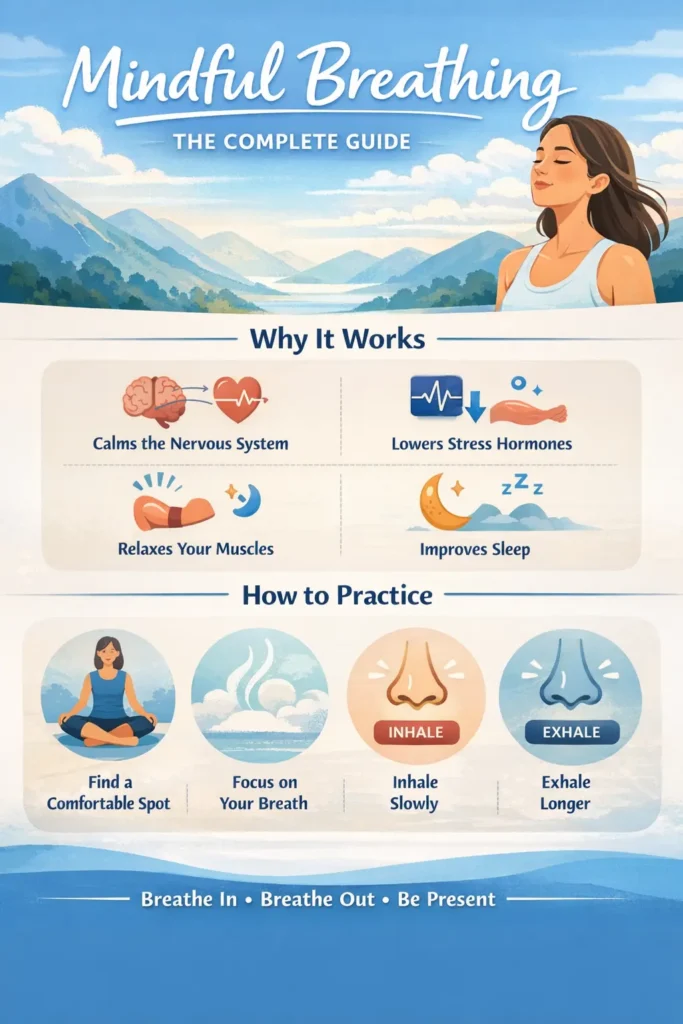
Mindful breathing is the practice of bringing deliberate, non-judgmental awareness to the sensation of your breath. That’s it. You’re not trying to breathe differently. You’re not trying to slow it down or deepen it by force. You’re simply choosing to notice it — the way air enters your nostrils, how your chest or belly moves, the brief pause between inhale and exhale.
That might sound almost too simple. But there’s a meaningful distinction between breathing and mindful breathing.
| Type | What it means |
|---|---|
| Automatic breathing | Happens without you — shallow, reactive, shaped by your stress level |
| Deep breathing | Deliberately slower or deeper breaths — you’re changing the breath |
| Mindful breathing | Awareness of the breath as it is — the observation itself creates calm |
The concept comes from mindfulness-based stress reduction (MBSR), a clinical programme developed by Jon Kabat-Zinn at the University of Massachusetts Medical School, where breath awareness was used as the foundation for reducing chronic pain, anxiety, and stress in medical patients.
For beginners, this is the most important thing to understand: you are not trying to achieve a certain type of breath. You are simply paying attention to the one you already have.
That reframe alone can take a lot of pressure off.
If you want to learn more about mindfulness, the difference between mindfulness and meditation, or go deeper into mindfulness as a full practice, our complete mindfulness meditation guide.
The Science: What Mindful Breathing Actually Does to Your Body
If you’ve ever wondered whether breathwork is just a wellness trend or something with real physiological backing — the answer is clear. The research on conscious breathing and the nervous system is genuinely compelling.
Here’s what happens when you take a slow, intentional breath:
- Your vagus nerve — the long nerve that connects your brain to your heart, lungs, and gut — gets stimulated.
- This triggers the parasympathetic nervous system: the ‘rest and digest’ counterpart to the fight-or-flight response.
- Your heart rate begins to slow. Cortisol production drops. Muscle tension decreases.
- Your brain, receiving calmer signals from the body, begins to shift out of alert mode.
One of the most striking findings from neuroscience research is what’s called the physiological sigh. It’s a double inhale through the nose — two quick breaths in — followed by a long, slow exhale through the mouth. Research from Andrew Huberman’s lab at Stanford has shown this is one of the fastest known ways to reduce acute physiological stress. Your body actually does this spontaneously when you’ve been crying or holding tension for a long time. You can choose to do it deliberately.
Even simpler: a single exhale that lasts longer than your inhale activates the parasympathetic brake. You don’t need a twenty-minute session. Three slow breaths with extended exhales can begin to shift your body’s state in under a minute.
This is why mindful breathing works on the body before it works on the mind. You can’t think your way out of a stress response. But you can breathe your way out of one.
For a closer look at what happens when your nervous system stays on high alert.
How to Do Mindful Breathing: The Core Practice
The foundational practice takes about five minutes. You can do it sitting at your desk, lying in bed, or standing in a queue. Here’s how to start:
- Find a comfortable position — Sit, lie down, or stand — whatever you have available. You don’t need to sit cross-legged on the floor. Loosen anything tight. If you’re seated, let your feet rest flat on the ground.
- Close your eyes, or soften your gaze — Closing your eyes reduces visual input and makes it easier to turn attention inward. If closing your eyes makes you more anxious, simply lower your gaze to the floor in front of you.
- Take one natural breath — Don’t try to breathe ‘correctly’ yet. Just let a breath happen. Notice where you feel it most — your nostrils, your throat, your chest, or your belly.
- Follow each breath with your attention — When you inhale, notice the inhale. When you exhale, notice the exhale. You’re not narrating — you’re observing. The breath is the anchor, and you are simply staying close to it.
- Notice when your mind wanders — then come back — This is the actual practice. The moment you notice your mind has drifted to tomorrow’s meeting or this morning’s argument is not a failure. It is the practice working. You noticed. Now gently return your attention to the breath.
The Micro Version: 3 Conscious Breaths
If five minutes feels like too much right now, start here. Three slow, intentional breaths with your eyes closed. That’s it. You can do this anywhere — before a difficult conversation, in a bathroom stall at work, or lying in bed at 2am. It counts.
Most people assume they’re supposed to reach a state of perfect quiet. They aren’t. A wandering mind is not a broken mind — it’s just a mind. The practice is the returning, not the stillness.
For a deeper exploration of using breath as a full meditation anchor, see our dedicated guide to breath as a meditation focus.
5 Mindful Breathing Techniques (With Instructions for Each)
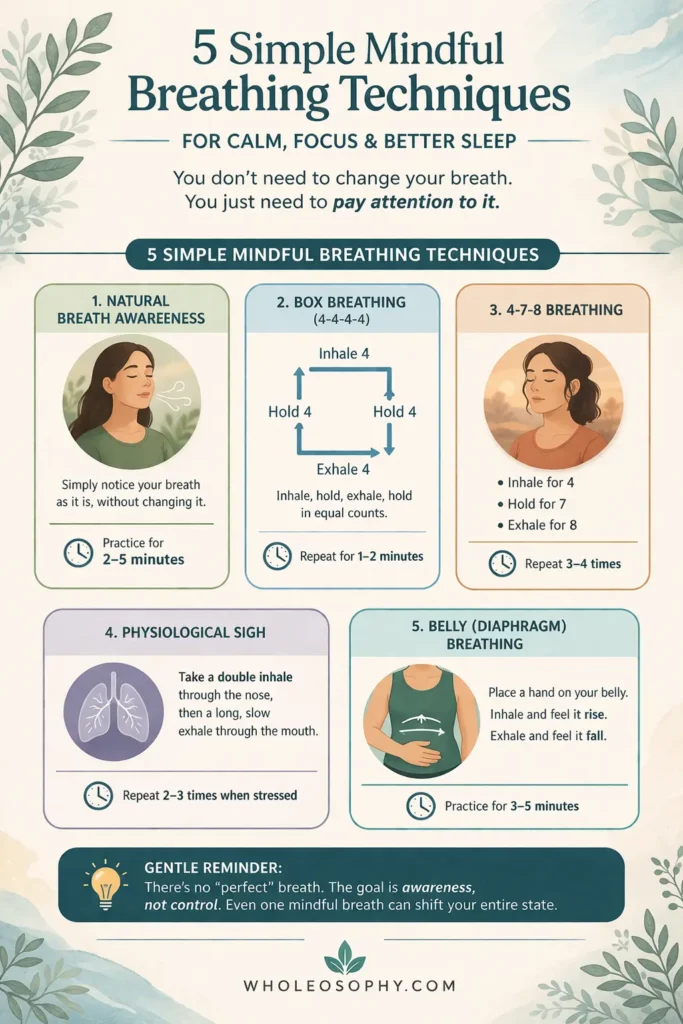
Once you have the core practice, these five techniques give you a menu to work from. Each one serves a different moment — choose the one that fits your situation.
1. Box Breathing (4-4-4-4)
Best for: stress, focus, pre-performance nerves
- Inhale for 4 counts
- Hold for 4 counts
- Exhale for 4 counts
- Hold for 4 counts
Note: This technique is used by US Navy SEALs and emergency responders to maintain clarity under pressure. The equal-ratio structure creates a predictable rhythm that interrupts anxious breathing patterns.
Duration: 4–6 cycles (about 2 minutes)
2. Extended Exhale (4-in, 8-out)
Best for: general anxiety, unwinding after a busy day
- Inhale through the nose for 4 counts
- Exhale slowly through the mouth for 8 counts
- Let the exhale be soft — no forcing
Note: The longer exhale is what activates the parasympathetic response. You don’t need to count perfectly — just make the out-breath noticeably longer than the in-breath.
Duration: 5–10 cycles
3. The Physiological Sigh
Best for: acute stress, moments of overwhelm
- Take a full inhale through the nose
- At the top, take a second short inhale to fully fill the lungs
- Release everything in one long exhale through the mouth
Note: This is the fastest known breath technique for reducing acute stress. One or two cycles is often enough to feel a physiological shift.
Duration: 1–3 cycles
4. 4-7-8 Breathing
Best for: falling asleep, deep relaxation
- Inhale through the nose for 4 counts
- Hold the breath for 7 counts
- Exhale through the mouth for 8 counts
Note: The extended hold and long exhale create a deeply sedative effect. Many people find this technique works best when lying down. Don’t push through discomfort — if the hold feels too long, shorten it.
Duration: 4 cycles
5. Counting Breath
Best for: beginners, when the mind is very busy
- Inhale naturally
- Exhale, and silently count ‘1’
- Inhale, exhale — count ‘2’
- Continue to 10, then start again at 1
Note: If you lose count, you’ve drifted — and that’s fine. Just start back at 1. The counting gives a scattered mind something concrete to hold, which makes it one of the most accessible entry points to any breath practice.
Duration: 5–10 minutes
Mindful Breathing for Anxiety: What to Do When You’re Overwhelmed
When anxiety rises, your breathing changes before you know it. It becomes shallower, faster, centred in the chest rather than the belly. This pattern signals ‘danger’ to your brain — which responds by amplifying the alert. The anxiety feeds the breathing pattern. The breathing pattern feeds the anxiety.
Mindful breathing interrupts that loop — but not by force.
Here’s the part that surprises most people: you don’t try to control your breath when you’re anxious. Trying too hard to breathe ‘correctly’ can actually increase anxiety, especially if you’re prone to hyperventilation or health anxiety. Instead, you observe.
The STOP Technique
- Stop what you’re doing
- Take one breath — just one, and notice it
- Observe: what do you feel in your body right now?
- Proceed — back to whatever you need to do
The STOP technique is four words you can remember in the middle of a panic spiral. It doesn’t cure anxiety. It gives you one second of space between the feeling and the reaction — and that second is enough to change what you do next.
For a physiological intervention during acute anxiety, the physiological sigh (two quick inhales, one long exhale) is your fastest tool. It works in under 30 seconds and requires no particular skill or mental clarity.
If anxiety is a persistent pattern rather than an occasional spike, our guide on using mindfulness to break the worry loop.
For the thought-loop side of anxiety, see why your brain won’t stop thinking — and what actually helps.
Mindful Breathing for Sleep: How to Wind Down With Your Breath
The problem at bedtime is rarely the thoughts themselves. It’s the activation level underneath them. Your nervous system is still running at the pace of the day — and your mind is just filling the space.
Breath is one of the few levers you have over that activation level.
The goal before sleep is not to stop thinking. It’s to shift your nervous system from sympathetic (alert, responsive) to parasympathetic (rested, restored). You can’t command that shift through willpower. You can invite it through breath.
A 10-Minute Wind-Down Breath Routine
- Dim the lights or close the screen 10 minutes before this practice
- Lie on your back, hands resting on your belly
- Take 3 natural breaths and notice where you feel them
- Begin 4-7-8 breathing: inhale 4 counts, hold 7, exhale 8
- Do 4 complete cycles
- Let your breath return to natural and simply observe it
- If thoughts arise, acknowledge them briefly — ‘there’s a thought’ — and return to the breath
This routine pairs well with a brief body scan — a slow sweep of awareness from the top of your head to your feet, noticing sensation without trying to change anything. The combination of breath and body awareness gives a restless mind two anchors instead of one.
If racing thoughts are the main obstacle between you and sleep, it helps to understand the mechanism behind them — why your mind won’t stop at night — and what’s actually happening.
You can also pair this practice with grounding techniques for a library of grounding practices to pair with breathwork.
How to Build a Mindful Breathing Habit (Even If You Keep Forgetting)
Knowing a technique and actually using it regularly are two very different things. The gap between them is not a motivation problem. It’s a design problem.
Most people try to add mindful breathing as a separate item on their to-do list. That rarely works. What works is attaching it to something you already do.
Habit Stacking: Attach Breath to Behaviour
- After the kettle boils, before you pour: three conscious breaths
- Before you open your laptop in the morning: one slow exhale
- When you get into the car but before you start the engine: ten seconds of stillness
- At the moment your head touches the pillow: 4-7-8 for four cycles
- When you pick up your phone after a notification: one breath before you look
None of these require carving out new time. They use the edges of habits you already have.
There’s also the Transition Breath — a single conscious breath at any transition point in your day. Room change. App switch. The moment a meeting ends. It’s invisible to anyone around you, and over time it recalibrates how you move through the day.
Research on mindfulness habit formation consistently shows that frequency matters more than duration. Three conscious breaths ten times a day does more for your nervous system than a single twenty-minute session you only do twice a week.
If you’re ready to expand this into a fuller practice, how to build a consistent daily meditation routine.
Common Mistakes Beginners Make (And What to Do Instead)
Most people give up on mindful breathing not because it doesn’t work — but because they misunderstand what success looks like. These are the most common traps, and how to step around them.
| Mistake | Why readers do it | What to do instead |
|---|---|---|
| Trying to empty the mind | We assume the goal is silence. It isn’t. | The goal is awareness — noticing thoughts without following them. A busy mind during breath practice is not failure. It’s proof you’re human. |
| Forcing the breath to be slower or deeper | The instruction is to ‘breathe deeply,’ which people interpret as effort. | Observe first, adjust later. If your breath naturally deepens as you relax into awareness, that’s fine. But forcing it creates tension, which is the opposite of the goal. |
| Stopping the practice when it feels uncomfortable | For some people, focusing on breath initially increases anxiety — especially those with health anxiety or past trauma. | Keep your eyes open. Try a shorter duration (30 seconds instead of 5 minutes). Focus on external breath sounds rather than internal sensation. Build gradually. |
| Judging the quality of the session | We’re conditioned to assess performance — ‘was that a good session or a bad one?’ | There are no bad sessions. The session where your mind wandered forty times and you returned forty times is the same practice as the one that felt effortless. |
| Waiting until you’re calm to practice | It feels counterintuitive to do a calming practice when you’re already anxious. | The anxious moments are exactly when the practice matters most. Regularity during low-stress moments makes it available when you need it under pressure. |
Frequently Asked Questions
What exactly is mindful breathing?
Mindful breathing is the practice of paying deliberate, non-judgmental attention to your breath — noticing the sensation of each inhale and exhale without trying to change it. Unlike deep breathing, which focuses on altering the breath, mindful breathing is about awareness first. It’s the simplest form of mindfulness practice, requiring no equipment, no prior experience, and no special conditions.
How long does mindful breathing take to work?
The physiological effects begin within seconds — a slow exhale can activate the parasympathetic nervous system in under a minute. The mental effects, such as reduced reactivity and improved focus, tend to build over days and weeks of regular practice. Don’t measure success by how calm you feel in a single session. Measure it by how quickly you can find your breath when things get difficult.
Can mindful breathing actually help with anxiety?
Yes — and the mechanism is physiological, not just psychological. Slow, intentional breathing stimulates the vagus nerve, which activates the parasympathetic nervous system and reduces cortisol production. Multiple peer-reviewed studies, including research published on PubMed, support breath regulation as a clinically significant tool for anxiety management. It is not a cure, but it is a reliable regulation tool.
What is the best breathing technique for sleep?
4-7-8 breathing (inhale for 4, hold for 7, exhale for 8) is the most consistently cited technique for sleep onset. The extended hold and long exhale create a sedative effect by deeply activating the parasympathetic response. Pair it with a body scan for best results. Do 4 cycles lying down with the lights off.
Is mindful breathing the same as meditation?
No — though they overlap. Mindful breathing is a single technique. Meditation is a broader practice that can include many different techniques, including breath awareness, body scans, visualisation, and more. Breath is the most common entry point to meditation precisely because it’s always available and requires no setup. Think of mindful breathing as the front door; meditation is the whole house.
Why does focusing on my breath sometimes make me more anxious?
This is more common than most guides acknowledge. For people with health anxiety, panic disorder, or trauma histories, turning attention inward can feel threatening. If this happens, try keeping your eyes open, focusing on the sound of your breath rather than the sensation, or starting with just three breaths instead of five minutes. Build gradually. The technique should serve you — adjust it until it does.
How often should I practice mindful breathing?
Frequency matters more than duration. Three conscious breaths ten times throughout the day — during natural transition points — will do more for your nervous system regulation than one twenty-minute session once a week. Start small. Build consistency. The practice compounds over time.
Your breath has been with you your entire life. It has been there through every anxious moment, every sleepless night, every time your thoughts ran faster than you could follow them.
You never had to learn how to breathe. But learning how to pay attention to it — that changes things.
You don’t need a perfect session. You don’t need silence or stillness or the right conditions. You just need to notice the next breath, and the one after that.
That’s the whole practice. And it’s always available to you.
If you want to take this further, explore our full range of mindfulness techniques — or if anxiety is the heart of the matter, our guide on using mindfulness to work with worry and racing thoughts is a natural next step.


