
You’re not broken for feeling overwhelmed. But there is a small, learnable shift that changes everything about how stress moves through you.
It’s 3pm. Your phone lights up with a message you weren’t expecting. Before you’ve finished reading it, your jaw is tight, your mind is already composing a response, and some part of you has completely left the room.
That’s not weakness. That’s your nervous system doing exactly what it was built to do — detecting a threat and mobilizing you to respond. The problem is that it can’t always tell the difference between a lion and an email.
Mindfulness for stress isn’t about suppressing that reaction or achieving some permanent state of zen. It’s about something much simpler: creating a brief pause between the moment something happens and the moment you respond. That pause — even half a second — is where your choices live.
In this guide, you’ll learn why you react the way you do, what mindfulness actually is (it’s not what most people think), and a practical framework you can start using today — no app, no meditation cushion, no experience needed.
The science behind this is well-established — and goes deeper than stress alone. If you want to understand how mindfulness affects anxiety, depression, and brain structure alongside stress, our overview of mindfulness and mental health covers what 47 clinical trials actually found.
What Does It Mean to React vs. Respond?
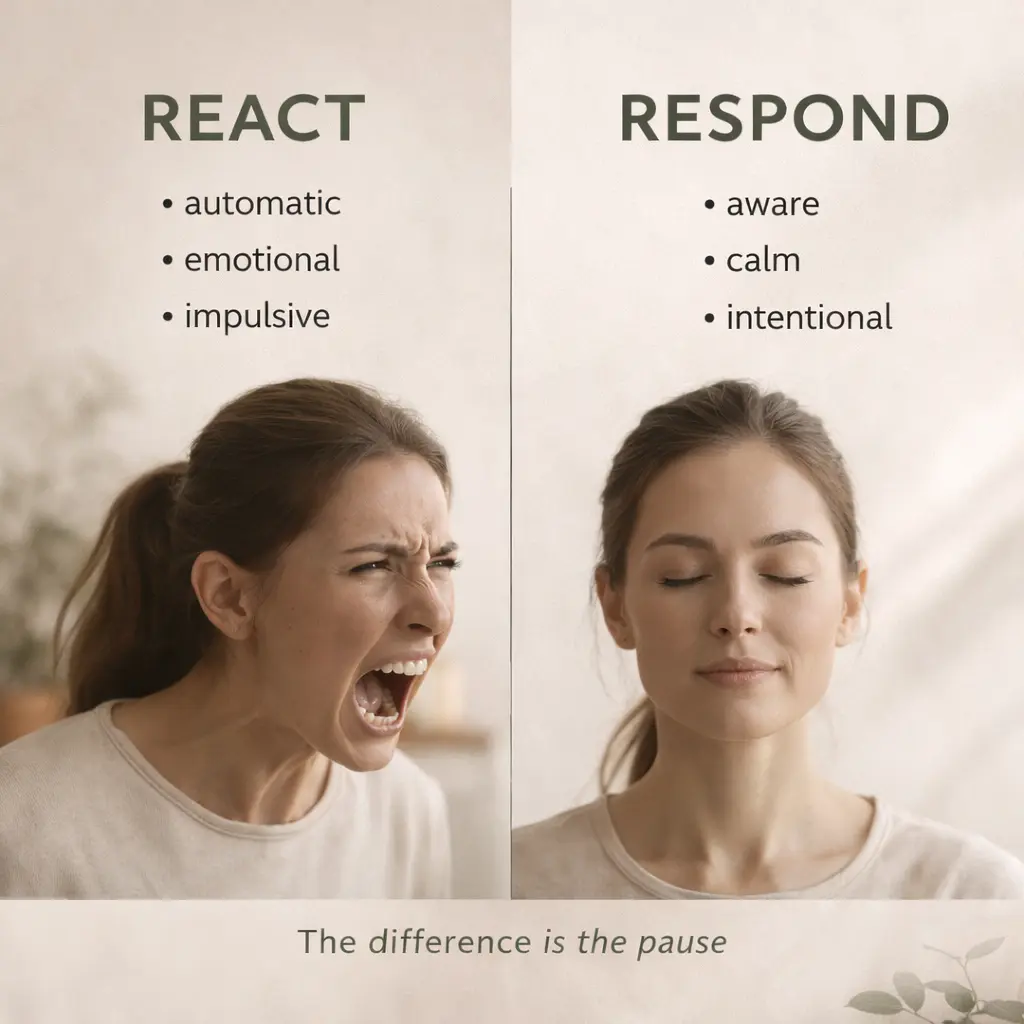
The philosopher and Holocaust survivor Viktor Frankl wrote: “Between stimulus and response there is a space. In that space is our power to choose our response. In our response lies our growth and our freedom.”
It sounds beautiful. It’s also neurologically accurate.
When something stressful happens — a tense conversation, an unexpected bill, a comment that stings — your brain processes it in milliseconds. The amygdala, your brain’s threat-detection center, fires before your prefrontal cortex (the part responsible for rational thought) has had a chance to weigh in. You feel it before you think it.
That’s a reaction: fast, automatic, and governed by pattern rather than choice.
When the stress response fires fast enough, it doesn’t just produce anxiety — it produces anger. The amygdala hijack that makes calm thinking impossible under stress is the same mechanism behind reactive anger. The guide on mindfulness for anger goes into exactly how to work with that specific pattern.
A response is something different. It still begins with that same physiological jolt. But somewhere between feeling and acting, you catch yourself. You notice what’s happening inside you. And you make a conscious choice about what to do next.
The difference isn’t discipline or willpower. It’s a skill — one that mindfulness directly trains.
| Try This Right Now: Think of the last time you reacted in a way you regretted.What was the trigger? What did your body feel first — tightness, heat, a sudden urge to speak?That physical sensation is the signal. Mindfulness teaches you to catch it before it becomes an action. |
What Stress Actually Does to Your Brain
To understand why mindfulness helps, it’s useful to know what’s happening under the hood when you’re stressed.
Your brain has a built-in alarm system. When it perceives a threat — whether that’s a physical danger or a difficult social situation — it activates the fight-or-flight response. Adrenaline and cortisol flood your system. Your heart rate climbs. Your muscles tense. Your attention narrows to the problem in front of you.
Psychologist Daniel Goleman coined the term “amygdala hijack” to describe what happens next: the emotional brain temporarily overrides the rational brain. You lose access to nuance, perspective, and creativity — exactly the things you need to navigate a complex situation well.
The cruel irony is that the more stressed you are, the harder it is to think clearly about the very thing stressing you.
Chronic stress compounds this. When the nervous system stays activated over time, the window of tolerance shrinks. Small things start feeling large. If you’ve ever noticed your body holding tension long after a difficult day has ended, grounding techniques — practices that bring your attention back into the body — are often the quickest way back to baseline.
Mindfulness works at a deeper level too. Research published in JAMA Internal Medicine found that mindfulness meditation reduces anxiety, depression, and perceived stress across a wide range of conditions — not by changing your circumstances, but by changing how your nervous system relates to them.
What Mindfulness Really Is (And Isn’t)
Before going further, let’s clear something up. Because the word “mindfulness” carries a lot of baggage.
It doesn’t mean emptying your mind. It doesn’t require meditation. It isn’t spiritual, religious, or reserved for people who have their life together. And it definitely isn’t about being permanently serene.
The working definition that holds up best — practically and clinically — comes from Jon Kabat-Zinn, the researcher who brought mindfulness into mainstream medicine: “paying attention on purpose, in the present moment, non-judgmentally.”
Three things. On purpose. Present moment. Without judgment. That’s it. Everything else is decoration.
You don’t need to sit in silence for 20 minutes. You can practice mindfulness while washing dishes, waiting for a meeting to start, or standing in a queue — as long as you’re directing your attention deliberately. If you want a practical starting point, practicing mindfulness in daily life is far more accessible than most people expect.
Mindfulness vs. Meditation: A Quick Note
People often use these words interchangeably, but they’re not the same thing. Meditation is a formal practice — a dedicated time when you sit, focus, and train your attention. Mindfulness is the quality of awareness that meditation helps develop.
Think of meditation as going to the gym, and mindfulness as the fitness you carry with you afterward. If you’re curious about building that formal practice, our guide on how to meditate properly covers the most common pitfalls — including what to do when your mind won’t stop.
For stress specifically, informal mindfulness — the kind woven into ordinary moments — is often more immediately useful, because stress doesn’t wait for your calendar.
The Mindful Pause: A 5-Step Framework
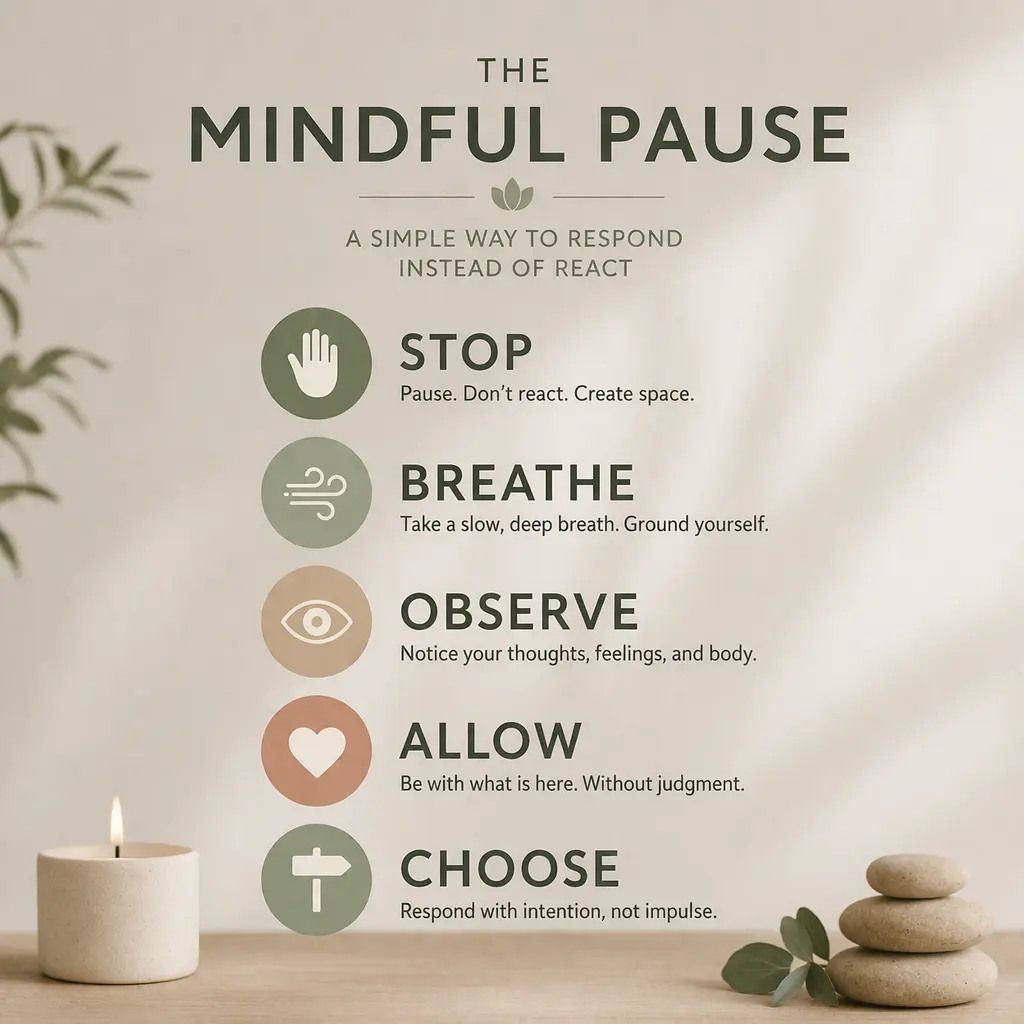
This is the core of the article. A simple, memorable framework you can use the next time stress arrives — before you say the thing you’ll regret, before you spiral, before you shut down.
It takes about 90 seconds the first time. With practice, it happens in seconds.
| 1 | STOP — Interrupt the Automatic Chain The moment you notice a stress response beginning — a tightening in your chest, a flash of irritation, a sudden urge to react — mentally say “stop.” Not to suppress the feeling, but to interrupt the automatic sequence before it runs on its own. |
| 2 | BREATHE — One Conscious Breath Take one slow, deliberate breath. In through the nose for four counts, out through the mouth for six. That extended exhale activates your parasympathetic nervous system — the body’s built-in calm response. You’re not just calming your mind; you’re literally changing your physiology. |
| 3 | OBSERVE — Notice Without Fusing Ask yourself: what am I feeling right now? Name it. “I’m feeling anxious.” “I’m angry.” “I feel dismissed.” Neuroscience research from UCLA shows that simply labeling an emotion reduces its intensity by activating the prefrontal cortex. You’re not feeding the feeling; you’re witnessing it. |
| 4 | ALLOW — Let the Moment Be Instead of immediately trying to fix, change, or escape what you’re feeling, let it be there for a moment. Resistance to discomfort amplifies it. Allowing it — even briefly — often takes its power away. You’re not agreeing with the situation. You’re just not fighting reality while you figure out what to do. |
| 5 | CHOOSE — Respond Intentionally Now you respond. From this slightly more spacious place, ask: what’s the most useful thing I can do right now? Not the most reactive. Not the most emotionally satisfying. The most useful. This is where cultivating presence pays off — the steadier your baseline awareness, the easier this moment becomes. |
| Remember It Easily: Stop — Breathe — Observe — Allow — Choose. You can also think of it as the 5-Beat Pause. Print it. Screenshot it. Keep it somewhere visible until it becomes second nature. |
Three Mindfulness Techniques for Stress That Actually Work
The Mindful Pause is your go-to for acute moments. But stress also lives in the body, in the background hum of the day, and in the thought loops that start at 2am. Here are three techniques — each targeting a different dimension of stress.
| 1. Box Breathing — For Acute Stress |
|---|
| WHEN TO USE: In the moment: before a difficult conversation, during an argument, when you feel panic rising. HOW: Breathe in for 4 counts. Hold for 4. Out for 4. Hold for 4. Repeat 3–4 cycles. This technique is used in high-stress environments including surgical theaters and military units — not because it’s spiritual, but because it works physiologically. It returns your heart rate variability toward baseline within minutes. |
| 2. The 2-Minute Body Scan — For Chronic Tension |
|---|
| WHEN TO USE: At the end of the workday, before sleep, or when you feel physically wound up but can’t identify why. HOW: Sit comfortably and close your eyes. Slowly move your attention through your body from the crown of your head to your feet. Don’t try to relax anything — just notice. Where is there tension? Heat? Numbness? Stress often lives in the body long after the triggering event has passed. This technique finds it. |
| 3. Thought Labeling — For Rumination |
|---|
| WHEN TO USE: When your mind won’t stop replaying a conversation, catastrophizing, or running a stress loop. If overthinking is a pattern for you, this technique specifically targets that cycle. HOW: When a stressful thought arises, instead of engaging with its content, gently say: “I notice I’m having the thought that…” For example: “I notice I’m having the thought that this is going to go badly.” This practice — drawn from Acceptance and Commitment Therapy — creates cognitive distance. The thought is still there, but you’ve stepped back from it. You’re the observer, not the thought. |
Meditation for Stress: A 5-Minute Practice for When You’re Already Overwhelmed
The techniques above work in the middle of stress — when something is happening and you need to respond. Meditation works differently. It’s what you do before the stress arrives, or once the acute moment has passed and you need to fully discharge what accumulated.
Think of it this way: the Mindful Pause stops the flood. Meditation drains the tank.
When the nervous system has been running in high-activation mode — cortisol elevated, jaw tight, mind cycling — it doesn’t automatically reset just because the stressful event is over. Meditation gives the body a structured window to actually complete the recovery process.
This practice takes five minutes and works particularly well at the end of the workday, after a difficult conversation, or whenever you notice you’re still carrying tension from something that’s already finished.
The 5-minute stress release practice:
- Find a position where your body feels supported. Sitting with your back against a chair, or lying flat. You’re not trying to be alert — you’re trying to let go, so comfort matters here.
- Start with a long exhale. Before you do anything else, breathe in through your nose, then let the air out slowly through your mouth — longer than the inhale, emptying completely. This one breath signals the parasympathetic nervous system that it’s safe to begin unwinding.
- Scan for where you’re holding tension. Without trying to fix anything, move your attention slowly through your body — jaw, shoulders, chest, stomach, hands. Just notice. Awareness alone begins to release what the body has been bracing against.
- Anchor on the breath. Settle your attention on the physical sensation of breathing — the air entering and leaving, the subtle movement of your body. Each time a stressful thought surfaces (and it will), simply notice it and return. You’re not solving anything right now. You’re just here.
- Stay for five minutes. When you finish, take one more slow exhale before opening your eyes.
You won’t feel nothing after this. You might still feel tired, or residually tense, or aware that the stressful situation still exists. That’s fine. What changes is the charge attached to it — the sense of urgency and physical bracing that turns manageable stress into exhaustion.
If you want to build this into a longer practice over time, the complete beginner’s guide to mindfulness meditation lays out exactly how to start without overcomplicating it.
How to Make the Mindful Pause a Habit
Understanding mindfulness isn’t the same as using it. Most people read articles like this one, feel genuinely inspired, and then forget to practice when stress actually arrives — because that’s precisely when the mind is least available for new strategies.
The solution isn’t more motivation. It’s smarter design.
Habit Stacking: Attach Mindfulness to Something You Already Do
Pick one routine activity you do every single day — making coffee, sitting down at your desk, stopping at a red light, washing your hands. Now attach a micro-mindfulness practice to it.
“Every time I sit down at my desk in the morning, I’ll take three conscious breaths before opening my email.”
That’s it. One cue, one behavior. Over two weeks, your brain starts to associate the cue with the practice. The cue does the work — you just have to start.
The 2-Minute Rule
Start smaller than feels meaningful. One breath. One body check. Fifteen seconds of deliberate attention. The goal at the beginning isn’t depth — it’s regularity. If you want to build toward a more structured practice, our complete beginner’s mindfulness meditation guide walks through a 6-step process that works even if you’ve never meditated before.
A practice you actually do every day beats a perfect practice you do once a week. Most people who sustain mindfulness long-term didn’t build a dramatic new routine — they found a crack in their existing day and slipped something small into it.
Use a Physical Anchor
Place a small object on your desk — a stone, a coin, a rubber band — as a visible cue for the practice. Every time you see it or touch it, take one conscious breath. Over time, the object becomes a trigger for presence without requiring any conscious effort. The practice becomes automatic — which is a beautiful irony.
Common Mistakes Beginners Make (And the Reframes That Help)
If you’ve tried mindfulness before and felt like it “didn’t work,” you’re not alone. Most people run into the same few obstacles. Here’s what they look like — and how to see them differently.
- Mistake: “I’m trying to stop my thoughts and I can’t.”
- Reframe: You’re not trying to stop your thoughts. You’re practicing noticing when your mind has wandered — and gently returning. That noticing is the practice. Every time you catch yourself drifting, that’s a rep.
- Mistake: “I’m bad at this.”
- Reframe: Nobody is bad at mindfulness. The mind wanders. That’s what minds do. The practice isn’t maintaining perfect focus — it’s returning, again and again, without judgment. You can’t fail at that.
- Mistake: “I only practice when I’m already stressed.”
- Reframe: Practicing only during crisis is like trying to learn to swim in a storm. Build a baseline first — small, daily, low-stakes moments of attention. Then the skill is available when you actually need it.
- Mistake: “It’s been two weeks and I don’t feel different.”
- Reframe: Neurological change is slow and invisible until it isn’t. Look for subtle shifts — catching yourself slightly earlier in a reaction, recovering from stress slightly faster. The small changes come first.
Frequently Asked Questions
What is the difference between reacting and responding to stress?
Reacting is automatic and unconscious — driven by your nervous system before rational thought can intervene. Responding is intentional. Mindfulness creates the pause between the two by training your attention so you can notice a stress trigger before acting on it.
How does mindfulness help with stress? Is there science behind it?
Yes. Mindfulness activates the prefrontal cortex while calming the amygdala. Regular practice reduces cortisol, lowers perceived stress, and improves emotional regulation. A 2014 meta-analysis in JAMA Internal Medicine covering 47 clinical trials confirmed its effectiveness across anxiety, depression, and stress conditions.
How long does it take for mindfulness to work for stress?
Most people notice something within the first few sessions — a slight sense of space, or catching themselves a beat earlier than usual. Measurable neurological changes tend to emerge after 6–8 weeks of consistent daily practice, even with short sessions. Consistency matters more than duration.
Can I practice mindfulness for stress without meditating?
Completely. The techniques in this article require no meditation experience or scheduled practice time. The Mindful Pause, thought labeling, and habit stacking all work informally — built into your existing day.
Is mindfulness the same as meditation?
Not exactly. Meditation is a formal training practice. Mindfulness is the quality of awareness that practice develops — and one you can bring to any moment of ordinary life. The relationship is similar to going to the gym versus being physically active throughout the day.
Why do I keep reacting even when I know better?
Because knowing and doing are processed by different systems. Emotional reactivity is neurological — the amygdala fires faster than conscious thought. Mindfulness works at the level of the nervous system, not just knowledge. With practice, you’re literally rewiring the pathways through neuroplasticity.
What if I don’t have time for mindfulness?
The Mindful Pause takes 90 seconds. Box breathing takes two minutes. Thought labeling takes zero additional time — you’re thinking anyway; this just changes how you relate to the thoughts. Mindfulness doesn’t need a time slot. It needs a willingness to pay attention.
You Are Not Your Reaction
Here’s what’s worth holding onto: you are not your stress response. You are the awareness that can notice it.
That distinction — between being swept along by a reaction and being the observer who catches it — is the whole of mindfulness, really. It doesn’t require a perfect practice, or daily meditation, or any particular belief system. It just requires a willingness to pause, even once, even briefly, before you act.
The next time stress arrives — and it will — you don’t have to respond the way you always have. You have the pause. You have the breath. You have the choice.
That’s not a small thing. That’s everything.
| Where to Go From Here: Practice the 5-Beat Pause once today — with something small, not a major stressor. If stress tips into anxiety for you, our piece on mindfulness for anxiety goes deeper on using presence to break the worry loop. And if what you’re ultimately building toward is a quieter, steadier inner life, these paths to inner peace are worth exploring as your next step. |


