

| Key Takeaway |
|---|
| You don’t need to force sleep. You need to stop fighting being awake. |
| A racing mind isn’t the problem. The pressure to “shut it off” is. |
| When you stop trying, your body can finally relax. When your body relaxes, sleep follows. |
| Don’t chase sleep tonight. Create the conditions—and let it come to you. |
You’re lying in bed, exhausted. But your mind is replaying that conversation from this afternoon, planning tomorrow’s to-do list, and reminding you—every three minutes—that you still aren’t asleep.
You’ve tried everything. White noise. Melatonin. Counting sheep. Nothing works when your brain decides bedtime is the perfect time to solve every problem in your life.
Here’s what you might not have considered: what if trying to fall asleep is actually the problem?
Mindfulness for sleep isn’t another trick to force yourself unconscious. It’s a different approach—one that works with your racing mind instead of fighting it. And for people whose thoughts won’t stop at night, this shift changes everything.
This article will show you why your mind races at bedtime, what mindfulness actually does for sleep, and the specific practices that help you rest peacefully—whether you fall asleep in five minutes or fifty.
Important: If you’ve struggled with sleep for months, experience extreme daytime fatigue, or suspect a sleep disorder like sleep apnea, talk to a doctor. This article is for the restless mind, not undiagnosed medical conditions.
Why Your Mind Races at Bedtime (And Why That’s Actually Normal)
Your nighttime thought spiral isn’t a character flaw. It’s a predictable pattern that happens when your body slows down but your mind hasn’t gotten the signal.
Think about your day. You move from task to task—emails, decisions, responsibilities. Your brain stays in “doing” mode because the pace demands it. No time to process. No space to feel.
Then you lie down. The noise stops. And your brain, which has been waiting all day for quiet, finally gets it.
So it does what brains do: it starts processing.
This is why nighttime thoughts feel so urgent. Your mind isn’t torturing you. It’s trying to complete the stress cycle from your day. That bothering conversation? Your brain wants to resolve it. The upcoming deadline? Your mind wants to plan for it.
The Three Types of Nighttime Thinking
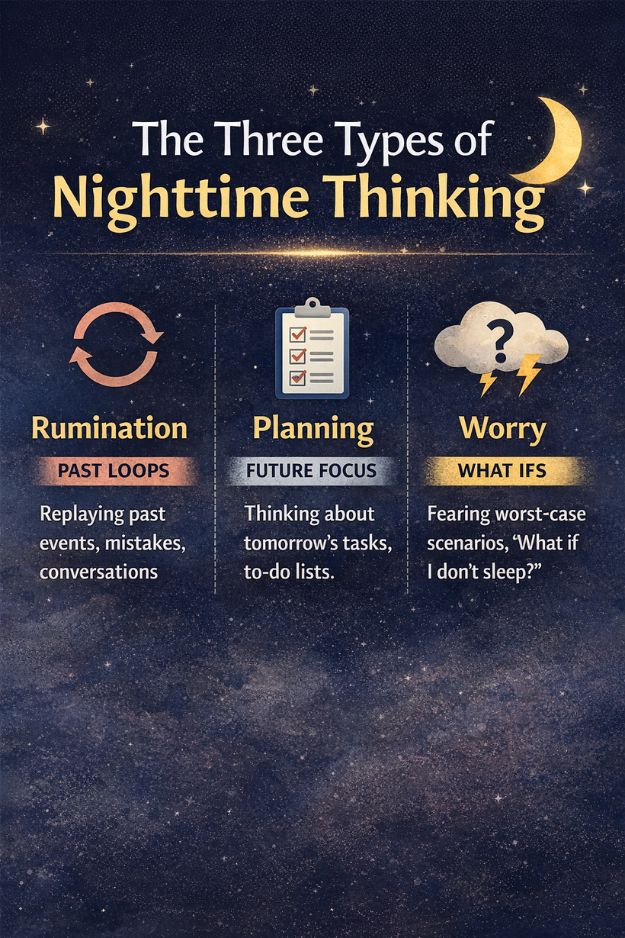
Rumination is repetitive thinking about the past—replaying conversations, rehashing mistakes, reviewing things you can’t change.
Planning is future-focused problem-solving. Your brain organizes tomorrow, solves problems, prepares for what’s coming. Planning thoughts feel productive, making them especially hard to let go.
Worry is anxiety about uncertain outcomes. “What if I don’t sleep?” “What if that meeting goes badly?” Worry creates physical tension because your body responds to perceived threats.
All three activate your stress response—the exact opposite state you need to fall asleep.
Understanding this breaks the shame cycle. You’re not broken. Your nervous system is doing what nervous systems do when they haven’t learned to downregulate.
(For a deeper dive into nighttime rumination mechanics, why your mind won’t stop at night offers additional strategies.)
The Sleep Effort Paradox (Why Trying Harder Backfires)
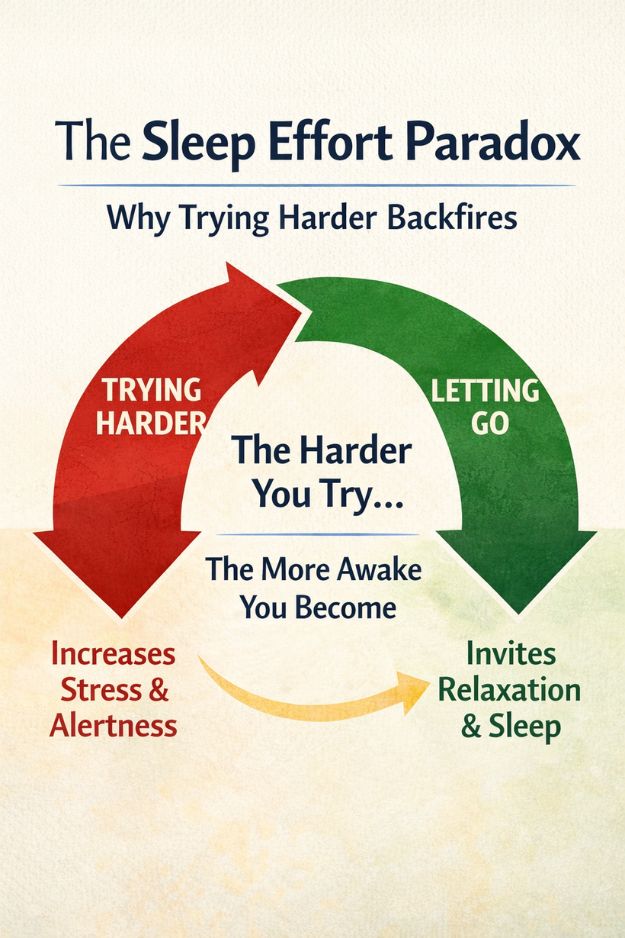
Here’s the cruel irony: the harder you try to fall asleep, the more awake you become.
Our culture teaches us to work harder at problems. Apply more effort. More discipline. This works for learning skills or completing projects.
But sleep doesn’t respond to effort. Sleep responds to surrender.
Effort creates arousal. When you’re trying to make yourself sleep, your body tenses. Your mind becomes goal-oriented (“I have to sleep”). You start monitoring (“Am I asleep yet?”). All of this activates your sympathetic nervous system—fight-or-flight.
Sleep requires your parasympathetic nervous system. Rest-and-digest. The state where your body feels safe enough to let go.
Notice if these sound familiar:
- Telling yourself “I HAVE to fall asleep” and feeling more awake
- Calculating remaining sleep hours (“If I sleep now, I’ll get 5 hours…”)
- Judging yourself for still being awake
- Monitoring every sensation, checking “Am I sleepy yet?”
This is effort. And effort is the opposite of surrender.
Sleep scientist Matthew Walker explains in Why We Sleep that anxiety about sleep activates the neurological systems preventing sleep onset. The worry creates the wakefulness you fear.
Mindfulness solves this not by teaching you to try harder at relaxation, but by teaching you to stop trying altogether.
(The paradox of trying versus allowing appears in manifestation practices too—sometimes the goal arrives when we stop forcing it.)
What Mindfulness for Sleep Actually Is (And Isn’t)
Mindfulness isn’t sitting cross-legged trying to “clear your mind” for 45 minutes. That’s not what this is.
Here’s the real definition: Mindfulness is paying attention to your present-moment experience—thoughts, sensations, sounds, breath—without judging or trying to change it.
For sleep specifically:
- Instead of fighting racing thoughts, you observe them without getting pulled in
- Instead of forcing relaxation, you notice tension without adding more tension
- Instead of achieving sleep, you rest in wakefulness until sleep arrives
What Success Looks Like
Immediately: Less anxiety about being awake. A quieter inner critic. Resting even when not sleeping.
Within 1-2 weeks: Falling asleep more easily. Less catastrophizing. More trust in your body’s ability to rest.
Within 4-8 weeks: Deeper sleep quality. Breaking chronic patterns. Daytime calmness that makes nighttime easier.
The goal isn’t faster sleep (though that often happens). The goal is peaceful rest whether you’re asleep or awake. When you stop fighting wakefulness, sleep often arrives naturally.
(If you’re skeptical you could ever “just observe thoughts,” how to meditate properly even when you can’t stop thinking addresses this concern.)
The Mindful Body Scan for Sleep
The body scan gives your mind a job: noticing physical sensations instead of spinning in thought loops.
When your mind races through thoughts, it’s in abstract mental space—replaying, planning, worrying. The body scan brings attention into your physical body, into sensation, into now. When attention shifts to present-moment sensation, thought loops lose their grip.
Why This Works
Moving attention slowly through your body triggers several shifts: Your prefrontal cortex shifts from rumination to observation. Your nervous system begins to downregulate—scanning your body with gentle attention signals safety. Unconscious muscle tension gets released as you bring awareness to tight areas.
The Practice
Lie in your natural sleep position. No need to sit up.
Three natural breaths
Don’t deepen or control breathing. Just notice three full cycles.
Feet to head
Bring attention to your left foot. What do you feel? Temperature? Tingling? Pressure? Maybe nothing—that’s fine.
Don’t try to relax your foot. Just notice.
Move slowly: ankles → calves → knees → thighs → hips → belly → chest → hands → arms → shoulders → neck → face.
Spend 5-10 seconds on each area.
When your mind wanders, return
Notice you’ve drifted, return to the last body part. No judgment. Just: “Thinking about work. Back to knees.”
Fall asleep whenever
If you fall asleep mid-scan—perfect. Still awake after completing it? Start over or switch to breath counting.
Common Mistakes
Don’t try to relax each body part—just notice. Don’t judge yourself for mind wandering—it’s built into the practice. Don’t expect immediate sleep—some nights you’ll rest peacefully while awake, and that’s valuable too.
The body scan is one of many grounding techniques for nervous system regulation—useful beyond bedtime.
Mindful Breathing When Your Mind Won’t Stop
If the body scan feels too slow, breath counting offers a different anchor.
Breath is always happening, always present, always available. Watching it—without controlling it—gives your mind something neutral to rest on.
Why Breath Works
When you count breaths, you occupy your working memory—the mental space your brain uses for active thinking. You can’t ruminate about work and count breaths simultaneously.
Mindful breath also activates your parasympathetic nervous system—the “rest and digest” mode.
The Practice
Step 1: Lie comfortably. Breathe naturally.
Step 2: On each exhale, count silently: “One”… “Two”… “Three”… up to “Ten.”
Step 3: Start over at one. Repeat.
Step 4: When you lose count (you will), start back at one. No frustration.
Step 5: Continue until sleep arrives.
When Breath Focus Creates Anxiety
Some people—especially those with trauma or panic disorder—find breath focus uncomfortable.
Try these alternatives:
Count backwards from 100 by threes: 100, 97, 94, 91…
Use sounds as your anchor: Listen to ambient noise. When your mind wanders, return to listening.
Try 5-4-3-2-1 sensory awareness: Name 5 things you see (or imagine), 4 you hear, 3 you feel, 2 you smell, 1 you taste.
Find what feels regulating for your nervous system.
(For deeper breath-based practices, mindful breathing offers a complete guide.)
The Noting Technique (For When Thoughts Won’t Stop)
When thoughts are particularly insistent, the noting technique offers a different approach: label thoughts and let them pass.
This creates psychological distance. You shift from being inside the thought (“I’m worried”) to observing it (“I’m noticing worry”).
Why Noting Works
Cognitive fusion is when you’re so merged with thoughts that they feel like absolute truth, like urgent commands, like you.
Noting breaks this fusion. When you label a thought, you activate your prefrontal cortex, creating space between observer and observed.
Instead of: “That meeting tomorrow is going to be a disaster…”
You get: “I’m noticing worry thoughts. Interesting.”
The Practice
Step 1: Notice when a thought has captured your attention.
Step 2: Silently label it: “Worrying,” “Planning,” “Remembering,” “Judging,” or just “Thinking.” Don’t analyze. Don’t engage. Just label and let it be.
Step 3: Return attention to your anchor (breath, body, or rest in awareness).
Step 4: Repeat endlessly. Thoughts keep coming. You keep noting. This is the practice.
The noting technique works for chronic overthinking and anxiety loops during the day too.
Befriending Wakefulness (The Ultimate Shift)
Here’s the most radical idea: The goal isn’t to fall asleep faster. The goal is to rest peacefully whether you’re asleep or awake.
This isn’t giving up. It’s removing the thing keeping you awake: resistance to wakefulness.
The Problem with Fighting
When you’re awake at 2 AM, there are two sources of suffering:
Primary discomfort: You’re awake when you want to be asleep.
Secondary suffering: Your reaction—the frustration, catastrophizing, self-judgment, anxiety about tomorrow.
You can’t always control the primary discomfort. But the secondary suffering? That’s where mindfulness works.
Every time you think, “I should be asleep. This is terrible,” you add tension and create a stress response that makes sleep even less likely.
The Shift
Instead of: “I’m still awake. This is awful.”
Try: “I’m awake right now. My body is resting. I’m safe.”
This isn’t positive thinking. It’s describing reality without adding catastrophe.
Acceptance doesn’t mean you like it. It means you stop fighting what’s happening.
When you stop fighting wakefulness, sleep often arrives more easily. Fighting creates arousal. Acceptance creates conditions for rest.
The shift from self-criticism to self-compassion during sleep struggles is genuinely transformative.
Building a Mindful Pre-Sleep Routine
Your nighttime mind is the culmination of your entire day—the stress absorbed, screens stared at, problems attempted.
A mindful evening routine creates a transition between the demands of the day and the stillness of sleep.
The Evening Wind-Down
| Start 30-60 minutes before bedtime: |
|---|
| Digital Sunset (30-60 min before bed) Screens off or night mode. Avoid emotionally activating content. |
| Worry Download (10 min) Brain dump in a notebook: tasks for tomorrow, lingering concerns, anything your mind keeps circling. Once it’s on paper, your brain can stop holding it in working memory. |
| Sensory Transition (5-10 min) Dim lights, lower temperature, play gentle sounds if you like. |
| Body Awareness (5 min) Gentle movement: slow stretches, progressive muscle relaxation, deep belly breaths. |
| Mindful Hygiene Brush teeth, wash face with attention. Notice sensations. This is informal mindfulness practice. |
| Gratitude or Intention (2 min) Three things you’re grateful for today. An intention to rest peacefully. Reminder: “I’m safe. I’m allowed to rest.” |
Building mindfulness throughout your day makes nighttime practice more natural. How to practice mindfulness in daily life shows you how.
What to Do When You Wake Up at 3 AM
Middle-of-night waking is normal. The difference between those who fall back asleep and those who lie awake? What they do in those first moments.
Don’t Check the Time
When you look at the clock, your brain does math (“If I sleep now, I’ll get 3 hours…”), creating sleep anxiety. The light signals it’s time to wake up. Resist checking. Cover your clock if needed.
The 3 AM Reset
| Try This |
|---|
| Step 1: Notice without judgment. “I’m awake. That’s what’s happening.” |
| Step 2: Do a brief practice: Quick body scan, count ten breaths, or note a few thoughts then return to body. |
| Step 3: If sleep doesn’t come in 15-20 minutes and you’re frustrated, get up. Go to another room. Keep lights dim. Do something gentle and boring—read (not on a screen), light stretching, sit quietly. Return to bed when you feel sleepy. |
If you consistently wake mid-night, you might be dealing with daytime overstimulation. Signs you’re overstimulated can help identify contributing factors.
When Mindfulness Isn’t Enough
Mindfulness significantly improves sleep quality and reduces insomnia symptoms. But it’s not a cure-all.
If you’ve practiced consistently for several weeks and still struggle severely, consider additional support.
When to See a Doctor
- Chronic insomnia: Difficulty sleeping 3+ nights per week for 3+ months
- Extreme daytime fatigue affecting function
- Suspected sleep disorders: Loud snoring, gasping, breathing pauses; sudden sleep attacks; intense urge to move legs at night
- Mental health concerns: Severe anxiety, panic attacks, depression, burnout, trauma-related disturbances
Cognitive Behavioral Therapy for Insomnia (CBT-I)
According to the American Academy of Sleep Medicine, CBT-I is the first-line treatment for chronic insomnia—more effective than medication long-term.
Many CBT-I programs now integrate mindfulness. You don’t have to choose—they work well together.
Self-compassion includes knowing when you need help beyond self-practice. Asking for support isn’t failure. It’s wisdom.
(If mindfulness practices feel difficult, 9 common meditation challenges walks through obstacles.)
Your Invitation to Rest
You’re not broken because your mind races at night. You’re not weak because sleep feels difficult. You’re not failing.
Your nervous system is doing what nervous systems do when overstimulated or lacking gentler downregulation skills. And you can teach it new patterns.
Mindfulness for sleep isn’t about forcing immediate unconsciousness. It’s about building a different relationship with wakefulness, thoughts, and the act of trying to sleep.
Some nights, you’ll practice body scan and drift off peacefully. Other nights, you’ll count breaths for an hour and still be awake, but calmer. Both are valuable. Both are practice.
Start tonight. Choose one practice—body scan, breath counting, or noting. Do it imperfectly. Do it when your mind wanders constantly. Do it even when it doesn’t “work.”
Because it’s already working if you’re resting more peacefully while awake. It’s already working if you’re judging yourself less. It’s already working if you’re learning you can be with discomfort without collapse.
Sleep will follow in its own time.
Your job is to create the conditions. To practice. To be gentle with yourself.
To rest, even before sleep arrives.
Frequently Asked Questions
Does mindfulness for sleep work immediately?
Mindfulness offers immediate and long-term benefits. The first night, you might experience reduced anxiety and a calmer mind, even if you don’t fall asleep faster. Within 1-2 weeks of consistent practice, most people fall asleep more easily. Deep improvements—sleeping through the night regularly—often take 4-8 weeks. Think of it like building muscle: you feel different after one workout, but strength takes consistency. If you’re less stressed about sleep or resting peacefully while awake, it’s working.
What’s the difference between mindfulness for sleep and sleep meditation?
Sleep meditation uses guided imagery, progressive relaxation, or soothing narratives to help you drift off—it’s designed to lull you to sleep. Mindfulness is about observing your present experience (thoughts, sensations, breath) without trying to change it. Sleep meditation is outcome-focused (the goal is sleep). Mindfulness is process-focused (the goal is awareness). Both help, and many people use both: mindfulness techniques first, then guided sleep meditation as final wind-down.
What if focusing on my breath makes me more anxious?
This is surprisingly common. For people with trauma, panic disorder, or certain anxieties, breath focus can feel threatening. If breath focus increases anxiety, try these: count backwards from 100 by threes, use external sounds as your anchor, do body scan but skip the chest area, or use 5-4-3-2-1 sensory awareness. Breath is just one possible anchor—find what feels regulating for your nervous system.
How long should I practice mindfulness for sleep each night?
Most people find 10-20 minutes before bed creates noticeable shifts. Very activated? You might need 20-30 minutes. Already calm? Five minutes might be plenty. Consistency matters more than duration—five minutes nightly builds more skill than 30 minutes weekly. Once in bed, there’s no endpoint. Fall asleep mid-practice? Perfect. Still awake after completing it? Start over. The practice continues until sleep arrives. Start with what feels doable—even three minutes is valuable.
Can mindfulness for sleep help with insomnia?
Yes. Research shows mindfulness-based interventions significantly improve insomnia symptoms, especially sleep-onset insomnia and sleep anxiety. Mindfulness addresses rumination, hyperarousal, the sleep effort paradox, and performance anxiety—all core insomnia mechanisms. However, it won’t cure sleep apnea, restless leg syndrome, or narcolepsy. For chronic insomnia (3+ nights weekly for 3+ months), mindfulness works best combined with CBT-I, the gold-standard treatment. Expect gradual improvement over 4-8 weeks, not instant results.
Should I practice mindfulness during the day too, or only at night?
Daytime practice strengthens nighttime results but isn’t required to start. When you practice throughout the day, you train your brain to unhook from rumination before it becomes a nighttime problem. Daytime mindfulness also helps you process stress in real-time instead of carrying it to bed. Simple ways to add it: three mindful breaths when you wake up, one conscious breath between tasks, attention to one meal daily, or notice your feet touching ground during walks. As bedtime practice becomes easier, add brief daytime moments. Skills compound.
What should I do if my mind keeps wandering during the practice?
Your mind is supposed to wander—that’s the practice, not failure. Mindfulness isn’t achieving perfect concentration. It’s noticing when your mind has wandered and gently returning attention. Every time you notice and return, you’re completing one successful repetition. Beginners might return attention 50 times in 10 minutes—that’s 50 successful moments of awareness. How you return matters more than how often you wander. Return with gentleness, not frustration: “Thinking about work. Back to breath.” Judging yourself for wandering adds a second problem on top of normal mind activity.


