

Mindfulness is one of the most recommended and least understood words in modern wellness.
Your therapist mentioned it. Your friend swears by it. You’ve seen it on app store banners and in magazine headlines. And yet, if someone asked you to explain what mindfulness actually is — not the marketing version, but what it actually involves and why it might help — you’d probably struggle to give a clear answer.
That’s not your fault. Most of the content around mindfulness is either too abstract to be useful or too prescriptive to be accessible. This guide is neither. It’s a grounded, honest introduction to what mindfulness is, what the research actually shows, and the simplest possible way to start — today, without any equipment or prior experience.
| Simple mindfulness explanation for beginners? Mindfulness is the practice of paying deliberate, non-judgmental attention to the present moment — to what you’re thinking, feeling, and experiencing right now, rather than being absorbed in the past or future. For beginners, this typically starts with a simple practice: focusing attention on the breath, noticing when the mind wanders, and gently returning. No special equipment, no particular belief system, and no ability to clear your mind is required. The wandering mind is not a problem to be solved — it is the raw material of the practice. |
| KEY TAKEAWAYS | |
|---|---|
| Mindfulness is a skill, not a state | You are not trying to feel calm. You are training the ability to notice where your attention is and redirect it deliberately. Calm is sometimes a byproduct. |
| The wandering mind is not the enemy | A mind that wanders during mindfulness practice is not failing — it is giving you something to work with. Every return is a repetition of the skill you are building. |
| You don’t need to clear your mind | This is the most persistent misconception about mindfulness. The goal is not to stop thinking. It is to change your relationship to thoughts — from fused to observational. |
| Five minutes is a genuine starting point | Research supports brief, consistent practice over long, sporadic sessions. Five minutes daily for two weeks will teach you more about mindfulness than any amount of reading about it. |
| The first two weeks are the hardest | Most people quit during this window, not because the practice isn’t working, but because it doesn’t yet feel like anything. The effects are cumulative and become noticeable around weeks three and four. |
| Mindfulness is not meditation — and not religion | Mindfulness can include formal meditation, but it is also a quality you can bring to any activity. It has roots in Buddhist tradition but is practised entirely secularly by millions worldwide. |
| The science is solid | Decades of research across hundreds of clinical trials show that consistent mindfulness practice reduces anxiety, stress, and depression symptoms — with effects comparable to other evidence-based treatments. |
What Mindfulness Actually Is (And What It Isn’t)
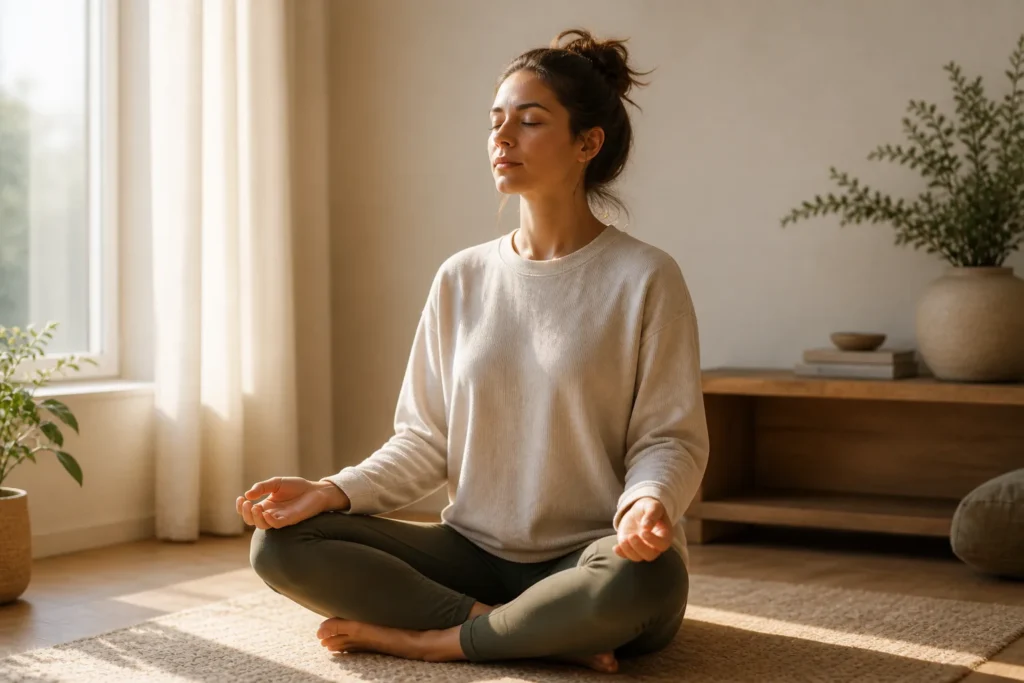
The most useful starting point is not a definition — it’s clearing up the three misconceptions that cause most beginners to either misunderstand the practice or give up on it too early. For a comprehensive definition and its origins, the complete guide to what mindfulness is covers the full picture. Here, we’re focused on what beginners most commonly get wrong.
Misconception 1: Mindfulness means clearing your mind
This is the most persistent and most damaging misconception. If clearing the mind were the goal, virtually everyone would fail — because the mind does not clear. It wanders, generates, evaluates, plans, and reviews. That is what minds do.
The goal of mindfulness is not to stop thoughts. It is to change your relationship to them — from being automatically pulled into every thought that arises, to noticing thoughts as mental events that you can observe without necessarily following. A thought observed from a slight distance has far less power over your mood and behaviour than a thought you are fully inside.
Misconception 2: Mindfulness is the same as meditation
Mindfulness and meditation are related but distinct. Meditation is a formal, seated practice where you deliberately train attention for a set period of time. Mindfulness is a quality of attention — present, deliberate, non-reactive — that can be brought to any activity: eating, walking, a conversation, washing the dishes. Formal meditation is one of the most effective ways to train mindfulness, but they are not interchangeable terms.
Misconception 3: Mindfulness is religious or spiritual
Mindfulness has roots in Buddhist contemplative practice, but the form that has been studied in clinical research and practised by millions worldwide is entirely secular. The Mindfulness-Based Stress Reduction (MBSR) programme developed at the University of Massachusetts Medical School — the most widely studied mindfulness intervention in the world — contains no religious content whatsoever. You do not need any particular beliefs to practise or benefit from mindfulness.
Why Mindfulness Works: The Science in Plain Language
The research on mindfulness is now extensive enough to make specific, confident claims about what it does and how quickly.
The default mode network problem
The brain has a network of regions that activate when you’re not focused on a specific task — the default mode network. When your mind is free, this system fills the space with self-referential thinking: reviewing the past, simulating the future, assessing how you measure up. Harvard researchers Killingsworth and Gilbert found that people spend nearly 47% of their waking hours thinking about something other than what they’re currently doing — and that this mind-wandering is consistently associated with lower wellbeing, regardless of what the mind is wandering to.
Mindfulness training directly targets this pattern. By repeatedly returning attention to the present moment, you are literally practising not being swept away by default mode activity. Over time, the pull of the mental drift weakens.
What changes in the brain and body
Brain imaging research by Sara Lazar and colleagues at Harvard showed measurable increases in cortical thickness in long-term meditators, particularly in regions associated with attention, interoception, and emotional regulation. These structural changes are not the result of decades of practice — earlier research by the same group showed shifts emerging within eight weeks of regular practice.
At the population level, the 2014 JAMA meta-analysis by Goyal and colleagues reviewed 47 randomised controlled trials and found moderate evidence that mindfulness meditation produces meaningful reductions in anxiety, depression, and stress symptoms. This is not soft evidence from wellness blogs. It is peer-reviewed, replicated clinical research.
For a full breakdown of the research, the evidence on mindfulness and mental health summarises the most important findings and what they mean practically.
| Mindfulness doesn’t make life quieter. It makes you less at the mercy of the noise. |
What Beginners Actually Experience (And Why It Feels Hard at First)
Most people who try mindfulness for the first time and give up do so during a specific window: the first one to two weeks. Understanding what happens in this window — and why it is not a sign the practice isn’t working — is what makes the difference between stopping and continuing.
The wandering mind
You sit down to practise. You focus on your breath. Within seconds, your mind is elsewhere — replanning tomorrow, replaying yesterday, wondering if you’re doing this right. You pull your attention back. It wanders again. Within three minutes, you’ve been ‘distracted’ dozens of times.
This is not failure. This is the practice.
Every time you notice that your mind has wandered and bring it back, you have completed one repetition of the skill you are training. A session with fifty returns is not a bad session. It is a session with fifty repetitions. The mind that wanders has given you exactly the material mindfulness is designed to work with.
The expectation gap
Most beginners expect to feel calmer during or immediately after their first sessions. When that doesn’t happen — when they finish five minutes of practice feeling just as busy-headed as when they started — they conclude the practice doesn’t work for them.
The effects of mindfulness practice are cumulative, not immediate. They build quietly across days and weeks. The shift that most people first notice is not ‘I feel calm when I meditate’ — it’s ‘I noticed I was getting wound up about something, and I caught it earlier than I used to.’ That observation — that tiny expansion of the gap between stimulus and reaction — is the practice working.
If the experience of sitting still with a busy mind feels genuinely overwhelming rather than just unfamiliar, this gentler starting point removes the expectation of stillness entirely and builds from movement instead.
If you find that mindfulness makes you more aware of your own self-criticism rather than less, the mindfulness for self-compassion guide addresses exactly that pattern.
The Best Way To Practice Mindfulness As A Beginner: A 5-Minute Practice
You do not need an app, a cushion, a quiet room, or any prior experience. You need five minutes and somewhere to sit.
- Sit upright in a chair or on the floor, with your back supported but not rigid. Close your eyes or let your gaze soften toward the floor.
- Take one slow, deliberate breath out — longer than the inhale — and let your shoulders drop.
- Bring your attention to the physical sensation of breathing. Not the idea of it — the actual feeling. The air entering your nose. The slight rise of your chest or belly. The pause at the top of the inhale.
- When your mind moves to a thought — and it will, probably within seconds — simply notice that it has moved. No judgment. Just: ‘Thinking.’ Then gently return your attention to the breath.
- Repeat for five minutes. That’s it.
The breath is the anchor because it is always present, always physical, and always in the present moment. It cannot be in the past or the future. Every time you return to it, you return to now. For more detail on using breath as your primary mindfulness tool, the complete guide to mindful breathing covers the mechanics and variations in depth.
5 Beginner-Friendly Mindfulness Practices

The breath anchor is the simplest entry point, but mindfulness is broader than formal sitting practice. These five practices cover different ways to develop the same skill. For a wider toolkit beyond these five, 15 mindfulness techniques that work has a full range to explore once you’ve built the basic foundation.
Practice 1: Breath Anchor (Seated)
Best for: building the foundational skill; any time, any place
| 1. Sit comfortably and close your eyes. |
| 2. Focus attention on the physical sensation of breathing — not controlling the breath, just noticing it. |
| 3. When the mind wanders, notice it has wandered and return to the breath. |
| 4. Repeat for five to ten minutes. |
Practice 2: Body Scan
Best for: releasing physical tension; anxiety held in the body; before sleep
| 1. Lie flat or sit with full support. Close your eyes. |
| 2. Move attention slowly through your body from head to feet, noticing what’s present without trying to change it. |
| 3. Pause at areas of tension and breathe gently into them. |
| 4. Take ten to fifteen minutes. There is no pass or fail — noticing is the whole practice. |
Practice 3: Mindful Walking
Best for: people who find sitting still difficult; building mindfulness into movement
| 1. Walk at a slower pace than usual — not dramatically slow, just unhurried. |
| 2. Direct attention to the physical sensations of walking: the contact of each foot with the ground, the movement of your legs, the air on your skin. |
| 3. When the mind moves to planning or reviewing, notice it and return attention to the sensations of walking. |
| 4. Five to ten minutes. No destination required. |
Practice 4: Mindful Eating
Best for: building presence into existing daily habits; no extra time required
| 1. Choose one meal or snack per day to eat without screens or other distractions. |
| 2. Before eating, pause for a moment and notice the appearance, smell, and texture of the food. |
| 3. Eat slowly. Notice taste, temperature, and texture with each bite. |
| 4. When you notice you’ve drifted into thought, return to the sensory experience of the food. |
Practice 5: The STOP Technique
Best for: in-the-moment reset; stress spikes; transition between tasks
| 1. S — Stop whatever you’re doing, even for thirty seconds. |
| 2. T — Take one slow, deliberate breath. |
| 3. O — Observe: what are you thinking? What does your body feel like right now? What’s happening in this moment? |
| 4. P — Proceed with a slightly more deliberate quality of attention. |
For a practical toolkit of everyday practices that don’t require formal sessions, the 34 mindfulness activities list is a useful companion to this guide — especially for beginners who want to start with something low-barrier.
How to Build a Mindfulness Habit That Actually Sticks
The most common reason people don’t maintain a mindfulness practice is not lack of motivation or discipline. It’s that they treat it as something to add to an already full life, rather than something to anchor their life around.
Habit stacking
The most reliable way to make any new practice stick is to attach it to something you already do without thinking. The existing habit carries the new one.
- Meditate before your morning coffee brews.
- Do the STOP technique every time you sit down at your desk.
- Do a one-minute body scan before getting out of bed.
- Take three mindful breaths before every meal.
The trigger — the existing habit — is more important than the time of day. If you have to remember to practise, you will often forget.
The minimum viable practice
On difficult days, the practice doesn’t disappear — it contracts. Three breaths, taken with full attention, before your phone goes on. That is a mindfulness practice. It is brief, but it is not nothing. It keeps the chain unbroken and the identity intact.
For those who want to extend this into a fuller morning routine, the morning meditation guide covers exactly how to build consistency without turning the practice into another obligation. And how to practise mindfulness in daily life addresses the longer-term question of weaving mindful attention into the texture of an ordinary day.
What to expect in the first month
Week one and two: mostly uncomfortable. The mind wanders constantly, the sessions feel unproductive, and you may wonder why anyone finds this useful. This is normal. Stay.
Week three: a subtle shift. You might notice you caught yourself mid-spiral and came back faster than before. That the gap between a stressful trigger and your reaction had a fraction more space in it.
Week four and beyond: the practice starts to feel like something. Not dramatic. Quiet. But real.
If your particular challenge is an overthinking mind that resists settling, mindfulness for overthinkers addresses that specific pattern with an approach tailored to how analytical, active minds actually work. And if anxiety is part of the picture, mindfulness for anxiety and mindfulness for stress each go deeper into those specific applications.
| You don’t need to feel calm to practise mindfulness. You just need to notice where you are — and gently return. |
Frequently Asked Questions
How long should I practise mindfulness as a beginner?
Start with five minutes daily. That is enough to build the skill and see results over time. The research is consistent that short, consistent practice outperforms long, sporadic practice. Once five minutes feels natural — usually after two to three weeks — you can extend to ten or fifteen minutes if you want to. But five minutes daily is a complete and sufficient practice for a beginner.
Do I need to meditate to practise mindfulness?
No. Formal sitting meditation is one of the most effective ways to train mindfulness, but it is not the only one. Mindful walking, mindful eating, the STOP technique, and even mindful conversation all develop the same quality of attention. If sitting still is genuinely difficult for you, start with movement-based practices and build from there.
What if I fall asleep during mindfulness practice?
Falling asleep during a body scan or breath practice is extremely common, especially in the early weeks when the body is catching up on rest. If it happens consistently, try practising sitting upright rather than lying down, and at a time of day when you’re not already tired. Falling asleep is not a failure — but if your goal is to build the skill, you need to be awake enough to practice returning.
Can mindfulness help with specific problems like anxiety, overthinking, or sleep?
Yes — and there is substantial research on each of these applications specifically. Mindfulness reduces anxiety symptoms, interrupts overthinking loops, and improves sleep quality in ways that have been replicated across dozens of clinical trials. The mechanism is broadly the same in each case: reducing default mode network activity, increasing prefrontal regulation, and shifting the nervous system toward a less reactive baseline. The specific practices that work best vary depending on the application.
Is there a right or wrong way to do mindfulness?
The only wrong way to practise mindfulness is to expect not to think. If you are sitting, returning to your anchor when you notice the mind has wandered, and doing this without harsh self-judgment, you are doing it right — regardless of how many times the mind wanders or how ‘unmeditative’ the session feels. There is no such thing as a failed mindfulness session, only a session that happened.
Do I need an app to practise mindfulness?
No. Apps can be useful scaffolding for beginners — they provide structure, guidance, and reminders. But they are not necessary, and some people find that relying on an app prevents them from developing the internal relationship with the practice that makes it genuinely portable. The five-minute breath anchor practice described in this article requires nothing but a place to sit and a timer.
You Don’t Need to Be Calm to Begin
One of the most useful things to understand about mindfulness is that it is not a calm person’s practice. It is a practice for busy minds, anxious mornings, and days when everything feels like too much.
You do not need to feel ready. You do not need the right conditions. You do not need to be the kind of person who is naturally good at this — because no one is naturally good at it. The skill is built through practice, not through disposition.
Five minutes. Somewhere to sit. The willingness to begin and return when the mind wanders. That is everything you need.Once you’ve established those five minutes, building a consistent daily routine is the natural next step — the place where the quiet, cumulative change of mindfulness practice really begins to compound.


