

If you’ve ever tried mindfulness and found that sitting quietly made your thoughts louder, not quieter — you’re not doing it wrong. You’re an overthinker. And most mindfulness advice wasn’t written for you.
The standard instruction is: sit down, focus on your breath, observe your thoughts without judgment. For a moderately calm, non-ruminative mind, that works. For an overthinker, it can feel like being told to hold still while standing in a wind tunnel.
The thoughts don’t slow down. They multiply. And then a new layer appears on top: thoughts about the thoughts. Am I doing this right? Why can’t I focus? What’s wrong with me?
Nothing is wrong with you. But the generic advice is genuinely not suited to how your brain works — and understanding why makes all the difference.
This guide is written specifically for the overthinking mind. It explains what’s actually happening neurologically, why standard approaches backfire, and what to do instead — with concrete techniques adapted for a brain that won’t stop.
| Mindfulness for overthinkers is the practice of training present-moment awareness in a way that accounts for how ruminative, anxious minds actually work. Standard mindfulness approaches — open awareness, long unstructured sessions, “just observe your thoughts” — often backfire for overthinkers because they provide too little structure for an active analytical mind. Adapted approaches use stronger anchors (breath counting, body scan, movement), shorter and more frequent sessions, and specific techniques like thought labelling to create the observer distance that overthinking erodes. The goal is not to stop thinking. It is to change the relationship between you and your thoughts. |
KEY TAKEAWAYS
| What overthinking is | A well-practised neural pattern driven by the default mode network — not a character flaw |
| The same network | Your overthinking brain uses the same network as creativity and insight — it’s not broken |
| Why standard advice fails | Open awareness gives the DMN more space to run; structure is what an anxious mind needs |
| The 3 key adjustments | Shorter sessions, stronger anchors, movement as an entry point |
| The best techniques | Breath counting, 5-4-3-2-1 grounding, body scan, mindful walking, thought labelling |
| The white bear problem | Trying NOT to think about something makes you think about it more (Wegner, 1987) |
| The meta-thinking trap | Thinking about your thinking mid-session is the overthinker’s specific failure mode |
| What progress looks like | Noticing the loop sooner, not having fewer thoughts — the gap matters more than silence |
What Overthinking Actually Is (And Why It’s Not Your Fault)
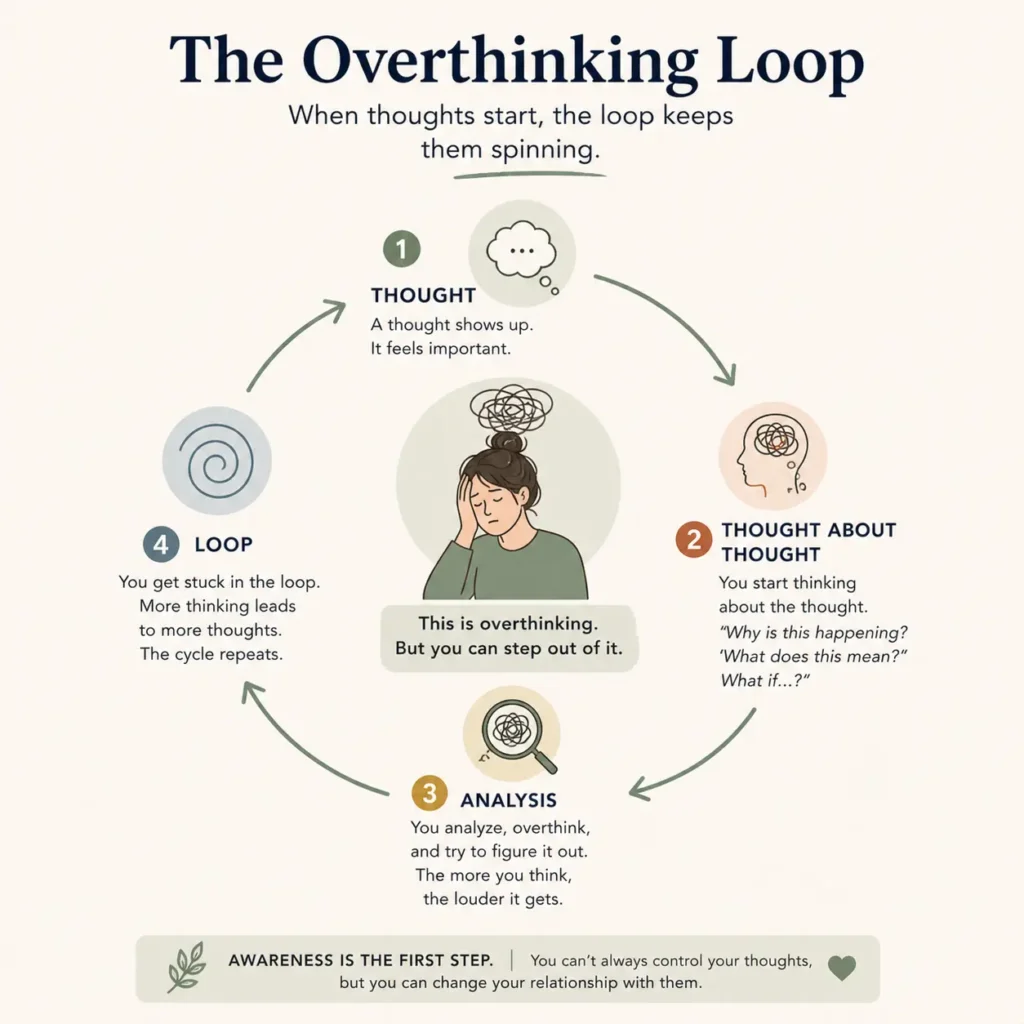
Overthinking is not a personality flaw or a sign that something is wrong with you. It is a highly practised neural habit — and the brain that got good at overthinking can get good at something else.
At the neurological level, overthinking is driven by the default mode network (DMN) — the brain’s default state when it’s not focused on an external task. As the Harvard wandering mind study found, this network is active roughly 47% of waking hours in most people. In chronic overthinkers, it tends to be more active, more persistent, and harder to exit once engaged.
The DMN generates self-referential thought: reviewing the past, anticipating the future, running simulations of social scenarios, rehearsing conversations that haven’t happened. In moderate doses, this is useful. It’s how humans plan, learn from experience, and navigate complex social situations. In excess, it becomes the loop that keeps you awake at 2am.
Much of what the DMN generates operates below conscious awareness — what the subconscious mind guide maps out in full, if you want to understand the deeper pattern driving the loop.
Research by Ethan Kross and colleagues at the University of Michigan’s Emotion and Self-Control Lab has found that rumination — the repetitive, negatively biased self-referential thinking that characterises overthinking — is associated with elevated blood pressure, prolonged stress reactivity, and increased risk of depression. The key word is “prolonged.” Ruminators don’t just feel bad. They stay in the stress state longer after a trigger has passed.
When rumination becomes persistent enough to tip into low mood, the mindfulness for depression guide covers what the evidence actually supports — and is honest about the limits.
Anxiety and perfectionism amplify the pattern further. An anxious mind treats uncertainty as threat, which keeps the monitoring system on high alert. A perfectionist mind adds evaluative pressure on top of that — turning not just problems, but the act of thinking itself, into something to analyse and get right.
For overthinkers whose mental pattern has led to genuine exhaustion and depletion, the mindfulness for burnout guide reframes the practice as permission to stop — not another performance to maintain.
| The Reframe That Changes Everything Here’s what most mindfulness articles won’t tell you: the default mode network that drives your overthinking is the same network behind creativity, imagination, insight, and complex problem-solving. Neuroscientist Scott Barry Kaufman calls it the imagination network. The overthinker’s brain is not broken. It is an active, generative, highly engaged mind that hasn’t yet learned to choose when to switch modes. That’s a trainable skill. And it’s exactly what mindfulness trains. |
Why Standard Mindfulness Advice Backfires for Overthinkers
Most mindfulness instruction was developed for and tested on populations with relatively typical levels of anxiety and rumination. The standard advice — sit quietly, observe your breath, watch your thoughts pass like clouds — works reasonably well for those people.
For overthinkers, it often doesn’t. Here are four specific reasons why, and what each one implies about a better approach.
1. Open awareness gives the DMN more space, not less
When you sit quietly with no specific anchor and try to “just be present,” you’re essentially removing the external task demands that normally suppress the default mode network. For a calm mind, this creates space for stillness. For an overactive DMN, it creates space for the loop to run.
Open awareness is actually an advanced practice. It requires enough baseline stability in your attention system to sit with the openness without being swept into thought. Most overthinkers don’t have that stability yet — not because they’re doing it wrong, but because they haven’t built it yet.
The implication: overthinkers need structured anchors, not open space. Breath counting, body scan, physical sensation — anything that gives the analytical mind a specific, concrete job to do.
2. “Just observe your thoughts” triggers meta-thinking
Meta-thinking is thinking about thinking. It’s the voice that appears mid-meditation saying: “Am I observing correctly? Is this how observing is supposed to feel? I think I’m observing but it feels like I’m still thinking. Why am I thinking about observing? Should I be observing the thought about observing?”
For overthinkers, the instruction to “observe” without more specific guidance can inadvertently trigger this layer. Instead of watching thoughts from a distance, they analyse the watching process itself. The result is a recursive loop that can feel worse than ordinary mind-wandering.
The implication: give the overthinker a specific, concrete action rather than an abstract stance. “Count your breath” is a concrete action. “Observe your thoughts” is an abstract stance that leaves too much room for the analytical mind to find a new problem.
3. The pressure to do it right activates perfectionism
Perfectionism is one of the most common drivers of overthinking. It’s the tendency to treat performance and correctness as conditions for being okay. And meditation, as it’s typically taught, is full of implicit performance metrics: how long you sat, how calm you felt, how few thoughts you had.
For a perfectionist, this framing turns meditation into another arena for evaluation — and another way to fall short. The frustration of “failing” at meditation is not just a minor annoyance. For overthinkers who already struggle to relax even when nothing is wrong, adding a layer of self-judgment to the practice can make it actively counterproductive.
The guide to mindfulness for self-compassion addresses this directly — it’s written for overthinkers who observe their thoughts clearly but then use that clarity as another source of self-criticism.
The implication: reframe the session completely. A session is not good or bad based on how calm it felt. It is a good session if you sat for the time you intended and kept returning when you wandered. That’s the only metric that matters.
4. Long, unstructured sessions overwhelm an anxious nervous system
A 20 or 30-minute meditation session is a significant ask for a nervous system that’s already running hot. For overthinkers with underlying anxiety, long sessions can increase cortisol rather than decrease it — particularly in the early weeks before any baseline regulation has been established.
This is why many overthinkers try a guided app, sit for 20 minutes, feel worse than when they started, and conclude that meditation isn’t for them. It isn’t that meditation doesn’t work for them. It’s that the dose was too high for where they were starting. The signs of overstimulation are often the same signs that appear after a too-long meditation session gone wrong.
The implication: start with 3 to 5 minutes. Multiple short sessions throughout the day will do more good than one long session that leaves the nervous system more agitated than settled.
The 3 Adjustments That Make Mindfulness Work for Overthinkers
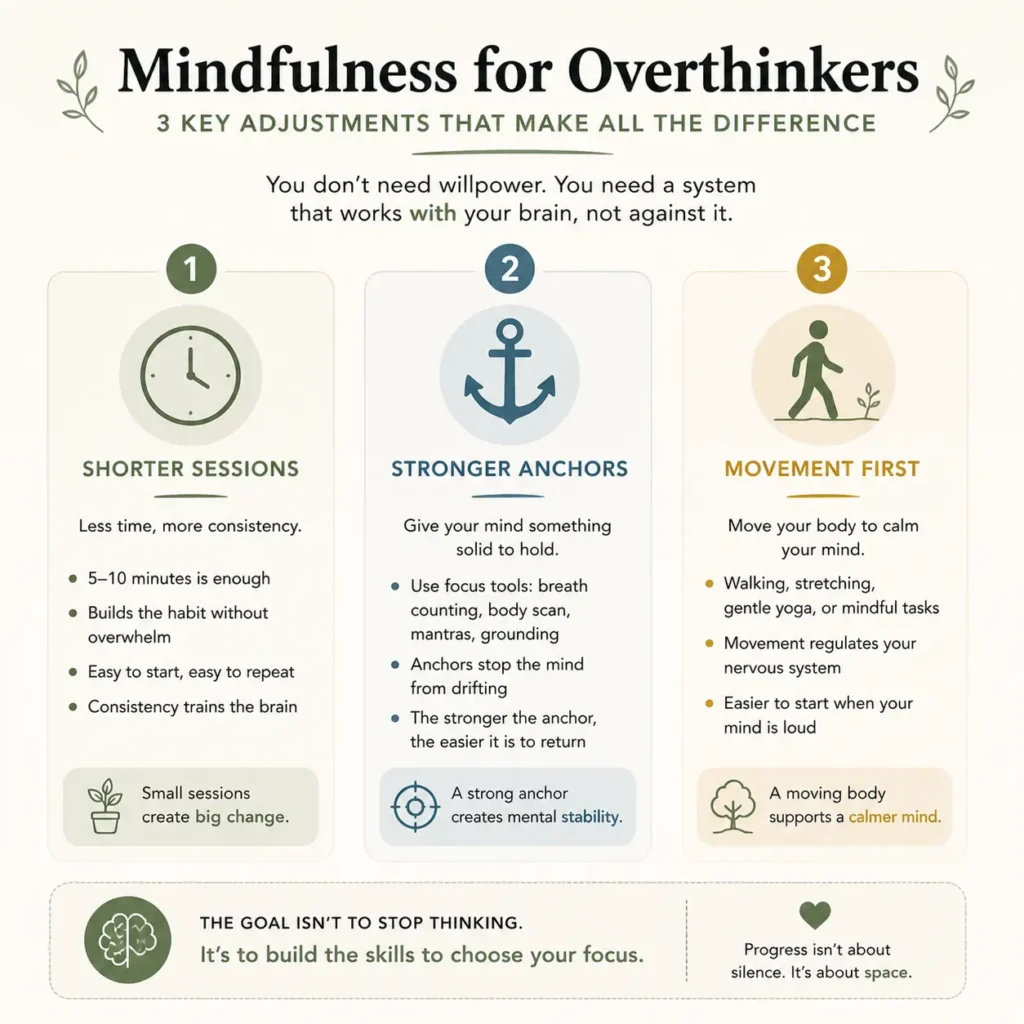
These are not different practices. They are a different approach to the same practices — calibrated for how an overthinker’s brain actually works.
Adjustment 1: Shorter sessions, more frequently
The goal in early practice is not depth. It’s frequency. A 3-minute practice done four times throughout the day does more for an anxious nervous system than a 20-minute session once.
Short sessions work with the overthinker’s natural attention span rather than against it. They create multiple small anchor points in the day — moments of reset before the loop has time to build to full momentum. Over weeks, these micro-practices accumulate into meaningful change.
Practically: set a timer for 3 to 5 minutes. Do it at a consistent trigger point — before your first coffee, before a meal, before opening your phone after work. Start there. Extend only once that feels genuinely manageable, not forced.
Adjustment 2: Strong anchors over open awareness
An anchor is any specific, concrete focus for attention. The breath is the most common, but the key is specificity. Not “focus on your breathing” but “count each exhale from 1 to 10.” Not “be present” but “notice the weight of your hands in your lap.”
Strong anchors work for overthinkers because they give the analytical mind a task. The part of the brain that wants to chew on something gets something specific and neutral to chew on. This is not a workaround or a lesser version of practice. It’s the correct starting point for a mind that needs structure before it can access openness.
The techniques in the next section are all anchor-based for this reason. Once you have 6 to 8 weeks of consistent anchor-based practice, open awareness will feel more accessible — not because you’ve fixed your brain, but because the foundational stability has been built. The full range of mindfulness techniques includes both anchored and open approaches, worth returning to once the foundations are in place.
For informal practices that build the same attentional habit throughout the day — without requiring a dedicated session — the 34 mindfulness activities list is worth bookmarking alongside the techniques guide.
Adjustment 3: Movement as an entry point
For many overthinkers, particularly those with anxiety or high physical restlessness, sitting still is itself a source of tension. The instruction to be still activates the nervous system rather than settling it.
Movement-based practices resolve this by providing an automatic physical anchor — one the body holds without the mind having to work for it. Walking meditation mindful movement, even mindful stretching all qualify. The attention rests on physical sensation rather than being asked to generate its own structure from nothing.
This is not a lesser form of practice. Many experienced meditators maintain movement-based practices as a primary form throughout their lives, not just as a beginner’s entry point. If sitting never feels right, meditation alternatives explores the full range of non-seated approaches.
The 5 Best Mindfulness Techniques for Overthinkers
Each technique below is chosen specifically because it works with the overthinker’s brain rather than against it. Each has a strong anchor, a concrete structure, and a built-in response to the most common failure mode.
Technique 1: Breath Counting with the Restart Rule
Why it works for overthinkers: it gives the analytical mind a specific numerical task, and the restart rule removes perfectionism from the equation entirely.
- Sit comfortably with eyes closed or gaze softened toward the floor.
- Breathe naturally. On each exhale, count silently: 1, 2, 3… up to 10.
- When you reach 10, start again at 1.
- The Restart Rule: if you lose count, find yourself at 14 or 23, or realise your mind went somewhere entirely — start again at 1. No frustration. No commentary. Just 1.
- Continue for 5 minutes.
The restart rule is the key detail. It converts the inevitable loss of count from a failure into a neutral instruction. Overthinkers tend to add self-judgment to every mistake. The restart rule structurally prevents that by making the mistake the practice, not a problem.
For a deeper exploration of breath as a mindfulness anchor, the breath meditation guide and the mindful breathing guide both extend this practice significantly.
Technique 2: 5-4-3-2-1 Grounding
Why it works for overthinkers: it interrupts the thought loop from the outside in, using sensory data to override the internally-generated narrative. Particularly effective mid-spiral when the loop has already built momentum.
- Take one slow breath. Let it out fully.
- Notice 5 things you can see. Name them mentally without evaluating: ceiling, plant, window, hand, shadow.
- Notice 4 things you can physically feel: the chair beneath you, the temperature of the air, the weight of your feet.
- Notice 3 things you can hear. Background sounds you weren’t actively registering.
- Notice 2 things you can smell, or 2 additional things you can see if smell isn’t available.
- Notice 1 thing you can taste.
This technique works in under two minutes and can be done anywhere — at a desk, in a waiting room, in a car. It doesn’t require closing your eyes. The sensory anchoring engages the present-moment perceptual system, which competes directly with the narrative-generating system that runs thought loops.
The 35 grounding techniques guide has a full library of sensory and body-based anchors — worth exploring once you’ve used this one enough to know it works for you.
Technique 3: The 5-Minute Body Scan
Why body scan meditation works for overthinkers: it shifts attention from the head to the body, which is an almost direct anatomical interrupt for ruminative thinking. The physical orientation is the opposite of where overthinking lives.
- Lie down or sit comfortably. Close your eyes.
- Take three slow breaths to settle.
- Bring your attention to the soles of your feet. Notice any sensation — warmth, pressure, tingling, numbness. You’re not trying to relax the area. Just notice what’s there.
- Slowly move attention upward: ankles, calves, knees, thighs. Spend 15 to 20 seconds on each area.
- Continue up through the torso, hands, arms, shoulders, neck, face. When your mind wanders — and it will — notice it gently and return to wherever you left off in the body.
- Finish at the top of the head. Take one slow breath.
The 5-minute version covers the full body at a brisk pace. The point is not to reach any particular state. It’s to practise directing attention deliberately and returning it when it wanders — all while using the body as a non-conceptual anchor that the thinking mind can’t easily colonise.
For sleep-related overthinking — the 2am spiral variety — the mindfulness for sleep guide uses a longer body scan as its primary technique and is worth reading alongside this.
Technique 4: Mindful Walking
Why it works for overthinkers: movement provides an automatic physical anchor that doesn’t require the mind to generate structure. The body does the anchoring work, leaving attention free to practise presence without having to hold everything up.
- Find a space where you can walk slowly for 10 to 20 steps — a hallway, a garden, a quiet room.
- Begin walking at roughly half your normal speed.
- Direct your full attention to the physical sensations of movement: the lifting of the heel, the shift of weight, the placement of the foot, the gentle swing of the arms.
- You can add a silent label if it helps anchor attention: “lifting, moving, placing” in rhythm with your steps.
- When your mind pulls to a thought — a worry, a plan, a replay — notice it, and return to the sensation of the foot making contact with the ground.
- Continue for 5 to 10 minutes.
The ground contact is the anchor. It is always available, always present, and always specific enough to hold attention. Many overthinkers find this the most accessible technique of all — the body’s movement feels natural in a way that sitting still doesn’t, and progress feels more tangible.
The walking meditation guide is the most accessible structured version — it can be done in a hallway, takes 10 minutes, and gives the restless mind a concrete anchor.
Technique 5: The Labelling Technique
Why it works for overthinkers: it creates observer distance without requiring you to stop thinking. Instead of trying to suppress thoughts — which makes them louder — you name them. The naming shifts your relationship to the thought from “inside it” to “noticing it.”
- Sit comfortably. Close your eyes. Take a few natural breaths.
- As thoughts arise, give each one a brief, neutral label. Not the content of the thought — the category. “Planning.” “Worrying.” “Remembering.” “Judging.” “Analysing.”
- After labelling, return to the breath. When the next thought appears, label it and return again.
- If you notice yourself labelling the labelling — “I’m thinking about thinking” — label that too: “meta-thinking.” Then return.
- Continue for 5 to 10 minutes.
The labelling technique is particularly well-suited to overthinkers because it works with the mind’s analytical tendency rather than against it. The mind wants to classify and categorise. This technique gives it exactly that job — but at the category level, which prevents deep engagement with any individual thought’s content.
This technique is directly related to Ethan Kross’s self-distancing research — creating psychological distance from your own thought processes reduces their emotional intensity and duration. It’s also what the Greater Good Science Center describes as one of the most effective tools for managing intrusive and ruminative thoughts.
For overthinkers whose inner voice is particularly harsh, loving-kindness meditation trains the emotional orientation that mindfulness alone doesn’t address — directing warmth toward yourself rather than just observing the criticism.
How to Handle the “I Can’t Stop Thinking” Moment
This is the most universal overthinker experience during meditation, and the one that most frequently leads to quitting. You sit down. Within thirty seconds your mind is running. You try to bring it back. It runs again. You try harder. It runs faster. After a few minutes of this, you give up and conclude you’re unfixable.
Here’s what’s actually happening — and why the response most people try makes it worse.
The white bear problem: why trying not to think backfires
In 1987, psychologist Daniel Wegner conducted a now-famous experiment. Participants were told not to think about a white bear. They were asked to verbalise their stream of consciousness and ring a bell every time the white bear came to mind. The result: trying to suppress the thought made it appear more frequently, not less.
Wegner called this ironic process theory. The mechanism: to check whether you’re thinking about something, a part of your mind has to bring that thing to mind. So the suppression system and the monitoring system are working against each other — and the monitoring system, being automatic, tends to win.
For overthinkers during meditation: trying not to think, trying to force thoughts to stop, fighting with the content of thoughts, or getting frustrated with the volume of mental activity all activate exactly this mechanism. The harder you push against the thoughts, the more they push back.
The two-step response that actually works
Step one: name it. When you notice your mind has gone into a thought loop, don’t fight it. Just note it — “wandering,” “planning,” “worrying” — with the same tone you’d use to note that it’s raining outside. Factual. Neutral. No drama.
Step two: return. Not with relief that you caught it, not with frustration that it happened, not with a plan to prevent it next time. Just return to the anchor — the breath count, the foot on the floor, the body sensation. That’s it.
The name-and-return sequence is the entire practice. Every time you complete it, regardless of how chaotic the session felt, you have done the work. The thoughts during meditation are not interruptions. They are the weights you’re lifting.
| Reframing the Session A meditation session with fifty wandering thoughts and fifty returns is not a bad session. It is fifty reps. The session where your mind wandered once and you sat in a pleasant fog for twenty minutes is the worse session — because the fog involved no actual returning. Chaos is not the enemy. Autopilot is. |
The Meta-Thinking Trap (And How to Get Out of It)
This section exists because no general mindfulness guide covers it — and for overthinkers, it’s often the central problem.
Meta-thinking is thinking about thinking. It’s the layer that appears mid-meditation — not the original thought loop, but the analytical commentary on it. “I’m thinking too much. I’m supposed to be observing but I’m analysing. I’m analysing my analysing. I wonder if this means my anxiety is getting worse. I should probably research this later.”
For overthinkers, meta-thinking is the specific failure mode of meditation. It’s what happens when the brain’s analytical tendency gets applied to the meditation process itself. The mind that is very good at examining problems turns its full attention to the problem of its own thinking — and gets stuck in a recursive loop that can feel like drowning.
How to recognise it
Meta-thinking has a particular quality: it feels urgent and important. The thoughts feel like genuine insights about your psychology, your meditation practice, or your mental health. They feel like they deserve attention. This is what makes them sticky.
The tell: if you’ve gone from meditating to thinking about meditating, you’re in it. If the content of your thoughts has shifted from ordinary life content (the meeting, the shopping list) to thoughts about thoughts, the practice, or your performance — that’s the trap.
The one-word exit
When you notice you’re in the meta-thinking loop, the exit is a single word: “noticing.”
Not “I notice I’m meta-thinking and I should probably do something about that.” Just: “noticing.” Said internally, once, in the same neutral tone as a breath count label. Then return to the anchor.
The word “noticing” works because it is accurate — you are noticing — and because it doesn’t require engagement with the content of what you’re noticing. It names the act without feeding the loop. This is the same mechanism as the labelling technique, applied specifically to the meta-layer.
For overthinkers who find their journals filling up with analysis of their own thought patterns, mindfulness journaling can be a useful companion practice — it gives the analytical tendency a legitimate outlet outside of meditation, which reduces the pressure to process everything internally during sessions. The journaling for mental clarity guide covers this specifically.
Building Consistency When Your Brain Talks You Out of Everything
Overthinkers have a specific relationship with habit-building that makes it harder than it needs to be. They research the habit thoroughly. They design an elaborate system. They identify all the reasons it might not work. They plan for contingencies. And then, frequently, they don’t start — or they start, hit the first obstacle, and spiral into analysis about whether the whole approach is right.
The antidote is to make the decision as small as possible, as often as possible, for as long as it takes to stop requiring a decision at all.
The two-minute rule
Commit to two minutes. Not five, not ten — two. Two minutes is so small it’s almost impossible to argue yourself out of. It takes less time than making a coffee. It requires no setup, no special conditions, no particular mood.
The two-minute session counts. It is a real practice. The goal in the first two weeks is not quality — it’s the simple mechanical fact of having sat down and directed attention somewhere, every day. Duration follows consistency. Consistency never follows duration.
Habit stacking
Attach the practice to something you already do automatically: before your first coffee, after brushing your teeth in the morning, immediately after sitting at your desk. The structure “after X, I do Y” removes the need to decide each day. For overthinkers — who can spend significant mental energy on the decision to do something they’ve already decided to do — removing the decision point is not a minor detail. It’s the whole strategy. The daily meditation routine post covers exactly how to build this structure in a way that holds.
The “good enough” session
Perfectionism will tell you that a session where you felt distracted, frustrated, or mentally scattered didn’t count. It did. A session where you sat for your intended time and kept returning — even if “returning” happened forty-seven times in five minutes — is a complete session.
The 9 common meditation challenges guide has a specific section on perfectionism and meditation that’s worth reading before it becomes the reason you stop. And if you hit a wall and meditation starts feeling genuinely impossible rather than just hard, what to do when meditation feels hard has specific alternatives for exactly that moment.
What to do when you skip
You will skip. Everyone does. The rule is simple: don’t miss two days in a row. One missed day is a skip. Two missed days is the start of a gap. The difference matters because the brain’s pattern-recognition system uses consistency to consolidate habit — and overthinkers’ brains are especially good at finding evidence that “it didn’t work” after a break.
When you come back after a skip, don’t extend the session to compensate. Just do the usual two to five minutes. The return is the practice.
What Progress Actually Looks Like for Overthinkers
This is possibly the most important section in this guide, because misunderstanding what progress looks like is the primary reason overthinkers conclude mindfulness “isn’t working” and stop.
Progress for overthinkers does not look like: fewer thoughts, a quieter mind, being able to sit without distraction, feeling calm during sessions, or reaching a point where the loop stops.
Progress looks like this:
- You notice you’re in a thought loop — and you catch it eight minutes in instead of forty-five.
- A worry thought appears. For a brief moment, you observe it rather than being completely inside it. The moment passes, but it was there.
- Someone says something frustrating. You feel the reaction — and there’s a half-second pause before you respond. The response is slightly different.
- You’re spiralling at 2am. You remember the breath count. You try it. The spiral slows, or it doesn’t — but you reached for something instead of just lying there.
- You notice you’ve been tense for three hours. You didn’t notice it building. But you notice it now. That’s new.
- The recovery time after a difficult conversation gets slightly shorter. Not the reaction — the recovery.
None of these are dramatic. All of them are real. The metaphor that helps most overthinkers: you are not trying to stop the storm. You are learning to be the person watching the storm rather than the person inside it. The storm doesn’t have to stop for that to be progress.
The distinction between being in a thought and noticing a thought — the observer position — is what the self-distancing research points to as the key shift that reduces rumination’s emotional intensity and duration. You don’t have to stop thinking to stop suffering from your thinking. You have to move from inside the thought to beside it. Mindfulness is how you practise that move.
Frequently Asked Questions
I’ve tried mindfulness and it made my anxiety worse. Is that normal?
For some overthinkers, particularly in the first week or two, mindfulness initially increases awareness of how much mental noise is present — which can feel like things getting worse before they get better. This is relatively common and usually resolves with continued practice. If anxiety consistently worsens after weeks of regular practice, try shorter sessions, a more structured anchor, or a movement-based approach. If it continues to worsen, speak with a therapist before continuing — some people with significant trauma or anxiety disorders need guided support rather than self-directed practice.
Why does my mind get louder when I try to meditate?
Two reasons. First, you’re not used to noticing the volume — it was always that loud, but you were distracted. The stillness reveals what was already there. Second, for the overthinker, removing external task demands (work, screen, conversation) activates the default mode network more strongly. Both are normal. The response is not to fight the loudness, but to anchor more specifically — breath counting, body scan — so the analytical mind has something concrete to do.
How do I stop analysing my meditation sessions?
You probably can’t stop completely — and that’s okay. Some reflection on practice is useful. The problem is when post-session analysis becomes another loop. Try keeping it to one simple question after each session: did I sit for my intended time and keep returning? If yes, it was a good session. That’s the only question that matters in the first few months. Everything else is optional data, not a verdict.
Is it okay to meditate with background noise or music?
Yes, with one caveat. Neutral background sound — ambient noise, soft instrumental music, rain sounds — can actually help overthinkers by providing a mild external anchor that reduces the stark silence in which the mind tends to amplify. What doesn’t help is anything with lyrics or strong melodic hooks that the analytical mind can follow and engage with. White noise, brown noise, or gentle nature sounds tend to work better than music with narrative content.
What if I don’t have time for a full session?
Two minutes is a full session at the start. One breath, taken intentionally before a difficult meeting, is a mindful moment. Three deliberate breaths at a red light counts. The formal practice builds the capacity; the informal micro-moments are how that capacity gets used throughout the day. Both matter. You don’t need a timer or a quiet room to practise mindfulness — you need the intention.
Should I use an app or not?
Apps can help or hurt depending on the person. Many overthinkers find that the gamified streak systems and performance metrics in popular apps trigger exactly the perfectionism that makes meditation harder. If an app is adding pressure rather than support, drop it and use a simple timer instead. Self-directed practice — a timer, a technique, no commentary — is often cleaner for overthinkers than being guided through every session. If guided practice is helpful, look for teachers who emphasise the returning rather than the stillness. The how to meditate properly guide covers self-directed practice in depth.
When will I stop overthinking?
Mindfulness will not stop you from overthinking. It will change your relationship to it. The thoughts will still come. The loops will still form, sometimes. What changes — gradually, over months, not days — is how quickly you notice, how cleanly you step back, and how long you stay inside the loop before you find the exit. That’s not a small change. Over a year, it compounds into something that genuinely transforms how you experience your own mind.
The Bottom Line
Your brain isn’t broken. It’s just well-practised at thinking.
The default mode network that drives your overthinking is the same network behind your creativity, your ability to plan, your capacity to imagine and empathise and connect. It’s not the enemy. It’s an asset that hasn’t yet learned to stand down when it’s not needed.
Mindfulness for overthinkers is not about silencing that network. It’s about building the other thing — the capacity to notice when it’s running, to step beside it rather than inside it, and to choose what to follow. That capacity is trained. It doesn’t arrive. It accumulates, two minutes at a time, until one day you catch yourself noticing a thought loop you would previously have been lost inside for an hour.
Start with breath counting. Set a timer for three minutes. Use the restart rule. That’s everything you need to begin.
If you want to understand the broader foundations of what you’re building, the What Is Mindfulness guide and the What Is Meditation guide are the natural companions to this one. And for the days when the practice feels hard rather than just uncomfortable, how to practise mindfulness in daily life has the informal approaches that keep the thread alive between formal sessions.


