

You’ve probably tried this before.
You set an intention — maybe wrote it in a journal, said it out loud, or even made a vision board. And then, almost immediately, the doubts arrived. Is this real? Am I doing it wrong? Why hasn’t anything changed?
If your mind went there within minutes of starting, that’s not a character flaw. It’s what a certain kind of mind does. And the reason standard manifestation advice hasn’t worked for you might have nothing to do with your beliefs, your effort, or your deserving.
It might simply be that the instructions weren’t designed for your brain.
The Law of Attraction, as it’s usually taught, assumes a calm, focused, emotionally settled baseline. For chronic overthinkers — people whose minds race, loop, and dissect everything in real time — that assumption skips over most of the actual work.
This article doesn’t skip it. What follows is a grounded, honest guide to how the Law of Attraction actually works, why the overthinking mind specifically struggles with manifestation, and what to do instead — starting today, with the mind you already have.
| What you’ll find in this article: |
|---|
| • A clear, hype-free explanation of what the Law of Attraction actually is • Why overthinking disrupts manifestation — the neuroscience behind it • The role of your nervous system (the piece almost every article skips) • A 4-step framework built specifically for anxious, overthinking minds • Practical techniques you can try even if you’re not sure you believe in any of this yet |
What the Law of Attraction Actually Is — Without the Hype

The Law of Attraction has accumulated a lot of noise — vision boards, scripting rituals, the promise that if you just think hard enough about a new car, one will arrive. Some of that noise contains genuinely useful ideas. A lot of it puts intelligent, sceptical people off before they’ve had a chance to look at the mechanism underneath.
So let’s strip it back.
The core principle — like attracts like — isn’t a mystical claim. Before we go further, it helps to be clear on what manifestation actually means at a practical level. At its simplest, it’s a reasonably accurate description of how sustained attention shapes perception and behaviour. When you’re focused on a problem, your mind finds evidence of that problem everywhere. Shift your focus toward possibility, and you start noticing openings you used to walk straight past.
There’s a neurological term for this: the Reticular Activating System, or RAS.
The RAS is a cluster of neurons in your brainstem that filters the overwhelming flood of sensory information your brain receives every second. It surfaces what your dominant thoughts and emotions have primed it to consider relevant — and quietly discards the rest.
You don’t see the world as it is. You see the world as your attention is trained to find it.
A simple example: the moment you start looking for a new apartment, you suddenly notice rental signs on streets you’ve walked down for years. They were always there. Your RAS just wasn’t flagging them as relevant. That’s the Law of Attraction in neurological terms — and it’s not magic.
Manifestation, properly understood, is about aligning your inner state — your attention, your beliefs, your emotional baseline, and your actions — so that you move toward what you want and recognise opportunities when they appear. It’s something you participate in, not something that happens to you. If you’re looking for a broader overview of manifestation techniques that work, that’s worth exploring alongside this guide.
Why Overthinking Blocks Manifestation (And Why It’s Not Your Fault)

Here is the tension that most manifestation teachers don’t address:
Effective manifesting asks you to hold a clear, emotionally present intention — without obsessively monitoring whether it’s working. For the overthinking mind, that’s roughly equivalent to being told to relax by trying harder.
The problem runs deeper than willpower. Here are the three specific ways overthinking disrupts the process.
1. Rumination trains your brain to look for what’s missing
When we ruminate — replaying old failures, analysing why nothing has changed, rehearsing worst-case scenarios — we are issuing a repeated instruction to the RAS: keep scanning for lack. Keep looking for the problem. This pattern of compulsive thinking has its own momentum, and it runs directly counter to what manifestation requires.
Conscious manifestation asks for sustained, genuine attention toward what you want to create. These two modes of mind cannot operate at full strength simultaneously. Rumination doesn’t just distract from manifestation. It actively works against it.
2. A stressed nervous system physically blocks receptivity
This is the part that almost every article about the Law of Attraction leaves out — and it may be the most important.
Researcher Stephen Porges’ Polyvagal Theory describes how the state of your autonomic nervous system determines your capacity for openness, creativity, and connection. When you’re in a chronic low-grade stress state — which most overthinkers are, by default — your nervous system is operating in a defensive, threat-scanning mode.
Visualisation, gratitude, and emotional alignment all require what Polyvagal Theory calls the ventral vagal state: calm, open, safe. You can’t think your way there. You have to physically arrive there first — through the body, not the mind.
This is why so many people try to manifest from a place of anxiety and feel nothing shift. They’re trying to plant a seed in concrete.
3. Information overload creates paralysis, not clarity
The manifesting world produces enormous amounts of competing advice. Different teachers, different methods, conflicting frameworks — all of it creating a secondary problem: the overthinking mind researches manifestation endlessly and practises it rarely.
This cognitive overload often goes hand in hand with something deeper. Signs of overstimulation — a nervous system already running on too much input — can look a lot like lack of motivation or discipline. But forcing more information into an overstimulated system doesn’t help. It deepens the paralysis.
Underneath the information overload, there’s often something quieter: limiting beliefs operating below the surface. The mind searches for the perfect method partly because it doesn’t quite believe any method will actually work — at least not for someone like you.
| Quick self-check — do any of these feel familiar? |
|---|
| • You set an intention and immediately start monitoring whether it’s working • Affirmations feel hollow, performative, or outright dishonest • You can visualise for maybe thirty seconds before your mind starts picking it apart • You worry that your doubt is sabotaging the process — then spiral about that |
If you recognised yourself in any of those, the problem isn’t your capacity for manifestation. It’s that the standard instructions weren’t written for the way your mind actually operates.
The rest of this article is.
The Foundation Nobody Talks About: Your Nervous System
Most manifestation frameworks start with your thoughts. A more accurate — and more useful — starting point is your body.
Dr. Joe Dispenza, whose research on meditation and neurological change sits at the intersection of neuroscience and contemplative practice, describes it this way: thoughts are electric, emotions are magnetic, and together they generate the field your body projects into its environment. The people who experience the most striking shifts in their outer circumstances are those who learn to sustain a genuinely elevated emotional state from within — regardless of what’s happening around them.
What that means practically: not better thoughts, but a changed body. A nervous system that can hold warmth, openness, and a sense of trust even before anything in your external world has shifted.
This is the work that underlies everything else. And for overthinkers, it’s the work that needs to happen before affirmations, visualisation, or intention-setting can land.
Why the same words produce completely different results
Two people can say the same affirmation — “I am open to abundance” — with entirely different outcomes. One says it from a grounded, relaxed body. The other says it from a clenched jaw, shallow breath, and a mind already running the next worry. The words are identical. The nervous system signal they carry is not.
Your body is not a vessel for your manifestation practice. It is the instrument through which that practice works. Calming your nervous system isn’t preparation — it’s the practice itself. Mindfulness techniques are one of the most accessible ways to begin that calming process, and many of them take less than five minutes.
The 4-Step Manifestation Framework Designed for the Overthinking Mind
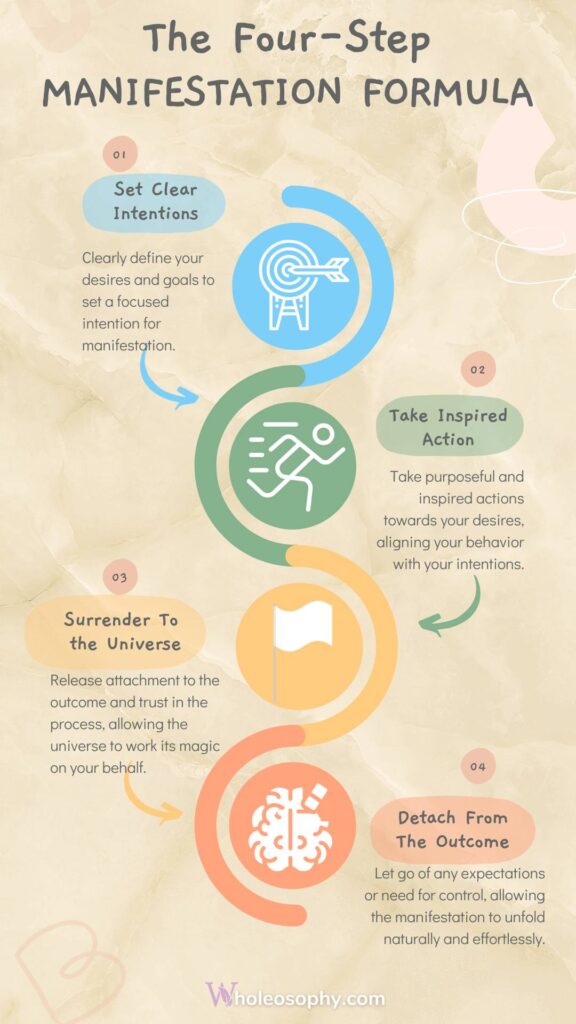
What follows isn’t a standard Law of Attraction how-to. Each step has been specifically adapted for minds that overthink, self-monitor, and spiral under pressure. The goal is to give your analytical mind enough structure to feel safe — then gently move it out of the driver’s seat.
Step 1: Ground First, Intend Second
Most manifestation guides tell you to set your intention first. For the overthinking mind, this gets the sequence backwards.
An intention set from anxiety carries the emotional signature of anxiety. You’re essentially planting the seed in soil that’s been compacted by stress. The words might be positive; the underlying state sends a different message entirely.
Before you set any intention, spend two to three minutes in a simple grounding practice. It doesn’t need to be elaborate or take long.
Try this:
- Sit with both feet flat on the floor. Feel the physical weight of your body.
- Take four slow breaths: inhale for four counts, hold for four, exhale for six.
- Name five things you can physically feel right now — temperature, texture, pressure.
- Consciously drop your shoulders. Soften your jaw.
Two minutes. That’s all. This isn’t meditation — it’s a nervous system reset. From this calmer baseline, the intention you set will carry a qualitatively different quality of energy. If you want to build out a fuller toolkit, there are 35 grounding techniques worth exploring — many of which take no more than a few minutes.
The box-breathing pattern above is also a gateway into breath meditation — a practice that deepens the same settling effect over time.
Step 2: Set One Clear, Emotionally Honest Intention
Specificity matters in intention-setting, but emotional honesty matters more.
The problem with intentions like “I want to manifest a six-figure income” is that for many people, they immediately trigger a counter-response: does that feel true? If the gut-level answer is no, the system stalls before it starts.
That counter-response isn’t random. It’s usually a limiting belief operating beneath the surface — a conviction, often unconscious, that this level of change isn’t really available to you. Working from emotional honesty is one of the most effective ways to sidestep that resistance.
Ask yourself: What do I want to feel? Not have — feel.
The answers are usually quieter and more honest than the external goals: secure, free, at ease, connected, seen.
Set your intention from that place. Compare:
- Instead of: “I am manifesting financial abundance.”
- Try: “I am open to experiencing more ease and security around money.”
The second version isn’t weaker — it’s truer. And when an intention feels true to the nervous system, it doesn’t generate the subconscious resistance that stops most people before they begin. Being more present when you set your intention — rather than thinking three steps ahead — makes a significant difference to how clearly that intention lands.
Step 3: Take One Aligned Action, Then Actually Stop
Manifestation isn’t passive waiting. But it’s also not the relentless forcing and over-engineering that anxious minds tend to default to when they want something badly.
Inspired action — a phrase used throughout Law of Attraction teaching — refers specifically to action that arises from a calm, clear state. It feels purposeful rather than desperate. It moves toward something rather than away from fear.
After setting your intention, identify one small action that moves in the direction of what you want. Not a plan. Not a roadmap. One thing.
Do it. Then genuinely stop.
The stopping is as important as the action. It’s the part that trains your nervous system out of the exhausting habit of white-knuckling outcomes. For overthinkers, acting and then releasing is one of the most difficult and most valuable shifts in this entire process. For a deeper look at putting this into practice around specific goals, this guide to manifesting wealth and success goes further on the action side.
Step 4: Practice Daily Noticing, Not Daily Checking
One of the most quietly destructive habits of the overthinking manifestor is constant outcome-monitoring. The daily check: has anything changed yet? Is it working? Am I doing enough?
This habit keeps your attention anchored in the gap between where you are and where you want to be. It keeps your emotional state locked in the experience of not-yet-having. And from a neuroscience standpoint, it repeatedly trains the RAS to notice absence rather than movement.
Replace the daily check with a daily noticing practice. Each evening, write down one thing from your day that felt even loosely aligned with your intention — however small:
- A conversation that opened an unexpected door
- A moment of genuine ease where you expected friction
- A thought, idea, or opportunity that appeared without forcing
- Simply feeling more like the version of yourself you’re becoming
You’re not collecting evidence that manifestation is working. You’re training your attention. Over time, this practice gradually recalibrates the RAS toward noticing what’s actually moving. Practising mindfulness in daily life builds exactly this kind of attentional awareness — and it doesn’t require any extra time if you integrate it into what you’re already doing.
How to Visualise When Your Mind Won’t Stay Still
Standard visualisation advice goes roughly like this: find a quiet place, close your eyes, and spend fifteen to twenty minutes imagining your ideal life in vivid, cinematic detail.
For the overthinking mind, that instruction produces a very specific experience. About thirty seconds in, the mind wanders. You judge yourself for it. You try to bring it back. It wanders again. Eventually you conclude you’re either bad at visualising or bad at manifesting — and probably both.
The problem isn’t you. The instruction was written for a different kind of mind. It’s the same challenge that comes up when people try to meditate for the first time — and there’s a reason learning how to meditate when you can’t stop thinking deserves its own dedicated guide.
Research by psychologist Gabriele Oettingen, whose work on mental contrasting and motivation has been widely cited in behavioural science, found that extended passive fantasy can actually reduce motivation and follow-through. Brief, emotionally engaged imagery, on the other hand, activates the brain’s goal-pursuit systems in measurable ways.
The variable that matters isn’t how long you visualise. It’s the quality of emotional presence while you do it.
The 90-Second Sensory Flash
Instead of a long visualisation session, choose one specific moment from your desired future. Not a sweeping overview — just one scene. A specific conversation. A particular morning. One moment in one place.
Close your eyes, take two slow breaths, and for ninety seconds, engage all five senses:
- What does the air smell like in this moment?
- What sounds are in the background?
- What does the light feel like on your skin?
- What is your body physically doing — sitting, moving, still?
- What does the inside of your chest feel like right now?
Ninety seconds. Then open your eyes.
This practice works because it bypasses the attentional demands that derail longer sessions, while still generating the felt emotional signal that makes visualisation effective. If you want to pair this with a more structured stillness practice, these beginner meditation techniques cover a range of approaches that work well alongside short visualisation.
Gratitude Isn’t Spiritual Bypassing — It’s a Nervous System Tool
Gratitude is possibly the most over-repeated and least understood piece of advice in the entire manifestation space. Which is unfortunate, because the underlying mechanism is genuinely powerful.
Dr. Robert Emmons, whose gratitude research at UC Davis is among the most cited in positive psychology, has found that consistent gratitude practice measurably reduces cortisol, increases dopamine and serotonin, and shifts attentional bias away from threat-detection toward opportunity-recognition.
Gratitude isn’t about convincing yourself that everything is fine. It’s a direct physiological intervention — one that moves you out of a scarcity-signalling stress state and into a genuinely receptive one. From a manifestation standpoint, that transition is everything.
The common mistake that makes gratitude feel useless
Most people treat gratitude like a box to tick. They write their three things while mentally composing tomorrow’s to-do list. The words appear on the page. The body never registers them. Nothing shifts.
Gratitude only functions as a nervous system tool when it generates a felt sense of warmth — however brief — in the physical body. The quantity is irrelevant. One genuine moment is worth more than ten performed ones.
Here’s a version that works particularly well for the overthinking mind:
Once a day, not as a journaling exercise but as a brief physical pause, bring to mind one thing you genuinely appreciate. It can be small. A good coffee. Five minutes of quiet. A message that arrived at the right moment. Then stay with the feeling of it for thirty seconds, without moving on.
The brain cannot simultaneously process genuine appreciation and anxious rumination. Use this thirty-second practice as an interruption technique whenever the spiral starts up.
If you want to build this into a more consistent habit, gratitude affirmations can serve as a bridge — using language that primes the felt experience of appreciation, rather than just listing items from the day.
How to Let Go Without Giving Up: The Real Meaning of Detachment
Of all the instructions in manifestation teaching, “just let go” is the most important and the most maddening.
Let go of what, exactly? And how do you hold something you genuinely want while simultaneously not clinging to it?
Here’s the psychological explanation that usually gets skipped:
Tightly gripping an outcome keeps the nervous system anchored in its absence. Psychologists call this reactance — the more urgently we need something, the more the brain registers not-having-it as a threat. You end up emotionally rehearsing lack rather than moving through it.
Detachment isn’t indifference. It’s the emotional state of someone who ordered something online and knows it’s on its way. They don’t refresh the tracking every hour. They don’t question whether the order was real. They trust the process and get on with their day. The desire hasn’t disappeared — the white-knuckling has.
This relationship between attachment and manifestation — and exactly how to release it without abandoning your desire — is worth understanding in depth. Attachment and manifestation explores the psychology of this in full, and it’s one of the most practically useful reads you can pair with this article.
How your meditation practice is already teaching you this
If you meditate, you’ve been practising detachment every time you sit down — you just may not have named it that way.
Every time you notice a thought arising, observe it without chasing it, and return your attention to the breath, you are making exactly the same gesture that manifestation calls “letting go.” Mindfulness practice is, structurally, a detachment training. The same capacity that lets you hold a thought without following it is the same capacity that lets you hold a desire without gripping it.
If you’re building this capacity from scratch, this beginner’s guide to mindfulness meditation is one of the most practical starting points. Even five minutes of daily breath-awareness practice makes a meaningful difference over time. The Mindfulness-Based Stress Reduction (MBSR) programme, developed by Jon Kabat-Zinn, has decades of clinical research behind it for those who want to go deeper.
Your Overthinking Mind Is Not the Obstacle — It’s the Starting Point
Here’s something worth sitting with: the sensitivity that makes your mind run in circles is the same quality that makes you deeply curious, genuinely self-aware, and capable of real inner work. Overthinking isn’t a defect you need to eliminate before you can begin. It’s a signal that your mind cares — and caring, redirected, is exactly the fuel this process runs on.
The Law of Attraction, understood clearly and practised honestly, isn’t about bypassing your mind or performing positivity you don’t feel. It’s about creating the inner conditions — a regulated nervous system, an honest intention, aligned action, present attention — that let you move toward what you want with less friction and more ease.
You don’t need a perfectly quiet mind. You don’t need to believe in everything outlined here before you start. You just need to be willing to try one thing, from a slightly calmer place, and notice what changes. That process of settling inward is, in itself, a form of finding inner peace — and it turns out to be where most of the real shifts begin.
Start with one breath. Set one honest intention. Take one small step. Notice one thing.
That’s enough for today.
Frequently Asked Questions
Does the Law of Attraction have any scientific basis, or is it pseudoscience?
The answer depends on which part you’re asking about. The mystical framing — that the universe rearranges itself in response to your thoughts — isn’t something science can confirm or deny. But many of the underlying mechanisms are well-grounded. The Reticular Activating System explains how dominant focus shapes what we perceive. Neuroplasticity shows that sustained patterns of thought literally alter brain structure. Positive psychology research demonstrates that emotional state influences behaviour and outcomes in measurable ways.
Why does manifestation work for some people and not others?
The most consistent variable isn’t technique — it’s emotional state. People who see real shifts tend to set intentions from a calm, grounded place and take aligned action without obsessively checking for results. Chronic overthinkers often keep their attention — and therefore their nervous system — anchored in the emotional experience of not yet having what they want. That’s not a permanent trait. It’s a pattern, and patterns change with consistent practice.
Can you use the Law of Attraction if you have anxiety?
Yes — but the approach needs to be honest about the starting point. Standard manifestation advice assumes a baseline calm that anxiety disrupts. For anxious minds, nervous system regulation isn’t a bonus step — it’s the prerequisite. Simple breathwork, grounding practices, or mindfulness techniques for a quieter mind change everything when applied before any manifesting work. Without this step, visualisation and affirmations are trying to operate in the wrong gear entirely.
How long does manifestation take to work?
Any specific timeframe is a guess dressed up as guidance. What research on mindset change and habit formation does show is that the inner shifts that support manifestation — clearer focus, more aligned action, reduced habitual resistance — begin producing changes in perception and behaviour within weeks of consistent practice. The external results follow at their own pace, and often in ways you didn’t predict. A more useful question than “how long” is: am I starting to notice small things shifting in how I feel, what I’m drawn toward, and what I’m beginning to see?
Why do affirmations feel fake — and what actually works instead?
Affirmations feel fake when the gap between the statement and your current emotional reality is too wide. The brain’s threat-detection system registers the mismatch and generates resistance — which is why “I am abundant and wealthy” can feel worse than saying nothing. A more effective approach is using bridge statements that acknowledge where you are while moving toward where you want to be: “I am open to experiencing more ease around money” or “I am willing to see evidence that things can change.” For a deeper look at whether affirmations actually work — and when they don’t — that’s worth reading alongside this.
What’s the connection between mindfulness meditation and manifestation?
Deeper than most people realise. Mindfulness meditation trains sustained attention — the ability to hold an intention without the mind immediately scattering. It develops emotional regulation — the ability to access genuine positive feeling rather than perform it. And it builds present-moment awareness — noticing aligned opportunities rather than being too caught in mental noise to see them. The benefits of meditation extend well beyond relaxation; many of them directly support the inner conditions that manifestation requires.
Is visualisation strictly necessary for the Law of Attraction to work?
No — and this is worth saying clearly. What matters is the felt emotional signal, not the specific practice that generates it. If traditional visualisation frustrates you more than it grounds you, skip it. Gratitude, journaling, breath-based grounding, and aligned action can all produce the same inner alignment. Struggling with visualisation is also very common in meditation practice — common meditation challenges addresses this directly and offers practical alternatives. The 90-Second Sensory Flash described in this article is a lighter-touch approach that works well for minds that struggle with extended mental imagery.


