

If you’ve tried meditating and found it made the thoughts louder — not quieter — you’re not failing at meditation. You’re using a technique that was designed for a different kind of mind.
Standard meditation instruction was built around a relatively calm baseline. Sit. Watch your breath. Return when the mind wanders. For overthinkers, that’s a bit like being told to relax in the middle of a fire alarm. The instruction isn’t wrong — it’s just not calibrated for how your mind actually works.
Meditation for overthinking exists, and it’s genuinely different. The techniques are more structured, the goals are more specific, and the definition of success looks nothing like what most guides describe. This is that guide.
| Meditation for overthinking is a set of structured attention practices designed for minds with high default-mode network activity — the cognitive pattern that drives compulsive thinking and rumination. Unlike standard breath-focused meditation, these techniques give the busy mind a specific task, reduce meta-rumination, and train the brain to relate differently to thoughts rather than trying to stop them. |
| KEY TAKEAWAYS |
|---|
| Overthinking isn’t a character flaw — it’s a pattern of high default-mode network activity that standard meditation doesn’t address. |
| Trying to “clear your mind” often backfires for overthinkers, producing meta-rumination (thinking about thinking). |
| The goal of meditation for overthinkers isn’t a quiet mind — it’s a different relationship with thoughts. |
| Techniques with more structure (counting, noting, body scan) work better for busy minds than open awareness. |
| Shorter, consistent sessions (5–10 minutes) outperform longer occasional ones for overthinkers. |
| Progress looks like thoughts losing their grip, not thoughts disappearing. |
| Mindfulness for overthinkers and meditation overlap — both retrain how the brain relates to mental noise. |
Why Standard Meditation Backfires for Overthinkers
There’s a structure in your brain called the default mode network — the DMN. It’s active when you’re not focused on a task: daydreaming, planning, reviewing the past, imagining the future. It’s also the network most associated with rumination and overthinking.
For most people, the DMN quiets down when they sit to meditate and try to focus. For overthinkers, research from Harvard’s Killingsworth and Gilbert suggests the mind wanders almost half the time under normal conditions — and a highly active DMN doesn’t simply switch off when you sit down and close your eyes.
The result of telling a high-DMN mind to “just watch your thoughts” is often meta-rumination: thinking about the thinking. You notice a thought, then you have thoughts about why you’re having thoughts, then you have feelings about the thoughts about the thoughts, and so on. Standard meditation instruction doesn’t prevent this. Techniques designed for overthinkers do.
| The problem isn’t that you can’t meditate. It’s that you’ve been trying to do it the way calm people do. |
There’s also a deeper misunderstanding at play. Most people come to meditation wanting to stop overthinking. Judson Brewer’s research at Brown University found that what actually changes with consistent practice isn’t the volume of thoughts — it’s the degree to which those thoughts capture attention and drive behaviour. That’s a fundamentally different goal, and it requires a different approach.
The Real Goal: Not a Quiet Mind
This reframe matters more than any specific technique: the goal of meditation for overthinking is not to stop thinking. That goal is both neurologically unrealistic and counterproductive — trying not to think about something reliably makes you think about it more.
The actual goal is to change your relationship to thought. A thought arises — that’s involuntary and beyond your control. What meditation trains is the gap between the thought arising and you being carried away by it. Over time, thoughts begin to feel less urgent, less like commands and more like passing weather.
This is why overthinkers who’ve been meditating for weeks sometimes say “I’m still thinking just as much” while simultaneously reporting feeling less anxious. They are thinking just as much. The grip of those thoughts has loosened, even if the volume hasn’t.
5 Meditation Techniques That Actually Work for Overthinking
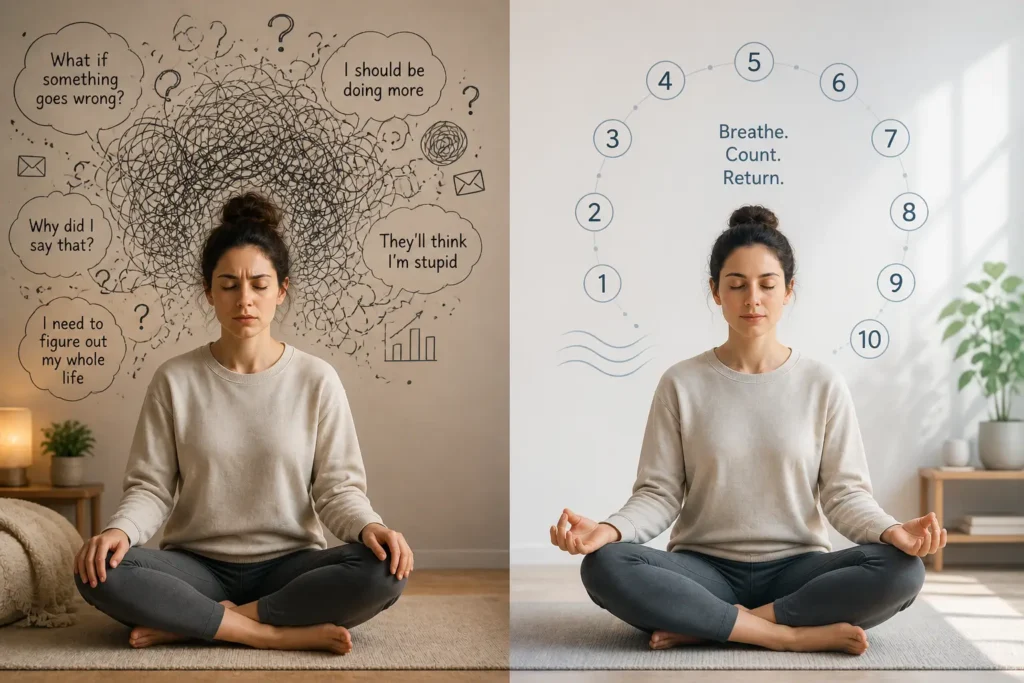
These techniques share a common design principle: they give the overactive mind enough structure to stay anchored, without demanding the impossible (silence). Each one also trains a specific skill that directly addresses overthinking patterns.
1. Counting Meditation
Best for: minds that can’t stay with the breath alone
| 1. Sit comfortably. Close your eyes or lower your gaze. |
| 2. Breathe naturally. Count each exhale: 1, 2, 3… up to 10. Then restart at 1. |
| 3. When you lose count — and you will — simply go back to 1. No judgment. |
| 4. The counting gives your mind a task simple enough to hold but specific enough to notice when you’ve drifted. That noticing is the practice. |
2. Noting Practice
Best for: compulsive thinkers and those who get pulled into thought loops
| 1. Sit and close your eyes. Let your attention rest lightly on the breath. |
| 2. When a thought arises, gently name its category in your mind: ‘planning’, ‘worrying’, ‘memory’, ‘judging’. |
| 3. Name it once, quietly, then return to the breath. Don’t analyse the thought — just label and release. |
| 4. This works because labelling activates the prefrontal cortex and reduces the emotional charge of the thought, creating distance without suppression. |
3. Body Scan Meditation
Best for: overthinkers who live in their heads and disconnect from physical sensation
| 1. Lie down or sit comfortably. Close your eyes. |
| 2. Bring attention slowly through the body from feet to crown: what do you feel in each region? Warmth, tension, tingling, nothing? |
| 3. Move slowly — spend 20–30 seconds on each area. If the mind wanders to a thought, acknowledge it and return to wherever you were in the body. |
| 4. The body is always in the present. Attention to physical sensation is one of the most reliable anchors available to an overactive mind. |
4. Open Monitoring (for intermediate practitioners)
Best for: those who’ve built some meditation baseline and want to work more directly with thoughts
| 1. Sit and close your eyes. Instead of focusing on one anchor, open your awareness to whatever arises. |
| 2. Observe thoughts, sounds, sensations, emotions — without following any of them. Watch them arise and pass. |
| 3. When you get pulled into a thought, notice that you’ve been pulled, and widen your awareness again. |
| 4. This is harder than it sounds — don’t start here. Build with counting or noting first. Once you’ve developed the capacity to notice when you’ve been captured, this technique becomes very powerful. |
5. Mantra or Anchor Word
Best for: minds that need strong redirection and can’t sustain breath focus
| 1. Choose a simple word or short phrase: ‘here’, ‘still’, ‘this moment’, or something personally meaningful. |
| 2. Repeat it silently, in rhythm with your breath. Inhale, then silently say the word on the exhale. |
| 3. When thoughts arise (they will), the repetition gives your mind something to return to that’s more compelling than staying lost in thought. |
| 4. This works partly through repetition overriding the DMN, and partly through giving the verbal mind — which overthinkers heavily rely on — a sanctioned task. |
How Long and How Often: The Overthinker’s Guide
The standard advice is 20 minutes a day. For overthinkers, that recommendation can become a barrier — 20 minutes of struggling with your own mind, unsure if you’re doing it right, is not a sustainable habit.
The research is actually reassuring here. Goyal et al.’s meta-analysis in JAMA found meaningful anxiety and stress reduction with moderate amounts of practice — not intensive retreat-level hours. For overthinkers specifically, consistency matters far more than duration.
5 minutes every day is better than 20 minutes twice a week. 10 minutes most mornings is better than 30 minutes when you feel like it. The brain learns through repetition, not through long uncomfortable sessions.
A morning slot works particularly well for overthinkers — before the day’s cognitive load accumulates and before anticipatory stress has a chance to build. Even five minutes before checking your phone changes the baseline you carry into the rest of the day.
| Five consistent minutes rewires more than twenty frustrated ones. |
What Progress Actually Looks Like
One of the reasons people abandon meditation is that they’re using the wrong metric. If the goal is a quiet mind, you’ll feel like you’re failing for months. If you’re measuring the right things, you’ll notice progress much sooner.
The signs that meditation for overthinking is working are subtle and often only visible in hindsight:
— You catch yourself mid-spiral and can step back where you used to just keep going.
— You recover from a stressful interaction more quickly than you used to.
— You have a thought that used to hijack your attention and notice it passing without following it.
— You fall asleep more easily because you’re not re-running the day.
None of these look like “a quiet mind.” They look like a mind that has a slightly different relationship with its own noise. That’s exactly what this practice is for.
If you’re finding any technique consistently difficult — the mind won’t settle at all, sessions feel like pure struggle — it’s worth reading about the most common meditation challenges before concluding the practice isn’t working. Most obstacles are specific and solvable.
Frequently Asked Questions
Can you meditate if you have really bad overthinking?
Yes — and you may benefit more than someone whose mind is already calm. Overthinking minds have a lot to work with. The techniques here are specifically designed for high-thought-volume minds, and the practice of returning attention repeatedly (which you’ll do more than average) is itself the training. The difficulty is the point.
Why does meditation sometimes make overthinking worse?
This is usually a sign of technique mismatch. Open-awareness instruction — “just watch your thoughts” — can produce meta-rumination in overthinkers. If that’s been your experience, switch to a more structured technique: counting meditation or noting practice. These give the mind a task, which prevents the spiral of thinking-about-thinking.
How long before meditation helps with overthinking?
Most people notice small shifts within 2–3 weeks of consistent daily practice (even 5–10 minutes). These are subtle at first — slightly faster recovery from stress, catching yourself mid-rumination once or twice. Significant changes to long-established overthinking patterns typically take 6–8 weeks of regular practice. Consistency matters far more than session length.
Does mindfulness have the same effect as meditation for overthinking?
They overlap significantly but aren’t identical. Mindfulness is a quality of attention — present, non-judgmental awareness. Meditation is the formal practice that trains that quality. For overthinkers, both matter: the formal seated practice builds the capacity, and informal mindfulness throughout the day (noticing when you’re lost in thought during ordinary activities) extends it.
What if I fall asleep during meditation?
Falling asleep, especially during body scan meditation, usually means your body needed rest and the relaxation gave it permission. It’s not a failure. To stay more alert, try meditating sitting up rather than lying down, keeping your eyes slightly open, or moving to morning rather than evening practice when your mind is fresher.
Can journaling replace meditation for overthinkers?
They serve different functions and work better together than as substitutes. Journaling for anxiety externalises and processes thought — it’s excellent for clearing specific worries or understanding patterns. Meditation trains the capacity to be with experience without reacting to it. Overthinkers often respond strongly to journaling because it gives the verbal, analytical mind a job. That’s valuable. But it doesn’t build the same attentional muscles that meditation does.
The Point Isn’t to Stop Thinking
The goal was never silence. Thoughts will keep arriving — that’s what minds do. What meditation for overthinking actually builds is the gap between a thought appearing and you being swept away by it.
That gap starts small. A fraction of a second. A brief moment of noticing before the spiral starts. Over weeks, that fraction becomes a full breath. Then a choice. Then something that feels, slowly and without drama, like a quieter way of moving through the day.
Start with five minutes. Pick one technique from this guide and stay with it for two weeks before trying another. If you want to understand the broader practice these techniques come from, the complete guide to mindfulness for overthinkers covers the full picture — including why most mindfulness advice backfires for busy minds and what to do instead.
The overthinking doesn’t disappear. It just stops running the show.


