

If you’ve tried meditation with ADHD and found it somewhere between frustrating and impossible, that’s not a personal failing. Standard meditation instruction was designed around a neurotypical baseline — a brain that can sustain focus on a fixed point, return when it wanders, and build from there. That’s not how the ADHD brain is regulated.
ADHD involves genuine differences in how the brain manages attention, impulse control, and dopamine — and those differences don’t disappear when you sit down to meditate. What changes with the right approach is the technique. Mindfulness for ADHD exists, and it looks different from what most guides describe. It’s shorter, more structured, often involves movement, and works with the restless mind rather than against it — much like the adaptations that help overthinkers.
This guide covers what ADHD does to attention, what the research actually says about mindfulness as an intervention, and the five techniques most consistently reported as effective by adults with ADHD.
| Does mindfulness help with ADHD? Research suggests mindfulness can meaningfully support ADHD management — particularly for attention regulation, emotional reactivity, and impulsivity — though it works best alongside other treatments rather than as a replacement for them. The key is using techniques specifically adapted for ADHD brains: shorter sessions, more structure, movement-based practices, and a strong emphasis on self-compassion when attention wanders. Standard open-awareness meditation is often too unstructured for ADHD brains to sustain. |
| KEY TAKEAWAYS |
|---|
| Mindfulness doesn’t cure ADHD — but it trains the one skill ADHD makes hardest: noticing when attention has wandered. |
| Research shows mindfulness reduces ADHD-related inattention, emotional reactivity, and impulsivity — particularly in adults. |
| Standard meditation is often too unstructured for ADHD brains. Shorter, more structured, movement-friendly techniques work better. |
| The most effective ADHD mindfulness practices give the brain a clear task: counting, moving, labelling, scanning the body. |
| Self-compassion is not optional in this practice — ADHD brains will wander more than average, and the return is the work. |
| Mindfulness works best alongside other ADHD supports (medication, therapy, coaching) — not as a substitute for them. |
| Meditation for overthinking shares significant overlap — many of the same adapted techniques apply to both. |
What ADHD Actually Does to Attention
ADHD is often described as a deficit of attention, but that’s not quite accurate. People with ADHD can sustain intense focus on things that are novel, urgent, or intrinsically interesting — sometimes for hours. What’s impaired is the voluntary regulation of attention: the ability to direct and sustain focus on demand, particularly on tasks that aren’t inherently stimulating.
The neurological picture involves differences in dopamine and norepinephrine function, which affect the brain’s reward and motivation systems, and dysregulation of the default mode network — the brain network associated with mind-wandering and self-referential thought. Research on ADHD and the DMN shows that in ADHD, the DMN is often active at times when it should be suppressed — including during tasks that require focused attention. This is the neurological basis of the ADHD experience of the mind wandering constantly, even when you’re trying hard to stay focused.
This overlaps significantly with the overthinking pattern — which is why the techniques developed for overthinkers often work well for ADHD too. Both involve a hyperactive DMN. Both benefit from more structure, not less.
| ADHD isn’t a broken attention system. It’s an attention system that runs on different fuel. |
What the Research Actually Says
The most cited study in this space is Zylowska et al.’s 2008 pilot study at UCLA, which found that an 8-week mindfulness training programme adapted for ADHD produced significant improvements in self-reported ADHD symptoms, attention, and mood in both adolescents and adults. Subsequent research has broadly supported these findings, with particular benefits in attention regulation, emotional reactivity, and impulsivity.
The honest summary: mindfulness is a meaningful support tool for ADHD, not a cure. It doesn’t address the dopamine dysregulation that underlies ADHD at a neurological level — that’s what medication does. What mindfulness does is build metacognitive awareness: the capacity to notice where your attention is, catch yourself mid-drift, and return. For ADHD brains, that skill is both genuinely harder to build and genuinely more valuable once built.
| Mindfulness and medication Mindfulness works best as a complement to other ADHD treatments, not a replacement. If you’re on medication that works well for you, mindfulness can extend and deepen its effects. If you’re not medicated and considering it, mindfulness doesn’t substitute for that conversation with a doctor. Both can be true at once. |
Why Standard Meditation Is Hard with ADHD (And What to Do Instead)
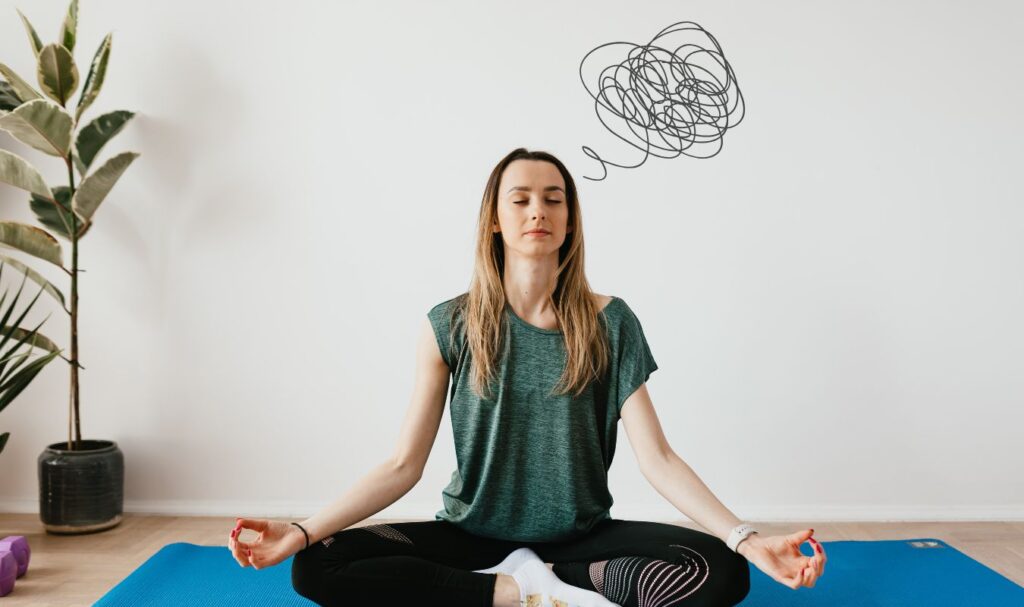
Most beginner meditation instruction asks you to sit still, focus on the breath, and return when you wander. For ADHD brains, this creates several specific problems.
Boredom activates avoidance
The ADHD brain is particularly sensitive to low-stimulation environments. Sitting quietly with no external input is experienced not as peace but as deprivation — the dopamine system signals urgency to find something more interesting. This isn’t weakness. It’s neurology.
Working memory drops mid-session
ADHD impairs working memory — which means by the time you’ve been sitting for five minutes, you may have genuinely forgotten what you were trying to do. Not lost focus. Forgotten the task. Instructions need to be simple, repeated, and short enough to hold.
Long sessions feel punishing
A 20-minute guided meditation asks an ADHD brain to sustain a low-stimulation activity for a duration that exceeds its natural attention span. The result is usually a session that becomes progressively more distressing rather than more relaxing. Shorter is better. Two minutes done well is more valuable than twenty minutes of struggle.
The adaptations that work: sessions of 3–10 minutes, techniques with more structure and a moving target, practices that incorporate physical sensation or movement, and — critically — removing the judgment about how many times the mind wanders. An ADHD brain will wander more than average. Each return is still the practice. See also: the most common meditation challenges and how to work through them.
5 Mindfulness Techniques That Work for ADHD Brains
These techniques share a design principle: they give the brain enough structure to stay anchored, enough stimulation to remain engaged, and enough flexibility to accommodate a mind that moves fast. Start with whichever feels least daunting.
1. Counting Meditation (3–5 minutes)
Best for: the most accessible starting point for ADHD brains
| 1. Sit or lie comfortably. Close your eyes or lower your gaze. |
| 2. Breathe naturally. Count each exhale from 1 to 10, then restart. |
| 3. When you lose count — and you will, repeatedly — go back to 1 without judgment. |
| 4. The counting gives the verbal mind a job. The restarting removes the failure mode. You can’t do this wrong. |
2. Mindful Walking (5–10 minutes)
Best for: ADHD brains that need movement to sustain attention
| 1. Walk at a slow, deliberate pace — indoors or outside, without headphones. |
| 2. Anchor attention to physical sensation: the feeling of each foot making contact with the ground, the movement of your arms, the temperature of the air. |
| 3. When the mind wanders (it will), notice it without frustration and return to the physical sensations of walking. |
| 4. This is one of the most reliably effective practices for ADHD because it gives the body something to do while training attention. It’s the same principle as the 10-minute walk for mental clarity — but done with deliberate sensory attention rather than just movement. |
3. The STOP Technique (60 seconds)
Best for: mid-day resets and catching the spiral before it starts
| 1. S — Stop whatever you’re doing for one moment. |
| 2. T — Take one slow breath. Inhale through the nose, exhale slowly through the mouth. |
| 3. O — Observe. What are you thinking? What are you feeling in your body? What’s happening around you? |
| 4. P — Proceed with awareness. Return to what you were doing, or make a deliberate choice about what to do next. |
4. Short Body Scan (5 minutes)
Best for: building body awareness and reducing physical restlessness
| 1. Sit or lie down. Close your eyes. |
| 2. Bring attention quickly through the body in three sweeps: legs and feet, torso and arms, neck and head. Spend about 90 seconds on each. |
| 3. Notice sensation without trying to change it. Tingling, tension, warmth, nothing — all fine. |
| 4. The moving structure of the body scan makes it more ADHD-friendly than static breath focus. There’s always a next region to move to — which reduces the boredom that derails longer static practices. |
5. Noting Practice (5 minutes)
Best for: ADHD brains that hyperfocus on thoughts and struggle to let them go
| 1. Sit comfortably. Rest attention lightly on the breath. |
| 2. When a thought arises, silently name its type: ‘planning’, ‘worrying’, ‘remembering’, ‘judging’. |
| 3. Name it once, then return to the breath. Don’t follow the thought — just label and release. |
| 4. For ADHD brains that get completely absorbed in a thought before noticing, the label creates a brief pause between the thought appearing and being pulled into it. That pause is the skill being trained. |
How to Build a Mindfulness Practice That Actually Sticks
Habit formation is harder with ADHD. The standard advice — ‘just practice at the same time every day’ — underestimates how much executive function that requires. These approaches reduce the friction.
Stack it onto something that already happens
Attach the practice to an existing habit: right after brushing your teeth, immediately before your first coffee, as part of a morning routine that’s already established. The existing habit acts as the trigger. You don’t have to remember to do it — the trigger does the remembering.
Start absurdly small
Two minutes. Not five, not ten — two. An amount so small it’s impossible to argue yourself out of. ADHD brains are particularly prone to all-or-nothing thinking about habits: if you miss a day, the streak is broken and the habit feels failed. Keeping the bar low removes that failure mode and makes resuming after a missed day feel easy rather than defeating.
Remove every possible obstacle in advance
Decide the technique in advance so you’re not making a decision in the moment. Set a timer so you don’t need to track time. Have a specific spot if you’re doing a seated practice. The more decisions removed from the moment of starting, the more likely starting actually happens.
Treat every return as a success, not a recovery
This is the most important reframe for ADHD practitioners. Missing a day (or a week, or a month) is not failure — it’s the ADHD brain doing what ADHD brains do. The return is always available. There is no streak to protect, no progress to lose. Every session is complete in itself.
Frequently Asked Questions
Can mindfulness replace ADHD medication?
No — and this is worth being direct about. Medication addresses the neurological basis of ADHD by modulating dopamine and norepinephrine function. Mindfulness builds metacognitive skills — awareness of attention, emotional regulation, impulsivity. These are complementary interventions, not interchangeable ones. Many people find that mindfulness extends and deepens the benefits of medication. But choosing mindfulness instead of medication (or instead of evaluating whether medication might help) isn’t a recommendation this guide makes.
How long should mindfulness sessions be for ADHD?
Start with 2–5 minutes. This isn’t a compromise — it’s appropriate calibration for where the ADHD brain is. Research on ADHD mindfulness programmes typically uses sessions of 10–20 minutes, but those are in supported, structured environments. For daily independent practice, consistency over duration is the priority. Two minutes every day is more valuable than 20 minutes twice a week.
What if I can’t sit still during meditation?
Then don’t. Mindful walking, mindful movement, and the STOP technique are all legitimate mindfulness practices that don’t require stillness. The goal of mindfulness is attention training, not physical immobility. If movement helps you stay present rather than fighting restlessness, movement is the right choice. Many adults with ADHD find that seated practice becomes more accessible after weeks of movement-based practice — but it’s not a prerequisite.
Is ADHD the same as overthinking?
They overlap but aren’t the same. Overthinking is a pattern of repetitive, often anxiety-driven thought loops. ADHD involves dysregulation of attention and executive function that can produce overthinking as a symptom, but also includes impulsivity, working memory deficits, and difficulty with tasks that aren’t stimulating — none of which are core features of overthinking. Many people have both. The mindfulness techniques that help with overthinking often help with ADHD too, because both involve hyperactive default-mode network activity.
How long before mindfulness helps ADHD symptoms?
Most research using structured mindfulness programmes shows measurable changes in ADHD symptoms after 6–8 weeks of consistent practice. For informal daily practice, the timeline is less predictable — but most people report noticing small shifts (catching themselves mid-drift slightly earlier, recovering from distractions slightly faster) within 2–4 weeks. The changes are subtle at first and cumulative over time.
Can children with ADHD practice mindfulness?
Yes, with age-appropriate adaptations. For children, even shorter sessions (1–2 minutes), more concrete anchors (listening to sounds, noticing what they can touch), and movement-based practices tend to work better than seated breath-focused meditation. School-based mindfulness programmes have shown positive results for ADHD in children, though the research is still developing. For specific guidance on children’s mindfulness, a paediatric mental health professional or CHADD is a reliable resource.
Every Return Is the Practice
The ADHD brain will wander during meditation more than average. It will wander during the first session, the fiftieth session, and probably the hundredth. This doesn’t mean the practice isn’t working. It means the practice is happening.
Every time you notice you’ve drifted and bring your attention back, you’ve completed one repetition of the skill you’re training. An ADHD brain that wanders fifty times in a five-minute meditation and returns fifty times has done fifty repetitions. That’s not a bad meditation. That’s an intensive one.
Start with two minutes. Pick one technique from this guide. Use it consistently for two weeks before evaluating whether it’s working. The changes are quiet and cumulative — which makes them easy to miss if you’re looking for dramatic shifts. But they compound. For a broader foundation to build on, mindfulness for beginners covers the core principles in a way that translates well for ADHD brains.
The ADHD brain isn’t bad at mindfulness. It just gets more practice at the hardest part.


