
If you’ve tried meditation and found yourself more inside your head than before, there’s a good reason for that. Most beginner instruction asks you to focus on something invisible — the breath, a sensation, the spaces between thoughts. For a busy mind, that’s like asking someone to stop thinking about a pink elephant.
The body scan is different. It gives your mind a specific, tangible task that moves: scan from your feet to the crown of your head, noticing sensation along the way. There’s always something to pay attention to. You can’t really fail at it. And because the body only exists in the present moment, it’s one of the most reliable ways to pull attention out of thought and into now — which is exactly what meditation for overthinking is designed to do.
This guide covers what a body scan meditation is, why it works so well for restless minds, and exactly how to do one — including a full 10–15 minute practice and a shorter 5-minute version for daily use.
| What is body scan meditation? Body scan meditation is a mindfulness practice in which you systematically move attention through the body, noticing sensations in each region without trying to change them. It was developed as part of Mindfulness-Based Stress Reduction (MBSR) by Jon Kabat-Zinn and is one of the most well-researched forms of mindfulness practice. Unlike breath-focused meditation, it gives the mind a moving, concrete anchor — making it especially effective for beginners and overthinkers. |
| KEY TAKEAWAYS |
|---|
| Body scan meditation moves attention systematically through the body, noticing sensation without trying to change it. |
| It was developed by Jon Kabat-Zinn as part of MBSR and is one of the most clinically researched mindfulness practices. |
| The body is a present-moment anchor — it’s impossible to physically feel your feet in the past or the future. |
| For overthinkers, the moving target of a body scan is easier to stay with than static breath-focused meditation. |
| Even 5–10 minutes of regular body scan practice can reduce anxiety, improve sleep, and build interoceptive awareness — your ability to read your own internal signals. |
| Falling asleep, feeling nothing, or noticing emotion arising are all normal — none of them mean you’re doing it wrong. |
| Consistency matters more than duration. A 5-minute daily scan compounds over weeks. |
What Is Body Scan Meditation?
Body scan meditation is a practice of deliberate, sequential attention. You begin at one end of the body — usually the feet — and move slowly upward, spending a few moments with each region: noticing warmth, tension, tingling, heaviness, or simply the absence of sensation. You don’t try to relax anything. You just notice what’s there.
It was introduced to Western clinical practice by Jon Kabat-Zinn as a core component of Mindfulness-Based Stress Reduction (MBSR) in the late 1970s. Since then, it’s become one of the most studied mindfulness interventions in clinical research, with documented effects on chronic pain, anxiety, stress, and sleep.
What makes it different from most meditation is the structure. Where breath meditation asks you to rest on a single, subtle sensation, the body scan gives you a moving sequence — a built-in reason to keep going. Your mind still wanders. But when it does, you always have a clear place to return to: wherever you were in the body.
Why Body Scan Meditation Works So Well for Overthinkers
The overactive mind has one reliable weakness: it can’t be fully present in two places at once. When attention is genuinely anchored in physical sensation — the weight of your leg against the floor, the subtle pulse in your fingertips — it’s temporarily out of the thought-loop. Not suppressed. Just elsewhere.
This works because of interoception — the brain’s system for sensing the body’s internal state. Research on interoception shows that developing body awareness is directly linked to emotional regulation and reduced rumination. When you get better at sensing your body, you also get better at noticing emotional states before they escalate into thought spirals.
There’s also a simpler reason: the body is always in the present. It can’t remember last Tuesday or anticipate next week. Every sensation you can feel is happening right now. For a mind that defaults to past or future, the body is one of the few genuinely reliable anchors to the present moment.
If you’ve tried other techniques and found them frustrating, the body scan is worth trying before you conclude that meditation just isn’t for you. The structure changes everything for a mind that needs something concrete to hold onto.
| The body is always here. The mind is usually somewhere else. The body scan is just the practice of catching up. |
How to Do a Body Scan Meditation: Step-by-Step (10–15 Minutes)
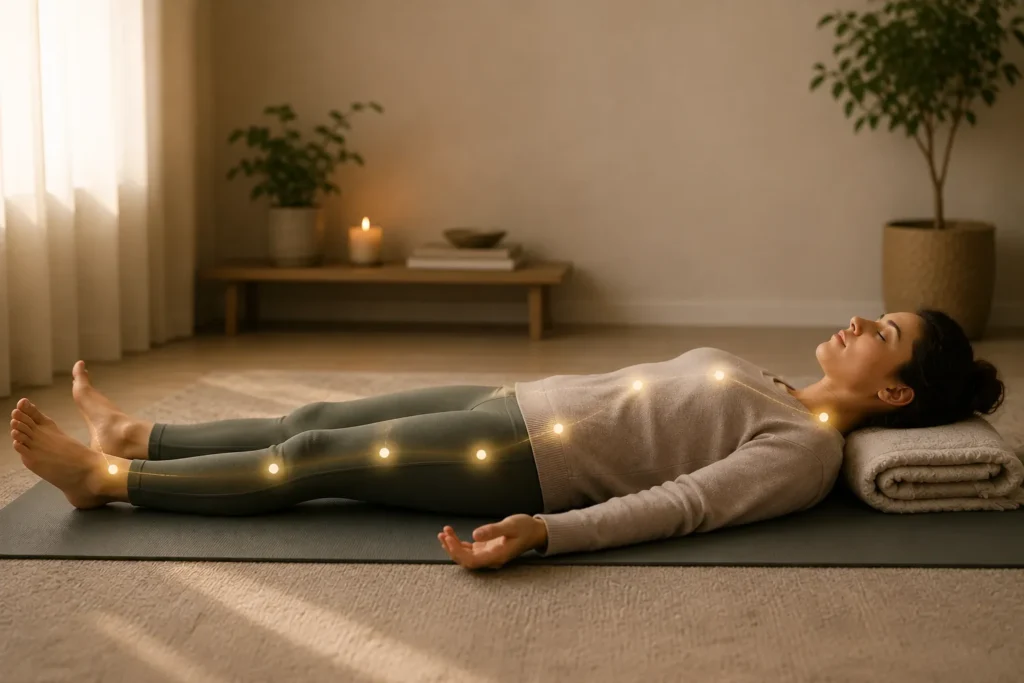
This is the full practice. You don’t need any prior meditation experience. You need somewhere to lie down or sit, and about 10–15 minutes without interruption.
The Full Body Scan Practice
| 1. Get comfortable. Lie on your back if possible — on a bed, a mat, or the floor. If lying down isn’t an option, sit with your feet flat on the floor. Close your eyes or lower your gaze. |
| 2. Take three slow breaths. Inhale through the nose, exhale through the mouth. Let the exhale be longer than the inhale. This signals to your nervous system that it’s safe to soften. |
| 3. Bring attention to your left foot. Don’t move it. Just notice: is there warmth or coolness? Tingling or numbness? The pressure of the floor or the fabric against it? Stay here for 20–30 seconds. |
| 4. Move slowly up the left leg. Left ankle, left calf, left knee, left thigh. Spend a few breaths with each region. You’re not looking for anything in particular — just noticing whatever’s there. |
| 5. Repeat on the right side. Right foot, right ankle, right calf, right knee, right thigh. Same slow, curious attention. |
| 6. Move to the pelvis and lower back. Notice the contact with the surface beneath you. Notice any tension or ease. Breathe into this area without trying to change it. |
| 7. Scan the abdomen and chest. Notice the rise and fall of the breath here. Notice any tightness, heaviness, or openness. Whatever is there is fine. |
| 8. Move to both hands simultaneously. Fingers, palms, wrists. Then up both arms — forearms, elbows, upper arms, shoulders. |
| 9. Scan the neck and throat. These areas often hold tension that goes unnoticed. Just observe — no effort to relax. |
| 10. Finish at the head. Jaw, mouth, cheeks, eyes, forehead, scalp. Let the final few moments be with the whole body at once — a sense of awareness spread across the entire shape of you. |
| 11. Stay for a moment before moving. Take a slow breath. Wiggle fingers and toes. Open your eyes when you’re ready. Don’t rush the transition back. |
| When the mind wanders It will. Many times. This is not a sign of failure — it’s the practice. Each time you notice you’ve drifted into thought, gently return to wherever you were in the body. The noticing is the skill. Over time, the wandering reduces. But the return is always the practice. |
The 5-Minute Body Scan: A Shorter Daily Practice
The full practice is ideal for winding down before sleep or for a dedicated weekly session. For daily use — especially on busy days — a shorter version builds the same skill with a smaller time commitment.
The 5-Minute Body Scan
| 1. Sit comfortably wherever you are. Close your eyes or lower your gaze. Take one slow breath. |
| 2. Scan from feet to head in three broad sweeps: legs and feet together, torso and arms together, neck and head together. Spend about 90 seconds on each sweep. |
| 3. Notice one area of tension or sensation that stands out. Bring a breath to it — not to change it, just to acknowledge it. |
| 4. Take a final slow breath. Open your eyes. Continue with your day. |
Five minutes done consistently is more valuable than twenty minutes occasionally. The goal is to build a daily habit of checking in with your body — which is a skill that starts to carry over into the rest of your day automatically.
What You Might Notice (And What’s Normal)
The body scan produces some experiences that feel like problems but aren’t. Knowing what to expect prevents unnecessary frustration.
Falling asleep
Extremely common, especially during lying-down practice or evening sessions. It usually means your body needed rest and the relaxation gave it permission. It’s not a failure. To stay more alert, keep your eyes slightly open, practice sitting rather than lying down, or shift to mornings when your mind is fresher.
Feeling nothing in some areas
Many people arrive at a body part and find… nothing. No sensation, no feeling, just blankness. This is normal. It often reflects areas of chronic tension that have numbed out over time, or simply regions of the body that rarely get conscious attention. Stay with the area anyway. Noticing the absence of sensation is still noticing.
Emotion arising unexpectedly
The body stores emotional experience. When you bring attention to the chest, the throat, or the belly, feelings sometimes surface that were running below the level of conscious awareness. Sadness, anxiety, a vague sense of dread. This is one of the most valuable things the body scan can do — it surfaces what’s already there. Let it be there. You don’t need to analyse or fix it.
Restlessness or the urge to stop
Particularly common in the first few sessions. Restlessness is just the mind’s habit of seeking stimulation encountering stillness. It’s uncomfortable, and it passes. Staying with the discomfort for even one more minute is the practice working. The most common meditation challenges almost always ease with repetition.
How Often and When to Practice
The body scan is flexible enough to work at different points in the day, and each timing has a different benefit.
Before bed
This is where the body scan shines for most people. It reduces the physiological activation that makes sleep difficult, and interrupts the thought-cycling that often starts when the room goes quiet. If sleep-related overthinking is a pattern for you, a 10-minute body scan before sleep is one of the most consistently effective interventions available.
Research on body scan and sleep consistently shows reduced time to sleep onset and fewer overnight awakenings with regular practice.
Morning
A morning body scan — even just 5 minutes — sets a different baseline for the day. It builds the habit of checking in with your body before the day’s inputs accumulate. Paired with a morning meditation practice, it creates a grounding anchor before the mental noise begins.
Mid-day or post-stress
The 5-minute version works well here — as a reset after a difficult conversation, before an important task, or whenever you notice mental clutter building. It takes less time than most people spend scrolling, and has the opposite effect on the nervous system.
Frequently Asked Questions
What is body scan meditation good for?
Body scan meditation is particularly effective for anxiety, stress, chronic tension, sleep difficulties, and overthinking. It builds interoceptive awareness — your ability to read your body’s internal signals — which directly supports emotional regulation. It’s also one of the most accessible practices for complete beginners, because the moving structure gives the mind something concrete to follow rather than asking it to sustain focus on a single point.
How long should a body scan meditation be?
The full practice typically runs 10–20 minutes. For daily maintenance, a 5-minute version covering the body in three broad sweeps is enough to build the habit and sustain the benefits. The most important variable isn’t duration — it’s consistency. Five minutes every day will compound into a meaningful shift in body awareness and stress response over weeks.
Can you do a body scan meditation for anxiety?
Yes — and it’s one of the more effective options. Anxiety often lives in the body as tension, shallow breathing, a tight chest, or a knot in the stomach — before it becomes a thought. The body scan trains you to notice these early physical signals, which creates a window of choice before the spiral starts. For a broader look at how mindfulness addresses anxiety, mindfulness for anxiety covers the specific mechanisms in more depth.
Is it normal to fall asleep during a body scan?
Very normal, especially in lying-down or evening practice. The body scan creates genuine physiological relaxation, and if you’re sleep-deprived or practicing before bed, sleep is often what the body prioritises. If you want to stay awake, practice sitting upright, keep your eyes slightly open, or shift to morning practice. If you fall asleep, it’s not a failed meditation — it’s rest you apparently needed.
How is a body scan different from progressive muscle relaxation?
They’re related but distinct. Progressive muscle relaxation involves deliberately tensing and releasing muscle groups — the goal is to reduce physical tension. The body scan involves passive observation — you’re not tensing or releasing anything, just noticing what’s already there. The body scan is a mindfulness practice; progressive muscle relaxation is a relaxation technique. Both are useful, but the body scan builds longer-term awareness rather than just producing temporary relaxation.
Can body scan meditation be done with eyes open?
Yes. Closing the eyes reduces visual distraction and makes it easier to feel internal sensation, so it’s generally recommended for beginners. But if closing your eyes causes anxiety or makes it harder to stay awake, a soft, downward gaze works just as well. The eyes-open option is also useful during short mid-day practices when you’re sitting at a desk — you can do a quiet internal scan without anyone around you knowing.
The Body Has Been Here the Whole Time
The mind travels constantly — through the past, through imagined futures, through conversations that haven’t happened and worries that probably won’t. The body doesn’t do any of that. It’s always right here, always in this moment, always producing sensation you can tune into.
Body scan meditation is just the practice of catching up with it. Of bringing the wandering mind home to the place where it actually lives. It doesn’t require stillness, silence, or any particular gift for meditation. It requires only attention — which you already have, even if it’s been scattered.
Start with the 5-minute version tonight. Move your attention slowly from feet to head, notice what you find, and return when the mind wanders. If you want to build this into a broader practice, mindfulness for beginners covers the full foundation — including why the body scan is often the best place to start.
The body is always present. That’s the whole point.


