
There’s a particular kind of tiredness that has nothing to do with how much sleep you got.
It’s the flatness you feel when nothing seems exciting anymore. The low-level irritability that follows you through the day. The sense that you’re going through the motions — technically functioning, but not really alive.
If that sounds familiar, you’ve probably found yourself searching for something: a way to feel better that isn’t just “think positive” or “be grateful.” Something that actually works.
This is that guide. We’re going to look at how to raise your vibration in a way that’s grounded in real life — supported by psychology and neuroscience, but written for someone who just wants to feel like themselves again.
No crystals required.
What Does ‘Raising Your Vibration’ Actually Mean?
Let’s start with the honest version.
The word “vibration” comes from the world of physics — everything at the subatomic level is in constant motion, vibrating at different frequencies. Spiritual teachers borrowed this language to describe emotional and energetic states: fear, grief, and anxiety have one quality; love, joy, and peace have another.
It’s a metaphor. But it’s a useful one — and it turns out the underlying phenomenon it points to is very real.
The science behind the idea
The HeartMath Institute has spent decades measuring how different emotional states affect the heart’s electromagnetic field. Their research shows that emotions like frustration and anxiety produce erratic, jagged patterns in heart rate variability (HRV), while emotions like appreciation and care produce smooth, coherent ones. These patterns affect everything from immune function to cognitive clarity.
What spiritual traditions call “low vibration” is, in physiological terms, a state of nervous system dysregulation — predominantly sympathetic (stress response) activation. What they call “high vibration” is coherence: a state where your nervous system, heart, and brain are working in sync.
Both descriptions are pointing at the same thing.
| You don’t have to believe in anything mystical to benefit from practices that raise your vibration. You just have to be willing to shift your state. |
For the purposes of this guide, we’ll use a simple three-level framework:
- Body level — physiology: breath, movement, food, sleep
- Mind level — emotional and cognitive state: thoughts, feelings, attention
- Environment level — external inputs: people, spaces, screens, nature
All three levels interact. Change one, and you shift the others. That’s the whole strategy.
Signs Your Vibration Is Low Right Now
Before we get to the practices, it helps to know what you’re working with.
Low vibration doesn’t always look like sadness or drama. Often it’s quieter than that. It’s the accumulation of small signals that your system is running below its natural capacity.
Physical signs
- Waking up tired even after a full night’s sleep
- A heaviness in the body — like everything requires more effort than it should
- Tension that lives in your jaw, shoulders, or chest
- Getting sick more often, or slow to recover
Emotional signs
- Mild, persistent irritability for no clear reason
- Feeling flat — nothing excites or interests you the way it used to
- Low frustration tolerance: things that wouldn’t usually bother you suddenly do
- A sense of heaviness or dread that arrives without a specific cause
Cognitive signs
- Difficulty making decisions — even small ones feel exhausting
- A mind that races at night but feels foggy during the day — if this one lands, this look at why the brain won’t quiet down after dark explains exactly what’s happening
- Negative thoughts that loop and replay without resolution
- Trouble being present: you’re physically here but mentally somewhere else
Relational and behavioural signs
- Withdrawing from people and activities you used to enjoy
- Scrolling endlessly but feeling worse afterwards, not better
- A low-level feeling that something is “off” but you can’t name what
Many of these signs overlap with what happens when the nervous system is running in overdrive rather than genuine low mood. If you recognise several of them, it’s worth reading about the difference between being overstimulated and just feeling lazy — the distinction changes how you approach the fix.
Your Nervous System Is the Starting Point
Here’s something that most vibration guides miss, and it’s the most important thing in this article:
You cannot think your way into a high vibration state.
The nervous system doesn’t respond to instructions. It responds to signals — and most of those signals come from the body, not the mind. This is why telling yourself to “just be positive” rarely works. You’re trying to override a physiological state with a thought. It doesn’t stick.
Two modes, one system
Your autonomic nervous system operates in two primary modes:
- Sympathetic activation (fight-or-flight): elevated cortisol, shallow breathing, tunnel-vision thinking, heightened reactivity. This is what low vibration feels like from the inside.
- Parasympathetic activation (rest-and-digest): deeper breathing, lower heart rate, broader awareness, access to creativity and connection. This is what high vibration feels like.
The good news: the parasympathetic system can be activated deliberately, through specific physical actions. This is the whole basis of breathwork, grounding, and the other practices in this guide.
The vagus nerve: your built-in reset button
The vagus nerve runs from the brainstem down through the heart, lungs, and gut. It’s the primary pathway of the parasympathetic nervous system — and you can stimulate it directly.
Research from Dr. Stephen Porges on polyvagal theory explains how this works: certain inputs — slow breathing, humming, cold water on the face, gentle movement — send a safety signal through the vagus nerve, shifting your system out of stress mode and into a state of calm alertness.
That shift is what “raising your vibration” actually involves, physiologically.
| The body is the fastest route to a higher state. Not the mind. The body. |
Try this now: the physiological sigh
This is one of the most effective nervous system resets available — takes under 60 seconds:
- Take a deep inhale through the nose.
- At the top of that breath, sniff in a little more air to fully inflate the lungs.
- Exhale slowly and completely through the mouth — as long as you can.
- Repeat 2–3 times.
You’ll often feel a noticeable shift within the first two breath cycles. That shift is real — it’s your vagal brake engaging. If you want to go further with breath as a daily practice, working with the breath as a meditation anchor is a natural next step from here.
The Simplest Shift: Change What You Put In Your Body
Before we get to morning routines and meditation, there are some foundational inputs that most people overlook. Your vibration doesn’t exist in a vacuum — it runs on a biological substrate.
If that substrate is depleted, no amount of journaling or breathwork will fully compensate.
Food and the gut-brain connection
Approximately 90% of your serotonin — the neurotransmitter most associated with mood, calm, and wellbeing — is produced in the gut. What you eat is a direct input to your emotional baseline, not just a metaphor for self-care.
Foods that support emotional regulation include:
- Fermented foods (yogurt, kimchi, sauerkraut, kefir) — nourish the gut microbiome, which influences neurotransmitter production
- Magnesium-rich foods (dark leafy greens, pumpkin seeds, dark chocolate) — magnesium deficiency is linked to anxiety and poor sleep
- Omega-3 fatty acids (salmon, walnuts, flaxseed) — associated with reduced depression symptoms in multiple studies
- Consistent meal timing — blood sugar swings create mood swings. Irregular eating is a hidden vibration drain.
Sleep is non-negotiable
A single night of poor sleep increases emotional reactivity by up to 60%, according to research from UC Berkeley. The amygdala — your brain’s threat-detection system — becomes hyperresponsive. Everything feels harder, bigger, more threatening.
If you’re trying to raise your vibration while running on chronic sleep debt, you’re working against the current.
Movement as state change
You don’t need an intense workout. Even a 10-minute walk — especially outside — triggers a cascade of neurochemical changes: dopamine, serotonin, endorphins. The body was designed to move, and stillness (especially the sedentary, screen-based kind) is a relatively new stressor on our systems.
Think of movement as tuning the instrument before you play it.
5-Minute Resets That Raise Your Vibration Immediately
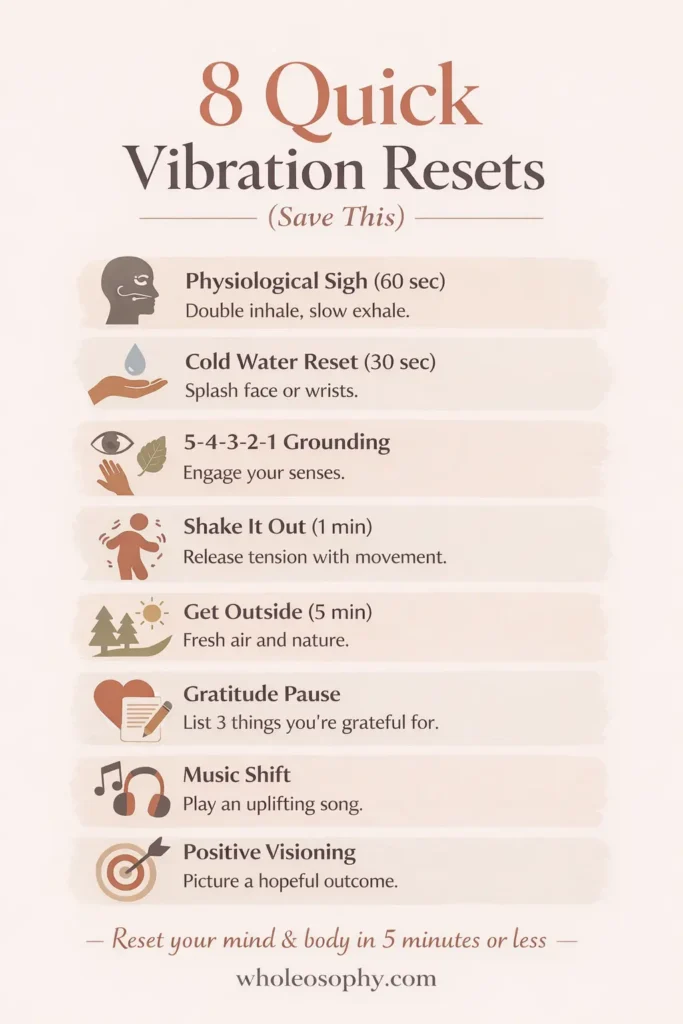
Sometimes you don’t have 30 minutes for a morning routine. Sometimes it’s 2pm and you’ve just had a difficult conversation and you need to come back to yourself right now.
These resets are designed for those moments. Each one takes 5 minutes or less and works by directly shifting your physiological state — not by convincing you to feel differently, but by giving your nervous system a different signal to respond to.
| ★ SAVE THIS LIST — 8 Quick Vibration Resets |
|---|
| 1. The physiological sigh (60 seconds) Double inhale through the nose, long exhale through the mouth. Repeat 3 times. Activates the vagal brake immediately. 2. Cold water on the face or wrists (30 seconds) Triggers the dive reflex, which slows the heart rate and activates the parasympathetic system. 3. The 5-4-3-2-1 grounding technique (2 minutes) Name 5 things you can see, 4 you can touch, 3 you can hear, 2 you can smell, 1 you can taste. Interrupts rumination by anchoring attention to the present. 4. Humming (2 minutes) Hum a single sustained note. The vibration stimulates the vagus nerve directly. Even 90 seconds produces a measurable shift in heart rate variability. 5. Step outside and look at the sky (3 minutes) Not at your phone. At the actual sky. Natural light, open space, and fresh air each send a safety signal to the nervous system. 6. Shake it out (2 minutes) Stand up and gently shake your hands, arms, legs, whole body. This is derived from somatic therapy — stress physiology stored in the body can be literally shaken loose. 7. Put on one song that makes you feel something (3–4 minutes) Music bypasses the cortex and goes directly to the limbic system — the emotional brain. The right song can shift your state faster than almost anything else. 8. Write one sentence of gratitude — specifically (2 minutes) Not “I’m grateful for my family.” Instead: “I’m grateful that my friend sent me a funny voice note this morning.” Specificity is what activates the neurological response. |
You’ll notice that none of these require believing in anything. They’re not rituals or practices in the spiritual sense — they’re inputs. Different signals in, different state out.
This list is a starting point. If you find that somatic and sensory techniques work especially well for you, there’s a much larger collection of grounding practices worth exploring — many of them work just as quickly.
Morning Practices That Build a Higher Baseline
The resets above are for in-the-moment shifts. But if you want to change your baseline — the level of vitality and wellbeing you return to throughout the day — the morning is where it happens.
There’s a physiological reason for this. In the 30–45 minutes after waking, your body goes through what researchers call the “cortisol awakening response” (CAR): a natural spike in cortisol that provides energy for the day ahead. What you do during this window determines whether that cortisol becomes focused alertness or ambient anxiety.
The minimum viable morning (for people who don’t have an hour)
You don’t need a 90-minute routine. You need a few anchors that consistently signal to your nervous system: the day is beginning well.
- No phone for the first 15 minutes. This alone is significant. Looking at your phone immediately after waking floods the brain with social comparison, news, and notifications before you’ve had a chance to orient to the day on your own terms. It sets a reactive tone before you’ve chosen a conscious one.
- Natural light within 20 minutes of waking. Even on a cloudy day, outdoor light is 10–50x brighter than indoor lighting. This resets your circadian rhythm, supports cortisol modulation, and improves sleep quality the following night. Open a window, stand outside, or sit near a glass door.
- Two minutes of deep, slow breathing. Before coffee, before checking anything. Just two minutes of intentional breath. This is your parasympathetic primer — it sets the tone for how your nervous system will respond to the rest of the day.
- One sentence of specific gratitude. Write or say aloud one thing you’re genuinely appreciating today. Not a performance of positivity — a real one. Even small. Especially small.
That’s it. Four anchors. Fifteen to twenty minutes total. Done consistently, this is more powerful than an occasional hour-long practice.
| Consistency beats intensity every time. One morning routine done daily for three weeks reshapes your baseline more than a weekend retreat done once. |
Add-ons if you have more time
- A short walk before starting work — movement + light + nature, three state-changers at once
A few minutes of journaling — one prompt: ‘What do I want to feel today, and what’s one thing I can do to make that likely?’ This is one of the simplest ways to bring mindfulness into your daily life without making it feel like another obligation.
If you want to add an affirmation practice, do it after the gratitude step — not before. Affirmations land differently once the nervous system has already settled. A strong set to start with can set an intentional emotional tone for the hours ahead.
The Hidden Drain: What Screens Are Doing to Your Vibration
This might be the section nobody wants to read, but it might also be the most practically useful one.
Much of what people experience as “low vibration” — the flatness, the mild numbness, the feeling that nothing quite satisfies — is not a spiritual problem. It’s a dopamine problem.
How the scroll loop depletes your energy

Your dopamine system is designed to reward novelty-seeking: find something interesting, get a hit of dopamine, move on. Social media has been engineered to trigger this system hundreds of times an hour. The result is what researchers call habituation: the system becomes tolerant to the stimulus, requiring more input to produce the same response.
After an hour of scrolling, a walk in the park feels boring. A real conversation feels slow. A creative project feels pointless before you’ve started. You haven’t become incapable of enjoying these things — your baseline has been temporarily inflated by overstimulation, making everything else appear flat by comparison.
This is the scroll loop: you keep scrolling hoping to feel something, but each scroll slightly raises the threshold for what will satisfy, making the next item need to be slightly more stimulating. Vitality drains out quietly, without a single dramatic event.
There’s a downstream effect worth mentioning: the overstimulation that accumulates during the day often shows up as a mind that won’t switch off at night. If you lie awake with thoughts you can’t stop, that restlessness usually has a daytime source.
A practical recalibration (not a full detox)
You don’t need to delete everything and move to a monastery. But a deliberate recalibration period helps reset your dopamine baseline so that ordinary, nourishing things feel rewarding again.
Try this for 24 hours:
- Phone on greyscale (Settings > Accessibility > Colour Filters). Colour is one of the most powerful engagement mechanisms in app design — removing it significantly reduces the pull.
- No social apps — just for one day. Email and messaging are fine.
- Replace one scroll session with a 20-minute walk or something physical.
- Notice what feels boring at first, and stay with it. The boredom is the recalibration happening.
Within 24–48 hours, most people notice that quieter things start feeling pleasurable again. A cup of coffee. A real conversation. The sound of rain. The flatness begins to lift — not because anything external changed, but because the internal threshold has reset.
People, Places, and the Energy You’re Absorbing
Here’s something you’ve probably noticed without having a framework for it:
Spend 20 minutes with certain people and you leave feeling lighter. Spend 20 minutes with others and you leave feeling mysteriously drained, even if the conversation was perfectly fine.
This isn’t imagination. It’s physiology.
Emotional contagion is a real phenomenon
Research on emotional contagion — pioneered by social psychologists Elaine Hatfield and John Cacioppo — shows that humans unconsciously synchronise nervous system states with the people around them. We do this through facial mimicry, postural mirroring, and physiological entrainment. In shared spaces, we literally catch each other’s emotional tones.
An anxious colleague, a tense home environment, a group chat full of catastrophising — all of these are inputs into your nervous system, shaping your state below the level of conscious awareness.
The concept of “energy vampires” isn’t just spiritual metaphor. Some interactions consistently pull your system into sympathetic activation. Learning to protect your energy in relationships is a genuinely practical skill, not a mystical one.
What to do about it
You don’t need to cut everyone off. You need awareness — and then choices.
| The energy audit: one simple practice For one week, rate your energy level (1–10) before and after each significant interaction or environment: a meeting, a phone call, a social media session, time in nature, a conversation with a particular friend. Patterns emerge quickly. Within a few days, you’ll have data on exactly what’s supporting your vibration and what’s depleting it. |
From there, you can make conscious decisions: more of what restores, less of what depletes.
If you’ve noticed that certain spaces feel heavy or difficult to settle in, clearing the energy of a room or environment can be a surprisingly effective complement to the relational work.
Gratitude as a Vibrational Technology
Gratitude gets a lot of eye-rolls. That’s fair — it’s been packaged and sold in ways that feel shallow, performative, or tone-deaf (“just be grateful!” is not useful advice when you’re in pain).
But the underlying neuroscience of gratitude is genuinely remarkable, and the practice, done correctly, is one of the most reliable ways to shift your emotional baseline over time.
What the research actually shows
Psychologist Barbara Fredrickson at UNC Chapel Hill developed what she calls the broaden-and-build theory of positive emotions. Her finding: positive emotional states — including gratitude — don’t just feel good. They physically broaden the aperture of perception, expand creative thinking, and over time build durable psychological resources like resilience, optimism, and social connection.
In separate research at UC Davis, psychologist Robert Emmons found that participants who kept gratitude journals for ten weeks reported higher levels of wellbeing, more optimism, better sleep, and greater connection to others compared to control groups.
Why most gratitude practices don’t work
The typical gratitude list — “I’m grateful for my health, my family, my home” — doesn’t activate the neurological response. It’s too general. It becomes rote. Your brain recognises a rehearsed phrase and files it away without engaging.
Specificity is the key.
Compare these two:
- “I’m grateful for my family.”
- “I’m grateful that my daughter laughed so hard at dinner last night that she nearly fell off her chair.”
The second one activates memory, sensation, and genuine emotional response. That’s what shifts the neurochemistry.
| The three specific things practice Each morning or evening, write three specific things you appreciated today — or are anticipating tomorrow. The rule: each entry must be specific enough that it couldn’t have been written yesterday.Done daily for three weeks, this practice measurably shifts emotional baseline. It’s not about forced positivity — it’s about deliberately noticing what’s real and good, which the brain, in its negativity-bias default, often filters out. |
If you’d like to extend this practice further, pairing it with a set of affirmations written specifically around appreciation can deepen the emotional imprint — especially when used just before sleep.
The Manifestation Bridge: What Your Vibration Has to Do With What You Attract
If you arrived at this article through the lens of manifestation or the law of attraction, this section is for you. If you arrived through the lens of psychology and neuroscience, this section might surprise you.
The reticular activating system: your brain’s relevance filter
Deep in the brainstem sits a structure called the reticular activating system (RAS). Its job is to filter the vast flood of sensory information your brain receives every second — roughly 11 million bits — down to the approximately 50 bits your conscious mind can process.
The RAS filters based on what you’ve told your nervous system is relevant. And your emotional state is one of the most powerful calibration signals it receives.
When you’re in a high-vibration state — open, curious, settled in the body, genuinely hopeful — your RAS is calibrated to notice possibility: opportunities, kind people, resources, coincidences that feel like openings. When you’re in a low-vibration state, it’s calibrated for threat: obstacles, risks, everything that could go wrong.
Whether you call this law of attraction or neuroscience, the practical effect is identical. Your state shapes what you perceive. What you perceive shapes what you act on. What you act on shapes what unfolds.
| Raising your vibration doesn’t change the world. It changes what you can see of it — and that changes everything. |
Vibrational scripting: a practice that bridges both worlds
One of the most effective manifestation techniques — and one that works through both the spiritual and neurological mechanism — is scripting.
Here’s how to do it:
- Find 10 minutes of quiet. Take a few slow breaths first, to drop into your body.
- Write a description of a single future day in your life — six months or a year from now — as though it has already happened.
- Use present tense, past tense of the future moment: ‘I woke up this morning feeling…’, ‘Today I had a conversation with…’, ‘I noticed I felt…’
- Include sensory detail, emotional texture, specific moments. What did it feel like? What did you notice?
- Write without editing. Let it be messy and detailed and genuine.
This practice works on multiple levels: it primes the RAS to notice aligned opportunities, it generates genuine positive emotion in the present (which shifts your state now), and it clarifies what you actually want — which most people are far less clear on than they think.
Scripting is just one approach. If the connection between emotional state and what you’re drawing into your life interests you, the full picture of how intention and vibration work together is worth exploring — as is a ranked comparison of different manifestation methods for beginners.
Final Thoughts: This Is About Coming Back to Yourself
Raising your vibration is not about becoming a different person. It’s about returning to a version of yourself that was always there — before the exhaustion, the overstimulation, the accumulated weight of everything you’ve been carrying.
That version of you still exists. It’s not far away.
The practices in this guide — the breathwork, the morning anchors, the dopamine recalibration, the specific gratitude, the embodied scripting — are all pointing at the same thing: small, consistent acts of coming back. Back to the body. Back to the present. Back to what’s real and true and nourishing.
You don’t have to do all of it. Pick one thing from this guide that feels accessible, and do it today. Then do it tomorrow. That’s the whole practice.
If this resonated, you might find it useful to go deeper on what it means to build a genuinely positive mindset — not the forced, performative kind, but the kind that grows from the ground up.And if underneath the low vibration there’s also a feeling of being lost or disconnected from yourself, that’s worth sitting with too. Finding your way back when life has pulled you off course is a related journey — and often the same one.
Frequently Asked Questions
What does it mean to raise your vibration?
Raising your vibration means shifting your physical and emotional state from low-energy or depleted toward more clarity, presence, and aliveness. In scientific terms, it means moving from sympathetic nervous system dominance (the stress response) toward parasympathetic activation (rest, repair, and coherence). You don’t have to use spiritual language for it — but both traditions are pointing at the same underlying shift.
How do you raise your vibration fast?
The fastest way is to change your physiological state before trying to change your mind. The physiological sigh (double inhale, long exhale), cold water on your face or wrists, and stepping outside for 3–5 minutes of natural light are among the most effective. Each one activates the parasympathetic nervous system within 60–90 seconds. Thoughts follow state — not the other way around.
What foods raise your vibration?
Foods that support the neurochemical basis of emotional wellbeing include fermented foods (yogurt, kimchi, sauerkraut), magnesium-rich foods (dark leafy greens, pumpkin seeds, dark chocolate), omega-3 sources (salmon, walnuts, flaxseed), and consistent meal timing to stabilise blood sugar. Chronically high sugar intake, excessive caffeine, and ultra-processed foods all create neurochemical instability that shows up as mood volatility and low energy.
What lowers your vibration without you realising it?
The biggest hidden drains are: chronic sleep debt, dopamine overstimulation from social media, draining social environments (emotional contagion is real), irregular eating patterns, and chronic low-grade stress that never fully resolves. Many of these operate below conscious awareness — which is why the energy audit practice (rating your energy before and after key activities) can be so revealing.
Does raising your vibration work for manifestation?
Yes — though the mechanism is neurological rather than magical. High-vibration states calibrate the reticular activating system (RAS) — the brain’s relevance filter — toward noticing opportunity, possibility, and aligned people. They also improve decision-making, reduce reactivity, and make you more open to connection. Whether you frame this as law of attraction or neuroscience, the practical effect on your life is the same.
How long does it take to raise your vibration?
Quick in-the-moment shifts (breathwork, movement, grounding) can change your state in 60 seconds to 5 minutes. Shifting your baseline — the level you habitually return to — takes consistent practice over 3–4 weeks. Morning routines, improved sleep, and nutrition changes produce the most durable results. Small, daily practices outperform occasional intense ones.
Is ‘raising your vibration’ spiritual or scientific?
Both, and neither has to cancel out the other. ‘Vibration’ is a metaphor drawn from physics and used in spiritual traditions to describe emotional and energetic states. The underlying phenomena — nervous system coherence, emotional baseline, heart rate variability, neurochemical regulation — are well-documented in science. You don’t need to hold any particular belief to benefit from the practices. You just have to be willing to try them.