

| Key Takeaways |
|---|
| A worry loop is a brain pattern, not a personal flaw Anxiety lives in the future, not the present moment Your brain treats imagined threats as real, triggering stress Mindfulness works by interrupting mental loops with sensory awareness You can’t stop thoughts by force — you stop feeding them Simple grounding practices can break the loop in seconds Consistency matters more than duration — small daily moments are enough A quieter mind isn’t empty — it’s less entangled in thought |
It’s late. You’re lying in bed, and the same thought just played for the fifth time tonight.
Maybe it’s something you said. Something that might happen. Something you can’t fix, can’t undo, can’t stop turning over in your mind.
You know, logically, that worrying about it won’t help. And yet here you are — still in the loop.
If that sounds familiar, this article is for you.
What you’re experiencing has a name — a worry loop — and it isn’t a character flaw or a sign that something is fundamentally broken in you. It’s a very specific pattern in the brain, and there’s a very specific reason why mindfulness is one of the most effective tools for interrupting it.
Not because mindfulness is magic. But because of how it works — mechanically, neurologically — on the exact type of thinking that keeps anxiety running.
By the end of this article, you’ll understand why you get stuck in thought spirals, what presence actually does to the brain when you’re anxious, and five simple practices you can use the next time your mind won’t stop.
The evidence base here is substantial — a 2014 meta-analysis of 47 clinical trials found consistent, measurable reductions in anxiety with regular practice. If you want the full picture of what the research shows across conditions, our guide to mindfulness and mental health covers the neuroscience and clinical findings in depth.
What a Worry Loop Actually Is (And Why It’s Not a Character Flaw)

A worry loop — sometimes called rumination in psychology — is when your mind returns to the same anxious thought repeatedly, without reaching any resolution.
It’s not the same as problem-solving. Problem-solving moves forward: you consider options, reach a conclusion, act or let go. Rumination circles. It reviews the same scenario again and again, adding emotional weight each time, without producing anything useful.
Research by psychologist Susan Nolen-Hoeksema, who spent decades studying rumination, found that this style of thinking is strongly linked to both anxiety and depression — not because the thoughts are especially serious, but because the looping itself amplifies distress.
Here’s what’s happening in the brain:
When your mind is idle — not actively focused on a task — a network called the Default Mode Network (DMN) becomes active. This is sometimes called the “mind-wandering” network. It’s responsible for self-referential thinking, imagining the future, and replaying the past.
For people prone to anxiety, the DMN tends to drift toward threat-relevant content. Not because you’re a pessimist, but because your brain has learned to scan for problems. It’s doing exactly what it evolved to do — protect you. It just doesn’t have an off switch.
Signs you might be in a worry loop right now:
- You’re thinking about the same scenario for the third (or tenth) time
- The thought generates emotion but no clarity
- You feel vaguely restless, tense, or unable to relax
- You keep “checking in” on the worry to see if it still feels urgent
- You’re tired, but your mind won’t let you rest
Understanding this is the first step. The loop isn’t you. It’s a pattern your nervous system has learned. And patterns can be interrupted.
Why Anxiety Always Lives in the Future
Here’s something worth sitting with: you cannot be anxious about the present moment.
Think about that for a second.
Anxiety — by definition — is a response to a perceived future threat. The tight chest, the racing thoughts, the dread — it’s all your body responding to something that hasn’t happened yet. A conversation you’re dreading. An outcome you’re afraid of. A mistake you’re worried you’ll make.
Psychologists call this “prospective thinking” — the brain’s ability to simulate future events. It’s genuinely useful. Planning, preparing, anticipating challenges — these are all forms of prospective thinking working well.
The problem is when the simulation gets stuck on a threat and won’t stop running.
And here’s the kicker: your body doesn’t know the difference between an imagined threat and a real one. When you vividly picture a difficult confrontation or a worst-case scenario, your nervous system responds with the same stress chemistry it would use if the threat were happening right now. Cortisol rises. Muscles tighten. Breath becomes shallow.
You’re experiencing a physical stress response to something that exists only in your mind — and almost certainly in a future that may never arrive.
This is why the present moment is so powerful for anxiety. It’s the only time zone where the worry loop can’t run. Right now — this exact moment, as you read these words — there is no threat. There is only sensation, breath, and what’s actually here.
That’s not wishful thinking. That’s the structural reality of anxiety.
How Presence Interrupts the Loop (The Mechanism, Not the Magic)
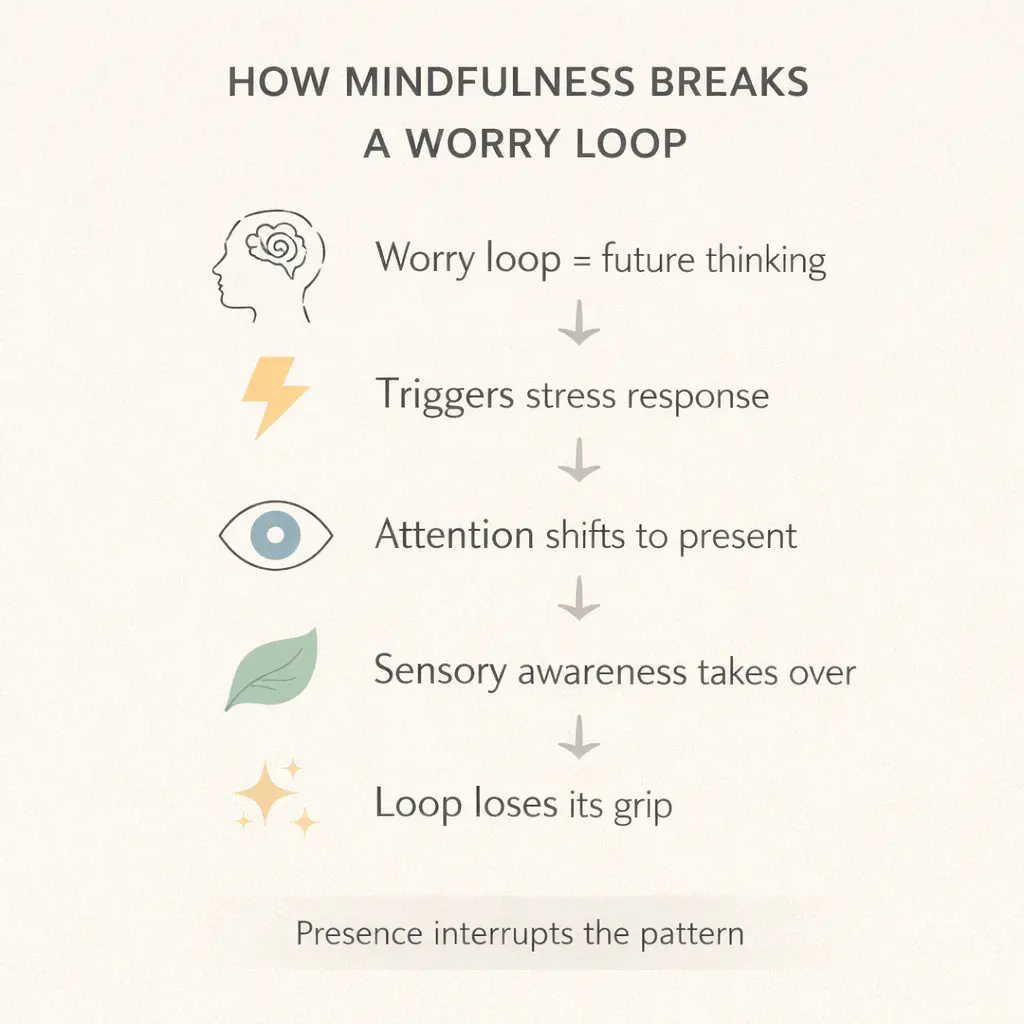
A lot of mindfulness content tells you to “be present” without explaining why it works. That gap is important, because when you understand the mechanism, the practice stops feeling like wishful thinking and starts feeling like a tool.
Here’s what’s actually happening when you bring your attention to the present moment.
Your working memory — the mental space where active thinking happens — has a limited capacity. It can only hold so much at once. When you’re in a worry loop, that space is occupied by the mental simulation your brain is running: the imagined conversation, the feared outcome, the replayed memory.
When you deliberately redirect your attention to something sensory and present — the weight of your feet on the floor, the sound of rain, the feeling of your own breath — you’re placing a competing signal into that same mental space. Sensory experience and future-simulation cannot fully co-exist. One begins to crowd out the other.
Neuroscientist Judson Brewer at Brown University has studied exactly this — how mindfulness disrupts habitual loops, including anxiety loops — and found that bringing curious, non-judgmental awareness to a thought or sensation disrupts the brain’s reward-based habit of worry. The loop loses its grip not because you fought it, but because you stopped feeding it.
This is also why simply telling yourself to calm down doesn’t work. “Calm down” is still happening inside the loop, in the mental space the worry already occupies. Grounding a sense in the external world — touch, sound, breath — reaches past the thinking mind entirely.
Research connected to the 8-week Mindfulness-Based Stress Reduction (MBSR) program at UMass Medical School — one of the most widely studied mindfulness programs in the world — found measurable changes in amygdala reactivity and significant reductions in anxiety among participants.
You don’t need 8 weeks to feel a difference. But knowing the research helps you trust the process on the days it feels like it isn’t working.
5 Ways to Use Presence to Break the Worry Loop Right Now
These five practices each target a different entry point into the present moment. Some will work better for you than others — that’s normal. Experiment, and notice which ones your nervous system responds to most quickly.
For more on building a sustainable mindfulness practice, see Mindfulness Techniques That Actually Work – 15 Practices for a Quieter Mind.
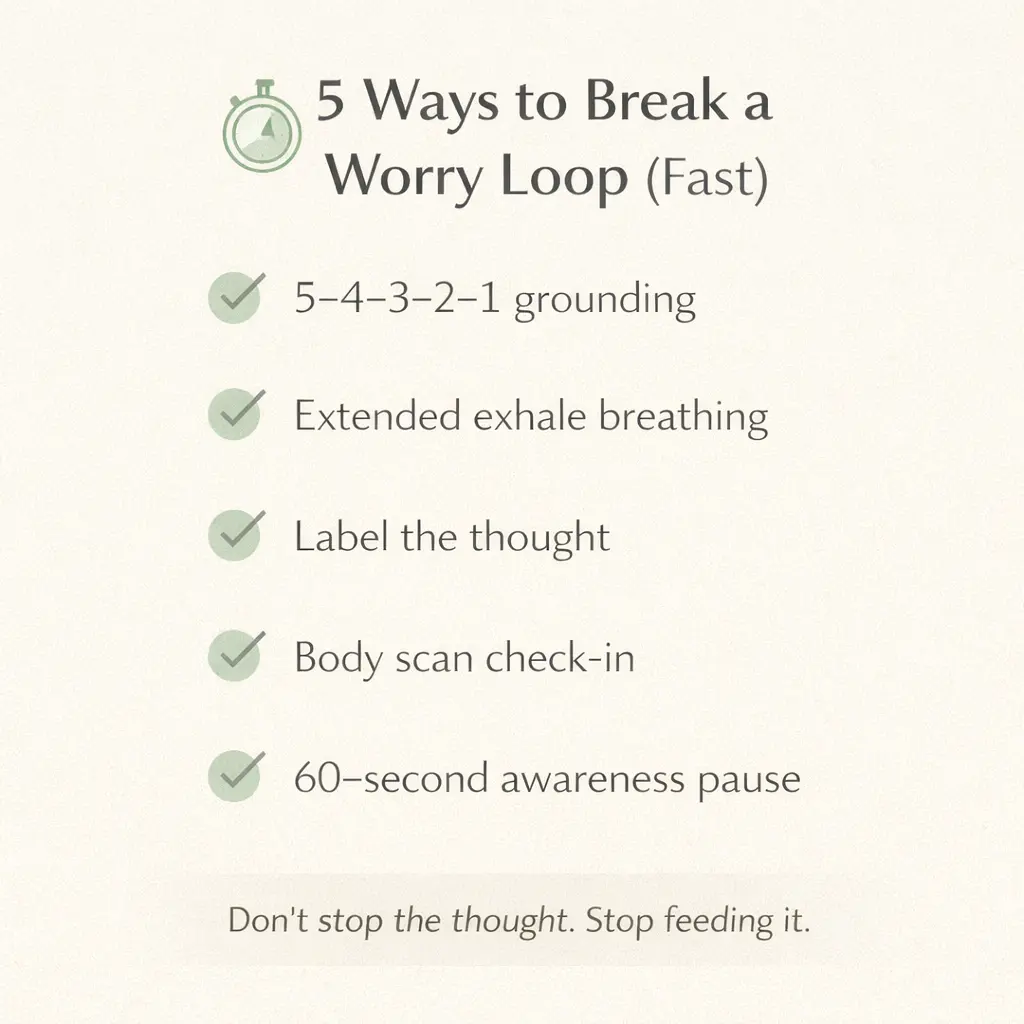
1. The 5-4-3-2-1 Sensory Grounding Technique
When to use it: When thoughts are spiraling fast and you feel physically activated — tight chest, shallow breath, restless body.
How to do it:
- Pause wherever you are and look around.
- Name 5 things you can see — out loud or silently.
- Name 4 things you can physically feel (your feet on the floor, the texture of fabric, the air on your skin).
- Name 3 things you can hear.
- Name 2 things you can smell (or can imagine smelling if nothing is obvious).
- Name 1 thing you can taste.
What you’ll notice: The loop quiets — not because the thought disappeared, but because your attention has moved somewhere else. This technique works quickly because it floods the sensory channels that anxiety can’t occupy.
For a deeper look at this and related approaches, see 35 Powerful Grounding Techniques You Need to Know.
2. The Extended Exhale Breath
When to use it: When you feel tension in the body, or when the spiral is making your breath shallow and fast.
How to do it:
- Breathe in slowly for a count of 4.
- Breathe out for a count of 6–8 — longer than the inhale.
- Repeat for 5–10 cycles.
What you’ll notice: Within a few breaths, you may feel a subtle shift in your body — a slight release of tension, a slowing of the mental noise.
The extended exhale activates the parasympathetic nervous system — what Stephen Porges’ Polyvagal Theory describes as the “rest and digest” state. The vagus nerve, stimulated by the slow exhale, sends a signal to the brain that the threat has passed. The body starts to come down even before the mind catches up.
For a gentle introduction to breath-centered practice, Breath Meditation Made Easy is a good place to start.
3. Thought Labeling (Cognitive Defusion)
When to use it: When a specific thought keeps returning and pulling you in emotionally.
How to do it:
- When the anxious thought arrives, instead of engaging with its content, add a simple prefix:
- “I notice I’m having the thought that…”
- “My mind is telling me that…”
- “There’s the worry about…”
- Just name it. Don’t analyze it, argue with it, or try to resolve it.
- Return your attention to what’s in front of you.
What you’ll notice: The thought doesn’t disappear, but it loses some of its urgency. You’ve stepped slightly outside the loop rather than inside it.
This technique comes from Acceptance and Commitment Therapy (ACT), developed by psychologist Steven Hayes. The goal is not to change the thought — it’s to change your relationship to it. You become the observer of the thought rather than its passenger.
The Greater Good Science Center at UC Berkeley offers accessible, research-based writing on exactly why this kind of non-judgmental awareness is so effective for anxiety.
4. The Body Scan Check-In
When to use it: When you’re emotionally activated but not sure why, or when the worry feels more physical than mental.
How to do it:
- Sit or lie down in a comfortable position.
- Close your eyes, or soften your gaze.
- Bring your attention slowly down through your body: forehead, jaw, neck, shoulders, chest, belly, hands, legs, feet.
- At each area, just notice. Is there tension? Warmth? Heaviness? You’re not trying to fix anything — just observe.
- Spend 2–5 minutes doing this.
What you’ll notice: Anxiety often stores itself in the body before the mind has registered why. The body scan brings you into contact with what’s actually happening physiologically, and that contact — that simple noticing — begins to soften it.
5. The 60-Second Awareness Pause
When to use it: During the day, as a proactive loop-breaker before the spiral builds momentum. Also useful when you catch yourself mid-loop.
How to do it:
- Stop whatever you’re doing.
- Ask: “What is actually happening right now, in this moment?”
- Name three things that are physically real: “I’m sitting. The room is quiet. My hands are warm.”
- Take one full breath.
- Continue.
What you’ll notice: One minute is enough to interrupt a loop in its early stages. This practice trains the nervous system to return to the present as a default — rather than drifting into future simulation.
Meditation for Anxiety: A Simple Practice to Try Right Now
Mindfulness and meditation are closely related but not identical. Mindfulness is a quality of attention — something you can bring to any moment. Meditation is a dedicated practice where you train that attention deliberately, for a set period of time.
For anxiety specifically, meditation works by giving the Default Mode Network something concrete to anchor to — your breath — so it has less idle space to fill with worry simulations.
This practice takes five minutes. You can do it sitting, lying down, or even at your desk.
The 5-minute breath anchor practice:
- Settle your body first. Press your feet into the floor (or your back into the chair). Feel the physical support beneath you. Take one slow breath out — longer than the inhale — and let your shoulders drop.
- Choose your anchor. Bring your attention to the physical sensation of breathing. Not the idea of it — the actual feeling. The air entering your nose. The slight rise of your chest or belly. The pause between inhale and exhale.
- Notice without fighting. Your mind will move toward the worry. That’s not failure — that’s the practice. The moment you notice the thought, gently return to the breath. Not with frustration. Just a quiet redirect, like turning a lamp back toward the thing you’re trying to see.
- Stay for five minutes. That’s it. Not to achieve a blank mind — just to keep returning. Every return is a repetition, and repetitions are how the pattern changes.
The anxiety doesn’t have to disappear for this to be working. What you’re building is the ability to interrupt the loop — to notice when you’ve been pulled into future simulation and choose, deliberately, to return. Over time, that gap between trigger and reaction gets wider. That gap is where calm lives.
If you find sitting still makes the anxiety louder rather than quieter, that’s common — especially at first. The mindfulness for overthinkers guide has a gentler entry point specifically designed for minds that resist stillness.
When anxiety is persistent and accompanied by low mood, the mindfulness for depression guide covers the overlap honestly — including what the evidence supports and where the limits are.
Why Trying to Stop Worrying Makes It Worse
This is the part most people don’t expect.
When you tell yourself — really firmly, with genuine intention — don’t think about this anymore, you almost always think about it more.
This isn’t weakness. It’s ironic process theory, described by psychologist Daniel Wegner. The mental process of monitoring whether you’re still thinking about something keeps that something active. The watcher and the watched are the same mind. You can’t suppress a thought without first calling it to attention.
This is why willpower fails as an anxiety strategy. “I need to stop worrying” just adds another anxious thought: the worry that you’re still worrying.
The shift mindfulness invites is different. Instead of trying to stop the thought, you stop feeding it. You stop engaging with its content, arguing with it, analyzing it, or trying to resolve it. You observe it, label it, and redirect your attention — not away in a forced, suppressive sense, but toward something real and present.
The thought still arises. But it passes more quickly when you don’t grab onto it.
This is what’s meant by “non-attachment” in mindfulness language — not that you become emotionally flat, but that you stop treating every thought your mind generates as an urgent problem demanding immediate analysis. Some thoughts deserve attention. A worry loop rarely does.
If you’re curious about how this connects to overthinking more broadly, Why Your Brain Won’t Stop Thinking — And How Mindfulness Finally Helps goes deeper on this pattern.
Building a Daily Presence Practice (Without Sitting Still for 30 Minutes)
You don’t need a meditation cushion. You don’t need an app. You don’t need 20 minutes carved out of a morning that’s already chaotic.
What actually builds a mindfulness practice is consistency — small, repeated moments of presence woven into the structure of a day you’re already living.
The concept is called habit stacking: you attach a new micro-behavior to an existing daily trigger. The trigger does the remembering for you.
Here are some examples:
- Morning coffee: Before you pick up your phone, take three slow breaths and feel the warmth of the mug in your hands.
- Shower: Spend the first 60 seconds noticing temperature, sound, and sensation — before your mind starts planning the day.
- Waiting: Any time you’re waiting (for a kettle, a light, a page to load), use it as a 30-second body scan.
- Transition moments: Before you start a meeting, walk into a room, or sit down to work — pause and take one breath.
A simple 7-day starter framework:
| Day | Practice | Duration |
|---|---|---|
| 1 | 5-4-3-2-1 grounding (once, in the morning) | 3 min |
| 2 | Extended exhale breath before bed | 5 min |
| 3 | Thought labeling — notice and name 3 worry thoughts | Throughout day |
| 4 | 60-second awareness pause (set one reminder) | 1 min |
| 5 | Body scan before sleep | 5 min |
| 6 | Combine: morning breath + one midday pause | 6 min |
| 7 | Your choice — whatever felt most natural this week | Open |
The goal isn’t to complete a practice. It’s to make returning to the present feel slightly more familiar each day.
Anxiety and stress often feed each other — chronic stress keeps the nervous system primed, which makes the worry loop easier to fall into. If stress is a significant part of what you’re navigating, mindfulness for stress covers the cortisol and fight-or-flight side of this in detail.
For more on building this kind of rhythm, see How to Practice Mindfulness in Daily Life: Simple Habits That Actually Stick and How to Easily Create a Consistent Daily Meditation Routine.
If you’re new to formal meditation and want to understand the basics first, How to Meditate Properly (Even When You Can’t Stop Thinking) is a gentle place to start.
Mindfulness, Manifestation, and the Quiet Mind
For those here with an interest in manifestation or intentional living — this section is for you. At its core, this shift toward a quieter, more aware mind is closely related to what spirituality actually means when it’s understood beyond belief or ideology.
One thing that often goes unexplored is how chronic worry loops interfere with the clarity that intentional practice requires. When the mind is caught in a loop — replaying fears, generating worst-case scenarios, bracing for what might go wrong — there’s very little cognitive space left for deliberate, focused thought.
You can’t hold a clear intention if your mind keeps hijacking the channel.
Presence isn’t just anxiety relief. It’s the foundation from which clearer, more directed thinking becomes possible. A quiet mind is one that can actually receive and hold what you’re deliberately calling into focus — whether that’s a goal, an intention, a visualization, or a feeling you’re cultivating.
If you’re exploring this connection further, Law of Attraction; Manifestation Simplified: The Technique That Actually Works connects the inner landscape of thought to the process of intentional creation.
When Mindfulness Isn’t Enough
Mindfulness is a genuine and well-researched tool for anxiety. But it’s important to say clearly: for some people, anxiety is a clinical condition that requires professional support.
If your worry is:
- Significantly disrupting your daily life, sleep, or relationships
- Accompanied by panic attacks, intrusive thoughts, or physical symptoms
- Persistent despite consistent practice over several weeks
…it may be time to speak with a therapist or mental health professional.
Conditions like Generalized Anxiety Disorder (GAD), OCD, or panic disorder often respond well to evidence-based treatments like Cognitive Behavioral Therapy (CBT) or medication — and mindfulness can complement those treatments beautifully. But it is not a replacement.
The American Psychological Association and NAMI (National Alliance on Mental Illness) both offer clear, accessible information on anxiety disorders and when to seek help.
There is no award for managing clinical anxiety with self-help tools alone. Getting support is one of the most grounded things you can do.
For some people, anxiety doesn’t stay quiet — it tips into frustration or reactive anger, especially when the worry loop has been running for a long time. If that resonates, the guide on mindfulness for anger addresses that edge directly.
Frequently Asked Questions
What is a worry loop and why does it happen?
A worry loop — or rumination cycle — is when the mind repeatedly returns to the same anxious thought without reaching resolution. It happens because the brain’s Default Mode Network, most active during idle mental states, tends to drift toward threat-relevant thinking. It’s not a character flaw; it’s an overactive protection system. Understanding this is the first step in working with it skillfully.
Can mindfulness actually help with anxiety, or is it just hype?
There is substantial clinical evidence that it can. Jon Kabat-Zinn’s 8-week MBSR program — now studied in over 200 clinical trials — shows measurable reductions in anxiety and cortisol levels. Neuroimaging research also shows reduced amygdala reactivity in people who practice regularly. Mindfulness works best as a complement to professional treatment for clinical anxiety disorders, but as a standalone tool for everyday anxiety and racing thoughts, it is well-supported by research.
Why do my thoughts get louder when I try to meditate?
This is completely normal and surprises almost every beginner. You haven’t created more thoughts — you’ve simply become aware of thoughts that were always there. The quiet of meditation removes the external noise that was drowning them out. With practice, noticing the thought becomes easier to hold without being pulled into it. What you’re experiencing is the beginning of the skill, not evidence you’re doing it wrong.
How long does mindfulness take to work for anxiety?
Many people notice a subtle shift within the first few sessions — a brief moment of distance from a thought they would usually get caught in. Lasting, consistent change tends to emerge after four to eight weeks of regular practice, even at just five to ten minutes per day. The nervous system learns through repetition, not intensity.
What’s the difference between mindfulness and just distracting yourself?
Distraction suppresses a thought by replacing it with something else — the thought returns when the distraction ends. Mindfulness observes the thought without engaging it. You see it, label it, and let it pass without feeding it. Over time, this changes your relationship with the thought — not just its temporary volume.
Can I do mindfulness without meditating?
Yes — and for many people, especially overthinkers who struggle to sit still, informal mindfulness is more sustainable. Mindfulness is simply paying deliberate attention to the present moment. You can practice it while walking, cooking, or waiting in line. The formal cushion is one option, not a requirement.
Is mindfulness enough if I have clinical anxiety?
For clinical anxiety disorders — including Generalized Anxiety Disorder, panic disorder, or OCD — mindfulness works best alongside professional support. It is a valuable complement to evidence-based treatments like CBT or medication, but it is not a replacement. If anxiety is significantly affecting your daily life, please consider speaking with a therapist or healthcare provider.
Closing
Right now, before you close this tab — take one breath.
Feel the weight of wherever you’re sitting. Notice the temperature of the air. Let your shoulders drop slightly.
That’s it. That’s the practice. Not an absence of thought, not a perfectly quiet mind — just a moment of genuine contact with what is actually here.
The worry loop feeds on your absence from the present. Every time you come back — even for thirty seconds — you’re doing something real. Something that adds up, slowly and quietly, into a different relationship with your own mind.
You don’t have to fix your thoughts. You just have to stop living inside them.


