

You’ve probably told yourself some version of this before: “I should really start journaling.” Maybe you even bought a notebook for it. Maybe you wrote in it twice, then put it in a drawer and felt vaguely guilty about it every time you noticed it sitting there.
You’re not alone. Most people who want to journal never actually start — not because they’re lazy or uncommitted, but because journaling carries this invisible weight of expectation. It should be thoughtful. It should be consistent. It should probably look like the aesthetic spreads you’ve seen online.
It doesn’t have to be any of that. This guide is about stripping journaling down to what it actually is — a simple, private thinking tool — and showing you how to start in a way that actually sticks.
To start journaling, all you need is something to write on and five minutes. There are no rules about what to write, how long to write, or how often. The only requirement is that you show up and put something — anything — on the page. That’s it.
KEY TAKEAWAYS
| You don’t need anything special | A notebook and 5 minutes is enough. Perfection is the biggest barrier to starting. |
| Journaling isn’t a diary | It’s a thinking tool — no rules, no grammar, no audience. |
| Start with one sentence | You don’t need to fill a page. One honest sentence is a complete journaling session. |
| Prompts help when you’re blank | Having a starting question removes the pressure of the blank page. |
| Consistency beats perfection | Three minutes every day outperforms an hour once a week. |
| There’s no wrong way | Messy, fragmented, emotional — it all counts. The only bad journal entry is the one you didn’t write. |
Why Journaling Feels So Hard to Start (And Why That’s Normal)
Most people who want to journal don’t struggle with the act of writing — they struggle with the idea of writing. The blank page feels loaded. What if what comes out sounds stupid? What if there’s nothing worth saying? What if you start and can’t keep it up?
This is perfectionism doing what perfectionism does: creating an imaginary standard and then making you feel bad for not meeting it before you’ve even begun.
Research on expressive writing — pioneered by psychologist James Pennebaker at the University of Texas — has consistently shown that the therapeutic and cognitive benefits of journaling come from the process of putting thoughts into words, not from writing anything particularly wise or beautiful. The bar is much lower than your brain is telling you it is.
There’s also a second, quieter reason journaling feels hard: making thoughts concrete makes them real. As long as what you’re feeling stays vague and internal, it’s manageable in a strange way. Writing it down means looking at it. That can feel vulnerable — even when no one else will ever read what you’ve written.
Both of these reactions are completely normal. And knowing they’re normal is half the battle.
What Journaling Actually Is (And Isn’t)
Forget the diary. The diary you kept as a teenager — the one that started with “Dear Diary” and documented what happened at school — is one version of journaling. But it’s a narrow version, and it’s not what most adults find useful.
Journaling, in its most useful form, is a thinking tool. It’s a way of externalizing the contents of your mind so you can look at them more clearly. It can be therapy-adjacent (processing emotions), clarity-building (working through a decision), or simply a place to notice what’s happening inside you without judgment.
It doesn’t need to be beautiful prose. It doesn’t need to follow any structure. A journal entry can be three words — “anxious, tired, overwhelmed” — or three pages of rambling that you never read again. Both are valid.
If you’ve found that your thoughts tend to loop or spiral, journaling for mental clarity is one of the most effective tools for interrupting that pattern — not by solving anything, but simply by getting the thoughts out of your head and onto a page where they can’t keep circling.
What You Actually Need to Start
Not much. Genuinely, not much at all.
- A notebook or app: Any notebook works. You don’t need a beautiful leather-bound journal — though if that helps you feel good about the practice, go for it. If you prefer typing, a notes app or a document on your phone works just as well.
- Something to write with: A pen. Or a keyboard. That’s it.
- Five minutes: You don’t need a dedicated 30-minute journaling session. Five minutes is a complete journaling practice.
- Zero audience: This is for you. No one is going to read it, grade it, or judge it. That freedom is the whole point.
What you don’t need: the perfect notebook, a dedicated journaling space, a specific time of day, a clear idea of what to write, a consistent schedule from day one, or any sense that you know what you’re doing.
The “right” conditions for journaling are the ones that exist right now.
How to Start Journaling: 5 Simple Steps
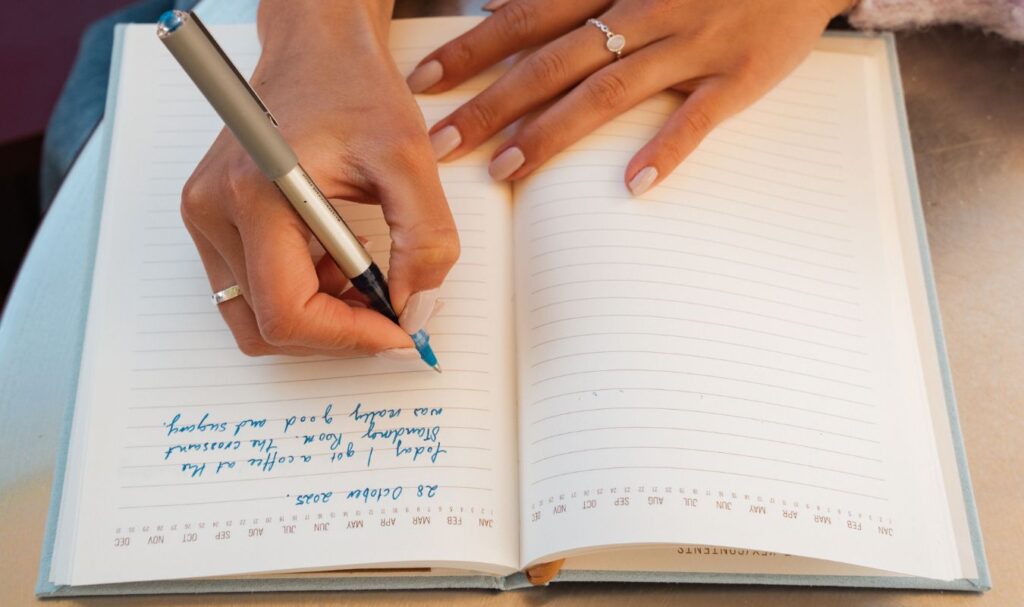
If you want a framework to get started — something to remove the decision fatigue — here’s one that works.
1. Pick your format: prompts or free writing
There are two basic approaches to journaling, and knowing which one suits your brain makes everything easier.
Free writing means writing whatever comes to mind with no structure. You just start and keep going for a set amount of time — even if what you write is “I have no idea what to write.” The goal is to keep the pen moving. This works well if you tend to overthink before starting, because it removes the possibility of doing it wrong.
Prompted journaling means starting with a question — “What’s bothering me right now?” or “What do I need more of?” — and writing in response. This works well if you freeze in front of a blank page or aren’t sure where to begin. (We have a full list of prompts below.)
Neither is better. Some people use both. The point is to pick one and try it.
2. Choose a time that already exists in your day
The most common reason journaling habits fall apart is that people try to carve out new time for them. That rarely works. Instead, attach your journaling to something you already do.
- Right after you wake up, before you pick up your phone
- With your morning coffee or tea
- Before bed, as a way to wind down
- On your lunch break, or any natural pause in your day
If you’ve tried a morning journaling practice before and it felt forced, it might just mean morning isn’t your natural window. Try a different time and see if it feels easier.
3. Start with one sentence, not a page
The biggest mistake beginners make is setting the bar too high. “I’m going to journal every morning for 20 minutes” is a resolution, not a habit. It puts enormous pressure on every single session.
Start with one sentence. One honest sentence about how you’re feeling, what you’re thinking about, or what happened today. If more comes out, great. If it doesn’t, one sentence is enough.
Over time, one sentence usually grows into a paragraph, then more. But you don’t need to force that growth — it happens on its own as the practice becomes familiar.
4. Let it be messy
Your journal does not need to be coherent, well-written, or even make sense. It can be fragments, half-finished thoughts, and things you’d never say out loud. It can contradict itself. It can be angry or sad or completely mundane.
The University of Rochester Medical Center notes that journaling helps manage anxiety and reduce stress — but only if you actually use it, which means letting it be an honest outlet rather than a polished performance. The mess is the point. That’s where the real thinking happens.
If you catch yourself editing as you write — stopping to reword something, crossing things out because they sound wrong — try writing faster. Give your inner editor less time to intervene.
5. Build the habit before you build the practice
In the first two weeks, your only goal is to show up. Not to write brilliantly, not to stick to a theme, not to develop a specific technique. Just open the notebook and write something.
The habit of sitting down comes first. The practice — the depth, the consistency, the particular approach that works for you — comes second. This is the same principle behind building any lasting habit: start smaller than feels meaningful, then let it grow.
Once the habit is established, you can start experimenting. But in the beginning, showing up is the whole job.
What to Write When You Have No Idea What to Write
The blank page is the most common sticking point. Here are 10 starter prompts — questions that give you somewhere to begin without requiring you to already know what you want to say.
| 1 | What’s one thing weighing on my mind right now? |
| 2 | How do I actually feel today — not how I’m supposed to feel? |
| 3 | What do I keep putting off, and why? |
| 4 | What would I tell a friend going through what I’m going through? |
| 5 | What do I need more of right now? What do I need less of? |
| 6 | What happened today that I want to remember? |
| 7 | What’s one thing I’m grateful for that I haven’t said out loud? |
| 8 | What does my ideal tomorrow look like? |
| 9 | What’s a thought I keep having that I haven’t examined yet? |
| 10 | If I was being totally honest with myself, I would say… |
These are starting points, not rules. If a prompt takes you somewhere unexpected, follow it. If you hate a prompt, skip it. There’s a full collection of prompts organized by what you’re actually feeling that’s worth bookmarking for the days when you’re not sure where to begin.
The Journaling Style That Fits Your Brain
Journaling isn’t one-size-fits-all. Once you’ve been at it for a few weeks, you might find yourself drawn to a particular style. Here’s a brief overview of the most common ones.
- Free writing / brain dump: Unstructured, stream-of-consciousness writing. Useful for clearing mental clutter and anxiety. Great for overthinkers who need to empty the mental queue before they can think clearly.
- Prompted journaling: Structured by specific questions. Useful for self-reflection, processing emotions, and days when you don’t know where to start.
- Gratitude journaling: Focused on noticing what’s going well. Particularly effective for shifting out of scarcity thinking — writing three things you’re grateful for each day rewires your attention over time.
- Manifestation journaling: Uses writing to get clear on what you want and why. Bridges journaling with intention-setting and is one of the most direct ways to bring a goal from vague wish to concrete vision.
If your mind tends to race or spiral when you write, these specific journaling techniques for overthinkers are worth trying — they’re designed to work with a busy mind rather than against it.
And if you’re drawn to using journaling as part of a broader mindfulness practice, there’s a whole approach built around writing as a way of slowing down and observing your own thoughts — without trying to fix or change them.
Frequently Asked Questions
How often should I journal?
As often as feels sustainable — which might mean daily, three times a week, or only when something is weighing on you. Consistency matters more than frequency. Three minutes every day will build a stronger habit than an hour once a week. Start with what feels manageable rather than what sounds impressive.
Is it better to journal in the morning or at night?
Both work, and the “best” time is the one you’ll actually use. Morning journaling tends to work well for setting intentions and clearing mental clutter before the day starts. Evening journaling tends to work better for reflection and unwinding. If you’ve tried one and it hasn’t stuck, try the other.
Do I have to write by hand, or can I type?
Either works. Some research suggests that handwriting engages the brain slightly differently than typing — it tends to be slower, which can encourage deeper processing. But if typing means you’ll actually do it and handwriting means you won’t, type. The medium matters less than the practice.
What if I write something and then feel worse?
This can happen, and it’s worth knowing about. Writing about difficult emotions can sometimes intensify them in the short term — especially if you write about an event without also exploring how you make sense of it. If journaling consistently leaves you feeling worse rather than better, try using prompts that guide you toward reflection rather than pure venting, or consider pairing journaling with a therapist or counsellor who can help you process what comes up.
What if I miss days?
Miss them. Journaling is not a streak competition. If you go a week without writing and then come back, you haven’t failed — you’ve just resumed. The entry after a gap doesn’t need to account for the missed time. Just write what’s true for you right now.
Can journaling help with anxiety?
Yes — and there’s solid research behind this, not just anecdotal evidence. Writing about anxious thoughts helps to externalize them, which reduces their perceived intensity. If anxiety is a regular part of your experience, a dedicated anxiety journaling practice with specific techniques designed for worry loops can be especially effective.
I don’t know what I’m feeling — how do I even start?
That’s a perfect starting sentence. Literally: “I don’t know what I’m feeling right now.” Write that, and then ask: “But if I had to guess, it might be…” Not knowing is always a valid place to begin.
Start Journaling Tonight, Not Tomorrow
Here’s the truth about journaling: you already know enough to begin. You don’t need to understand it better, research it more, or wait for a fresh week to start.
The only thing between you and a journaling practice is the first sentence. It doesn’t have to be meaningful. It doesn’t have to be the start of something consistent. It just has to be honest.
What’s one thing on your mind right now? That’s your first journal entry. Write it down — somewhere, anywhere — and you’ve already started.
Everything else — the habit, the depth, the specific approach that works for you — grows from there.


