There’s something quietly limiting about the word “attract.”
It implies a gap. You are here. The thing you want is over there. And if you do the right things — think the right thoughts, raise your vibration, stay positive — it will eventually cross the distance and arrive.
Neville Goddard had a different idea entirely. One that doesn’t ask you to close a gap, because in his framework, there is no gap. There is only what you assume to be true — and the world is always, without exception, reflecting your assumptions back to you.
His teaching is called the Law of Assumption, and it’s one of the most internally consistent and genuinely empowering frameworks in the whole space of conscious manifestation. It asks something harder than positive thinking — it asks you to actually inhabit the reality you want before you see any evidence of it. But for those who take it seriously, the results are often striking.
| What Is the Law of Assumption? The Law of Assumption, taught by mystic and author Neville Goddard, holds that whatever you assume to be true — and genuinely feel as true — becomes your experienced reality. Unlike the Law of Attraction, which frames manifestation as drawing things toward you, the Law of Assumption says there is no distance to close: consciousness itself is the only reality, and your persistent assumptions shape everything you experience. To manifest something, you don’t attract it — you assume it is already done. |
| KEY TAKEAWAYS | |
| Who he was | Neville Goddard (1905–1972) was a Barbadian-American mystic and author who taught that imagination is the only reality and that human consciousness creates all experience |
| The core idea | The Law of Assumption: whatever you assume to be true — and feel as true — becomes your experienced reality |
| vs. Law of Attraction | LOA focuses on attracting from a distance; the Law of Assumption collapses the distance entirely — you don’t attract, you assume you already have |
| Key technique | SATS (State Akin to Sleep) — a hypnagogic meditation where you plant a felt-sense scene of your desired reality just before sleep |
| Revision | Neville’s practice of rewriting past events in imagination to change their emotional imprint — and therefore their future effects |
| The central instruction | “Live in the end” — inhabit the emotional reality of your desire already fulfilled, rather than the reality of wanting it |
Who Was Neville Goddard?
Neville Goddard taught one thing, essentially, for forty years: that imagination is not a tool you use to improve your life. It is the substance your life is made of. Everything you experience — every relationship, every circumstance, every pattern that keeps showing up — is the externalisation of an inner assumption. Change the assumption, and the world changes with it.
That’s a radical claim. What made people take it seriously — then and now — was that Goddard didn’t dress it up in vague positivity. He built a complete, internally consistent philosophy of consciousness, drew it through the symbolism of the Bible as psychological rather than literal truth, and delivered it with the kind of precision that made it testable. His readers and listeners tried the techniques. Many reported results they couldn’t explain otherwise.
His work went largely quiet after his death in 1972, surviving mainly in metaphysical bookshops and among dedicated students of New Thought. Then the internet happened — and particularly the rise of manifestation communities on YouTube, Reddit, and TikTok. A new generation discovered Goddard and found that his framework, written decades earlier, was more specific, more empowering, and more practically useful than most of what had come since. He is now among the most cited figures in the modern manifestation space. For a fuller picture of his life and writing, his Wikipedia entry is a good starting point.
What makes him worth your time specifically: unlike teachers who offer techniques as standalone tools, Goddard offers a framework. Once you understand the underlying philosophy, the techniques aren’t things you try — they’re things that make obvious sense.
What Is the Law of Assumption?
At its core, the Law of Assumption rests on one claim: consciousness is the only reality. The physical world — what you see, touch, experience — is not primary. It is the out-picturing of consciousness. What you persistently assume to be true about yourself and your world is what consciousness externalises into form.
This is more radical than it first sounds. It doesn’t just say that positive thinking helps, or that belief matters, or that mindset shapes outcomes. It says that your assumption — the state you inhabit, the feeling of “this is how things are” — is the actual creative force. Reality conforms to assumption. Not sometimes. Always.
The word “assume” is important. Goddard didn’t mean intellectual belief or hopeful wishing. He meant the felt sense of a thing being true — the kind of knowing that lives in the body and colours your perception of everything. When you truly assume something, you don’t think about it with anxious hope. You think from it, the way you think from the assumption that you have hands or that the floor will hold you.
The practical implication is significant: you don’t need to figure out how your desire will arrive. You don’t need to earn it or deserve it or wait for the right circumstances. You need to assume it is already done — and hold that assumption with enough consistency and feeling that it becomes your new baseline.
Law of Assumption vs. Law of Attraction — What’s the Difference?
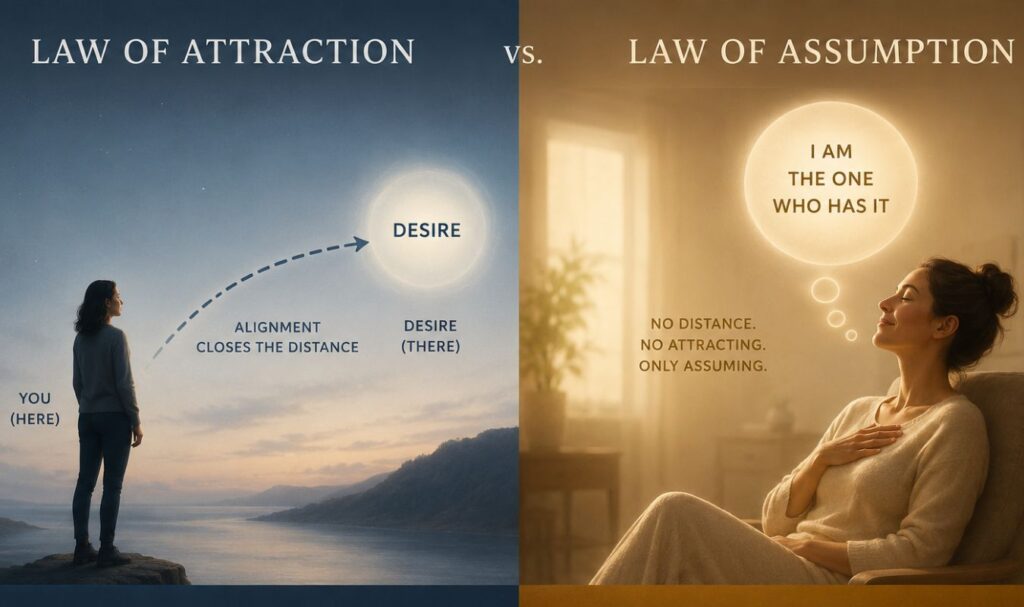
Both frameworks describe a relationship between inner state and outer reality. But the metaphor each uses leads to meaningfully different practices.
The Law of Attraction operates on the idea of like attracting like — you broadcast a signal, and matching experiences are drawn toward you. It’s fundamentally about closing a distance: you are here, the desire is there, and alignment brings them together.
The Law of Assumption collapses that distance entirely. There is no “out there” to attract things from. There is only consciousness and its assumptions. You don’t attract the relationship or the job or the abundance — you assume you already have it, and reality reshapes itself to match that assumption.
In practice, this shift changes everything about how you approach manifestation:
| Law of Attraction | Law of Assumption |
| You attract what you desire | You assume what you desire is already real |
| Focus on raising your frequency to match the desire | Focus on inhabiting the state of the wish fulfilled |
| The desire exists outside you, coming toward you | The desire exists in consciousness — there is no outside |
| Resistance is something to overcome | Resistance is simply an unconvincing assumption |
| Gratitude for what’s coming | Gratitude for what is already done |
Living in the End — Neville’s Core Instruction
If the Law of Assumption has a single central practice, it’s this: live in the end.
Most people approach manifestation from the position of wanting — they focus on the desire from the perspective of not yet having it. They visualise from the outside, looking in. They feel the gap between where they are and where they want to be, and they try to use positive thinking to close it.
Neville said this is exactly backwards. The moment you feel the want — the lack, the longing, the “I wish I had” — you are assuming the absence of the thing. And consciousness, loyal to your assumption, will continue to externalise that absence.
Living in the end means shifting your point of view entirely. Instead of looking at your desire from outside it, you step inside it. You imagine the scene that would exist after the desire is fulfilled — not the moment of getting it, but a quiet, ordinary moment of having it. The morning after. The conversation you’d have. The feeling in your body when this is simply your life.
You don’t observe this scene. You inhabit it. You feel the solidity of it, the naturalness of it, the way a fulfilled desire feels utterly unremarkable because it’s just how things are now.
That felt sense of already-having — held consistently, returned to daily — is what Neville called the assumption. And the assumption, given time and persistence, becomes fact.
SATS — The Technique Neville Used Most
SATS stands for State Akin to Sleep — the hypnagogic threshold between waking and sleeping, where the conscious mind quiets and the subconscious becomes maximally receptive. Neville considered this the most powerful window for planting new assumptions, and it’s the technique he returned to most consistently across his lectures.
The practice pairs naturally with manifestation meditation — both work with the same principle of accessing a deeply relaxed state to bypass the critical conscious mind. But SATS is specifically designed around Neville’s framework: you’re not visualising broadly, you’re constructing a single, specific scene that implies your desire is already fulfilled, and you’re entering it just as you fall asleep.
| PRACTICE: A Complete SATS Session |
| 1. TIMING — Do this lying in bed, in the last few minutes before sleep. |
| Your body is still, your mind is softening. This is the window. |
| 2. THE SCENE — Choose ONE short scene that implies your desire is already fulfilled. |
| Not the moment of receiving it — a quiet moment of having it. |
| Example: a friend congratulating you. A glance at your bank balance. |
| Waking up next to the person you love. Keep it short and specific. |
| 3. ENTER IT — Close your eyes and step inside the scene. You are not watching |
| yourself — you are there, looking out through your own eyes. |
| Feel the texture of it. The sounds. The emotional tone. |
| 4. THE LOOP — Let the scene play through to its natural end, then replay it. |
| Over and over, like a short film on a loop. Keep it gentle — |
| you’re not forcing intensity, you’re settling into familiarity. |
| 5. FALL ASLEEP — Let sleep take you while the scene is still running. |
| The goal is to cross the threshold into sleep from inside the scene. |
| What you carry into sleep, the subconscious accepts as real. |
| FREQUENCY: Every night, or as many nights as you can manage consistently. |
Revision — Rewriting the Past to Change the Future
One of Neville’s most distinctive and underutilised techniques is revision: the practice of going back to an event that happened — a conversation that went badly, a rejection, a moment of failure or shame — and rewriting it in imagination as you wish it had gone.
| “The past is not fixed. It is a story consciousness tells — and like all stories, it can be revised. Change the story, and you change what it generates.” |
This sounds counterintuitive. The event already happened. Why imagine it differently?
Neville’s answer: because the event’s power over you doesn’t come from the event itself. It comes from the assumption the event created. A rejection doesn’t just end a relationship — it plants an assumption: “I am not chosen. I am not enough.” That assumption then generates future experiences that confirm it.
Revision interrupts this cycle. By re-experiencing the event as you wish it had gone — feeling the alternative reality vividly, in the SATS state or in a quiet meditation — you change the emotional imprint the event left. You don’t deny that it happened. You revise its meaning and its legacy.
In practice, revision is particularly powerful for:
- Arguments or painful conversations you keep mentally replaying
- Rejections or failures that created lasting beliefs about your worthiness
- Childhood experiences that formed the limiting beliefs you’re still carrying
- Moments of self-sabotage you feel regret or shame about
Revision pairs powerfully with scripting manifestation — you can write the revised version of a scene in your journal before entering it in imagination, which deepens the emotional reality of the rewrite.
How to Apply the Law of Assumption Daily
The Law of Assumption isn’t a technique you apply occasionally — it’s a way of relating to your own consciousness all day long. Neville called this the “mental diet”: the practice of monitoring your habitual assumptions and consistently redirecting them toward the state you want to inhabit.
- Morning assumption-check. Before you look at your phone or engage with the day, ask: what am I assuming right now? About my life, my relationships, my capacity? Notice the default state you wake into, and consciously choose a better one.
- SATS every night. Even five minutes of the practice described above is enough to begin shifting the subconscious baseline. Consistency over intensity.
- Revision before sleep. If something went badly during the day, revise it before you sleep. Don’t carry the assumption it created into the night.
- Catch the “I AM.” Every statement that begins with “I am” — spoken, thought, or felt — is an assumption being made. “I am tired.” “I am unlucky.” “I am someone things don’t work out for.” Neville was emphatic: your I AM is your most creative power. Use it deliberately.
- Inhabit the end state briefly but often. You don’t need to spend hours in visualisation. A thirty-second return to the feeling of your wish fulfilled — while making coffee, walking to the car, waiting for something — repeated many times a day, is more effective than one long session.
For a broader framework of how all these practices fit together, the complete guide on how to manifest anything you want walks through the full process step by step.
Frequently Asked Questions
Is the Law of Assumption the same as the Law of Attraction?
They overlap but are meaningfully different. The Law of Attraction frames manifestation as drawing things toward you — there’s an implicit distance between you and your desire. The Law of Assumption removes that distance entirely: there is only consciousness and its assumptions, and reality is always conforming to what you assume. In practice, the Law of Assumption tends to produce less passive waiting and more active embodiment of the desired state.
Do I need to believe in God or be religious to use Neville Goddard’s teachings?
No. While Neville drew heavily on the Bible and used theological language, his framework is essentially psychological: consciousness creates experience. Many practitioners engage with his work entirely as a mind-body practice, without any religious framework. His use of “God” is largely synonymous with “infinite consciousness” or “imagination” — not a deity to petition, but the creative power within you.
What’s the single most important thing Neville Goddard taught?
Probably this: you are always manifesting, whether you intend to or not. Whatever you persistently assume to be true — about yourself, your worth, what’s possible for you — is being externalised into your experience. The question isn’t whether to manifest. It’s whether to do it consciously.
How long does SATS take to produce results?
Neville reported same-day and next-day results in some cases. More commonly, shifts become noticeable over days to weeks of consistent practice. The variable isn’t the technique — it’s the depth and consistency of the assumption. If you’re genuinely inhabiting the end state, reality tends to move quickly. If you’re performing the practice while secretly assuming it won’t work, that assumption is the one that holds.
Can I use the Law of Assumption to manifest a specific person?
Neville addressed this directly and said yes — with the important caveat that you’re not trying to control another person’s will, but to change your own assumption about your relationship with them. You shift your inner state; how that shows up externally is left to consciousness to arrange. This is a nuanced and often debated topic in the manifestation community, and it’s worth approaching with both openness and honesty about your own motivations.
Where should I start if I want to learn more about Neville Goddard?
His books are all in the public domain and freely available online. The most accessible entry points are The Power of Awareness — which lays out the philosophy most clearly — and Feeling Is the Secret, which is short, focused, and directly practical. Both can be found for free through various digital archives.
Tonight, Try SATS
Neville Goddard’s teaching isn’t complicated. It’s just demanding — in the best possible way.
It asks you to stop waiting. To stop attracting from a distance. To drop the story of “I hope this happens” and step into the story of “this is already done.” Not as a performance, not as wishful thinking, but as a genuine, felt shift in your inner state.
The techniques he gave — SATS, revision, living in the end, the mental diet — are all in service of that one shift. They’re ways of practising the assumption until it becomes your natural baseline. Until the thing you want stops feeling like a desire and starts feeling like a memory of the future.
You don’t need to read all his books before you start. You just need one scene, constructed with care and felt with honesty, carried into sleep tonight.
That’s where it begins.