

Have you ever felt a sudden and unexplainable restlessness — a quiet but insistent sense that there is something more to life than the routine you have been living? Have you found yourself questioning beliefs you once held with certainty, or experiencing moments of connection so profound they are difficult to put into words?
If so, you may already be moving through the stages of spiritual awakening. This guide explores all 7 stages in depth — not as a rigid checklist, but as a living map of the inner terrain you are navigating. If you haven’t already, you may also want to read our companion guide on the 35 symptoms of spiritual awakening to understand the specific signs and experiences that tend to arise at each stage.
What Are the Stages of Spiritual Awakening?
The stages of spiritual awakening are recognisable patterns of inner transformation that spiritual seekers across cultures and centuries have reported experiencing. They are not a neat staircase you climb rung by rung — they are more like seasons, sometimes overlapping, sometimes cycling back, always moving you forward in ways that are entirely unique to you.
Understanding these stages can be enormously reassuring. When you know that what you are feeling is part of a larger process — that others have walked this same ground and come through it — the disorienting parts feel less like something going wrong and more like evidence that something is going very right.
Spiritual awakening is not a problem to be solved. It is a process to be lived. The stages are not milestones to achieve — they are invitations to go deeper.
Is Spiritual Awakening a Linear Process?
One of the most important things to understand about the spiritual awakening stages is that they do not follow a strict, sequential order. You may move through several stages in quick succession, circle back to one you thought you had finished, or find yourself navigating two or three simultaneously.
This is not a sign of failure or confusion. It is the nature of authentic inner growth. Real transformation is not linear. It is cyclical, spiral, and deeply responsive to the unique needs of your soul at any given moment.
Rather than measuring your progress against a rigid timeline or comparing your path to someone else’s, the invitation is to trust your own journey. If you’re at a stage where things feel particularly unmoored or unfamiliar, our guide on how to find yourself again can offer grounding and practical support.
Honouring Your Individual Path
Just as no two snowflakes are identical, no two spiritual awakenings are the same. One person’s awakening might be ignited by a profound loss. Another’s might unfold slowly through years of meditation practice. Someone else might be launched into it by a single mystical experience that changes everything overnight.
What matters is not how your awakening begins, but how you show up for it. Are you willing to be honest with yourself? Are you open to releasing what no longer serves you? Are you curious enough to keep going even when the path ahead is unclear? Developing a foundation of consistent spiritual habits gives you the inner stability to navigate even the most disorienting phases with greater ease and presence.
The 7 Stages of Spiritual Awakening
With that foundation in mind, let’s explore each of the seven stages in depth. Approach them with openness rather than expectation — your experience of each will be shaped by your own history, temperament, and the timing of your soul’s readiness.
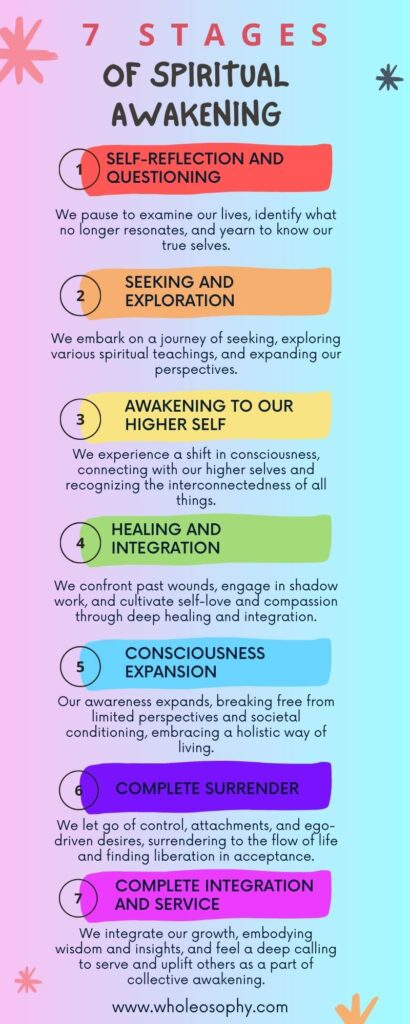
Stage I: Self-Reflection and Questioning
The first of the spiritual awakening stages is usually not dramatic. It often begins as a quiet but persistent discomfort — the feeling that something in your life is no longer quite right. The job that used to feel meaningful starts to feel hollow. The relationships that once satisfied you begin to feel shallow. The beliefs you were raised with start to feel too small for what you are beginning to sense.
This stage is characterised by honest self-reflection. You begin to ask questions you may have been avoiding: What do I actually value? What am I doing here? Is this really the life I want to be living? These are not questions with easy answers, and that is exactly the point. It is the willingness to sit with the questions — without rushing to resolve them — that opens the door to everything that follows.
At this stage, it can also be helpful to begin examining the limiting beliefs that may be keeping you from seeing yourself and your life clearly. Many of them were installed so early and so subtly that you’ve never thought to question them. This stage is the invitation to start.
Stage II: Seeking and Exploration
Once self-reflection has cracked open the door, the natural next step is seeking. You feel drawn toward answers — toward books, teachings, communities, and practices that resonate with the stirring you feel inside. This is the stage where many people first encounter meditation, yoga, energy work, or various spiritual philosophies.
This stage can be thrilling and overwhelming in equal measure. There is so much to explore, and so much of it seems to speak directly to something you have been feeling but couldn’t name. Some people call this the ‘dark night of the soul’ phase, though it is perhaps more accurately described as a deep inner searching — a period of open, childlike receptivity.
Follow your curiosity. Trust your intuition about what feels true versus what merely sounds appealing. And be wary of spiritual bypassing — the tendency to use spiritual ideas to avoid rather than face your inner work. Genuine seeking leads you toward your shadows, not away from them.
Stage III: Awakening to Your Higher Self
This is often the stage people point to when they say they ‘had a spiritual awakening.’ It is a profound shift in consciousness — a moment or series of moments in which you experience something beyond your ordinary sense of self. You feel connected to something vast and loving. The separation between you and the world around you seems, at least briefly, to dissolve.
During this stage, synchronicities increase. You notice signs and meaningful coincidences with a frequency that feels impossible to dismiss. Your intuition sharpens. You begin to experience the interconnectedness of all things not as a concept but as a felt reality.
This awakening to the higher self is deeply transformative, but it can also bring a kind of energetic intensity that requires grounding. Practices like mindfulness meditation and grounding techniques are invaluable at this stage — they help you stay rooted in your body and in your daily life even as your consciousness expands.
Stage IV: Healing and Integration
The awakening of Stage III often illuminates what still needs healing. As the light of expanded awareness reaches the darker corners of your inner world, old wounds, unresolved grief, and buried fears begin to surface. This is the healing and integration stage — and while it can be the most challenging of the spiritual awakening stages, it is also one of the most profoundly transformative.
This stage calls for deep self-compassion and, often, real courage. You are being asked to look honestly at the parts of yourself you have hidden or abandoned. Shadow work — a concept rooted in Jungian psychology — is particularly relevant here. It involves befriending the disowned parts of yourself, the aspects you have judged, suppressed, or been taught to be ashamed of, and integrating them with love rather than resistance.
Practices that support this stage include journaling, somatic bodywork, energy healing, and forgiveness work. Releasing resentment — toward others and toward yourself — is one of the most powerful things you can do to keep the energy of your awakening moving. Similarly, letting go of the past creates the internal spaciousness that genuine integration requires.
Stage V: Expansion of Consciousness
As the healing of Stage IV progresses, something remarkable begins to happen: your consciousness expands. The walls of your old worldview, built from social conditioning, inherited beliefs, and the limitations of the egoic mind, begin to fall away. In their place grows a more spacious, more inclusive way of seeing and being.
During this stage of spiritual awakening, you begin to think in larger patterns. You see connections that were previously invisible. The non-dual nature of reality — the understanding that apparent opposites are actually two aspects of the same whole — begins to feel less like philosophy and more like direct experience.
This expanded consciousness also brings a heightened sensitivity to energy — your own and others’. Learning how to protect your energy and incorporating regular energy cleansing practices becomes increasingly important as your energetic sensitivity grows. Without healthy boundaries, the openness of this stage can be as draining as it is beautiful.
Stage VI: Surrender and Letting Go
Perhaps the most counterintuitive of all the spiritual awakening stages, Stage VI asks you to do something the ego finds deeply threatening: let go. Let go of control. Let go of the need to know how things will unfold. Let go of the identity you have been carefully constructing and defending for most of your life.
Surrender, in the spiritual sense, is not passivity or resignation. It is the active, conscious choice to trust life more than you trust your fear. It is the recognition that the universe’s intelligence is larger than your planning mind, and that aligning with its flow produces outcomes your ego could never have engineered on its own.
This stage is powerfully supported by practices that cultivate present-moment awareness. Learning how to be more present is one of the most direct routes into genuine surrender — because the present moment is always safe, and surrender is only possible now. You might also find that self-love affirmations help soften the inner resistance that makes surrender feel so difficult. The ego lets go more easily when it feels genuinely loved rather than forced.
Stage VII: Integration and Service
The seventh and final stage of spiritual awakening is not an ending — it is a flowering. After the upheaval, the healing, the expansion, and the surrender, you arrive at a place of deeper wholeness. The insights and wisdom you have gathered are no longer just ideas you hold — they are qualities you embody.
This stage is characterised by a natural and genuine desire to be of service. Having moved through your own awakening, you feel drawn to support others in theirs. This might look like formal teaching or healing work, or it might be as simple as bringing more presence, compassion, and honesty to every interaction in your daily life.
Research in positive psychology consistently shows that acts of service and contribution are among the most reliable sources of lasting well-being and meaning. Studies on prosocial behaviour confirm what spiritual traditions have taught for millennia: giving freely of yourself does not deplete you — it expands you.
Building spiritual habits that sustain peace of mind becomes the foundation from which service flows naturally. And as you live more fully from this integrated place, you begin to recognise that your individual awakening is not separate from the collective one — every person who heals and grows contributes to the healing and growth of everyone.
How to Navigate the Stages of Spiritual Awakening
No matter which stage you are currently moving through, a few principles will serve you well throughout the entire journey:
- Be patient with yourself. There is no correct speed for this process.
- Stay grounded. Expansion needs roots. Tend to your body, your sleep, your nutrition, and your connection to nature.
- Find community. You don’t need to walk this path alone. Seek out people who understand and support your journey.
- Work with a professional when needed. Therapy, somatic work, or spiritual direction can be invaluable, especially during the healing stages.
- Don’t skip the inner work. Spiritual knowledge without emotional integration is the recipe for bypassing rather than genuine awakening.
- Trust the process, even when it feels chaotic. The stages of spiritual awakening have their own intelligence.
Your awakening is not happening to you — it is happening through you. Every stage, including the difficult ones, is serving your growth.
Frequently Asked Questions
How do I know which stage of spiritual awakening I am in?
The honest answer is that most people are navigating more than one stage at a time. Rather than trying to pinpoint exactly where you are, pay attention to what is most alive or most challenging in your inner life right now. You may also find our guide on the signs you are on a spiritual journey helpful for gaining broader context on your experience.
Can you get stuck in a stage of spiritual awakening?
Yes, and the most common place people get stuck is Stage IV — healing and integration. The work of facing old wounds and shadow material is genuinely difficult, and it is tempting to avoid it by moving prematurely into seeking more peak experiences or spiritual knowledge. The way through is not around. Gentle persistence, good support, and self-compassion are the keys.
How long do the stages of spiritual awakening last?
There is no universal answer. Some people move through certain stages in weeks; others take years. The depth and pace of your journey are shaped by your personal history, the nature of your inner work, and the readiness of your soul. Comparing your timeline to anyone else’s is both unhelpful and unnecessary.
Does everyone go through all 7 stages?
Most spiritual seekers will encounter all seven stages in some form over the course of their journey, but not necessarily in order and not necessarily with equal intensity. Some stages will feel very prominent in your experience; others may be subtler. The pattern is common; the experience is entirely individual.
Is spiritual awakening the same as a mental health crisis?
This is an important question. Some of the experiences associated with spiritual awakening — emotional intensity, disorientation, a sense of unreality, withdrawal from ordinary life — can superficially resemble symptoms of mental health conditions. If you are struggling to function in daily life, please seek support from a qualified mental health professional. Genuine spiritual awakening and good mental health care are not in conflict; in fact, they often support each other deeply.
Final Thoughts
The seven stages of spiritual awakening are not a destination. They are a living, evolving process — one that will continue to deepen and refine you for as long as you remain open to it. Each stage brings its own gifts and its own challenges. Each one is preparing you for the next.
If you are somewhere in the middle of this process right now — perhaps feeling disoriented, or tender, or on the verge of something you can’t yet name — know that you are exactly where you need to be. The fact that you are here, seeking understanding, is itself a sign of the awareness that awakening cultivates.
Trust your inner guidance. Be gentle with yourself. Reach out for support when you need it. And remember that every step you take on this path, however small, is contributing to something much larger than your individual story.
You are not lost. You are awakening. And that changes everything.


